

Most kitchen gadgets are designed to be sold. Kitchen tools designed by chefs are built to be used. There is a fundamental difference between a tool that looks good on a retail shelf and one that survives a twelve hour shift in a professional kitchen. When you choose equipment rooted in culinary logic, you aren't just buying a product. You're investing in a more intentional and efficient way to cook.
You've likely felt the frustration of a knife that loses its edge within weeks or the dull ache in your hand after a long prep session. It's exhausting to fight against tools that don't fit your grip or your workflow. You deserve a kitchen that supports your growth. This article will help you discover why chef-designed tools outperform standard gadgets and how to build a professional-grade kit for your home. We'll explore how the right balance and materials can streamline your kitchen, increase your confidence, and provide you with equipment that truly lasts a lifetime.
Key Takeaways
- Understand the shift from single-use novelties to versatile essentials designed to withstand the rigors of high-volume professional environments.
- Learn how the three pillars of culinary design—ergonomics, weight distribution, and material integrity—can prevent hand fatigue and improve your prep speed.
- Identify five essential kitchen tools designed by chefs that offer multi-functional performance to help you streamline your workspace.
- Master the simple "heft test" and other quality checks to verify the durability and balance of your equipment before you make an investment.
- Discover how modular components and chef-led innovation can bridge the gap between professional mastery and your daily home cooking.
What Does "Chef-Designed" Actually Mean for Your Kitchen?
The phrase "chef-designed" is often used as a marketing label, but its true meaning is found on the kitchen line. Professional kitchens are environments of extreme volume and relentless pressure. In this setting, a tool is an extension of the body. Kitchen tools designed by chefs are born from this necessity for absolute reliability. They are engineered to perform the same task hundreds of times a day without failing or causing physical strain.
When you bring this logic into your home, you're embracing the concept of frictionless cooking. This means removing the small, annoying barriers that slow you down. A dull blade, a slippery handle, or a flimsy spatula are all forms of friction. Professional-grade equipment eliminates these obstacles. It allows you to focus on the technique and the ingredients rather than struggling with your gear.
The Difference Between a Gadget and a Tool
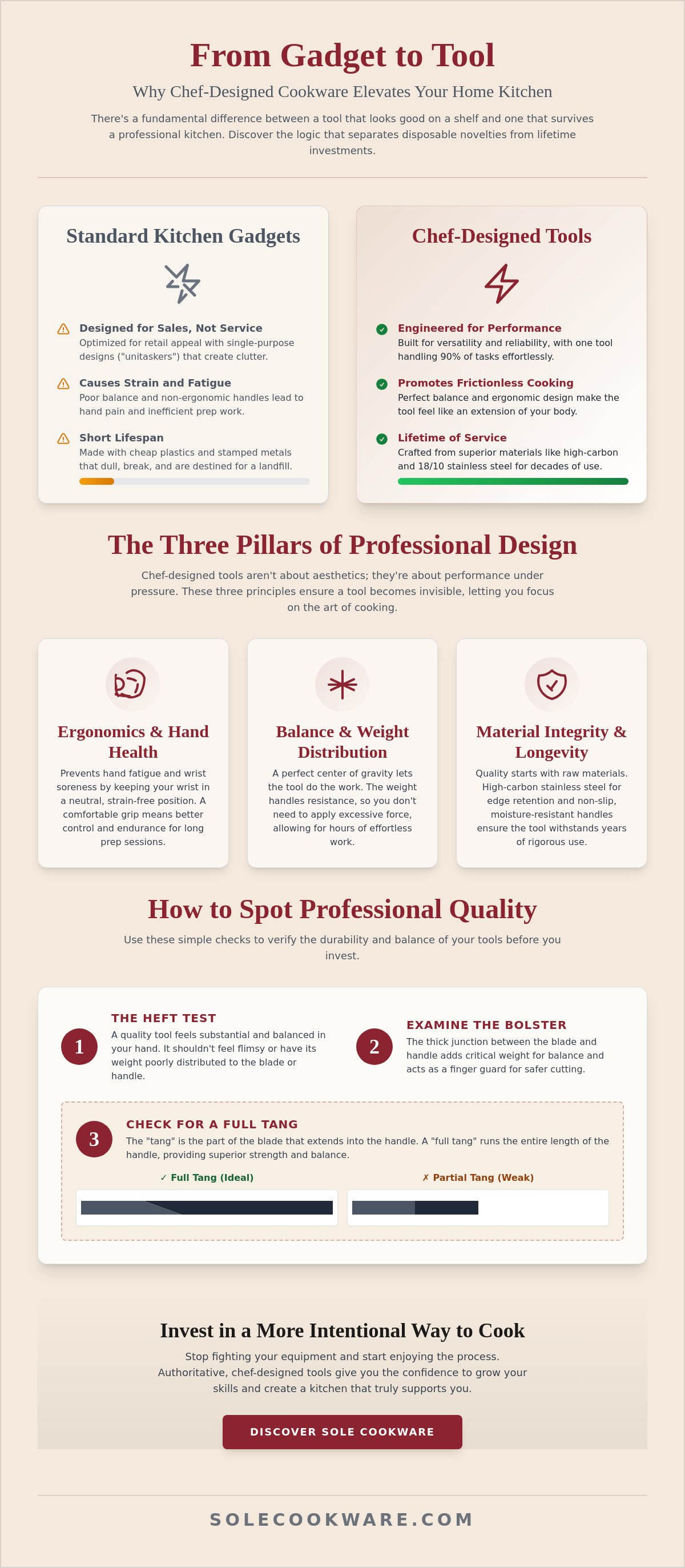
Retailers love to sell sets. They offer 20-piece knife blocks or drawers full of "unitaskers" designed for a single purpose, like strawberry hullers or garlic peelers. Chefs view these as clutter. A true tool is defined by its versatility and its lifespan. A high-quality Chef's knife can handle 90% of kitchen tasks, from mincing herbs to breaking down a chicken. While gadgets are often made of cheap plastics and destined for a landfill after a season, professional tools use materials like 18/10 stainless steel. They are built for decades of service, not just a few months of novelty.
Why Home Cooks Need Professional Logic
There's a common myth that professional tools are "too much" for the average person. In reality, the opposite is true. If you don't have the lightning-fast hand speed of a line cook, you need your equipment to work harder for you. Better weight distribution and superior edge retention compensate for a lack of professional practice. Using authoritative equipment also provides a psychological boost. When a tool feels balanced and capable in your hand, you feel more capable as a cook. You stop worrying about the tool and start enjoying the process. It's about instilling a sense of capability every time you step up to the cutting board.
The Three Pillars of Professional Culinary Design
True professional design isn't about aesthetics. It's about how a tool performs when the heat is on. In a professional kitchen, every millisecond counts and every movement must be deliberate. This is where the master-to-apprentice philosophy begins. A mentor doesn't just teach you how to cook; they teach you how to respect the tool as an extension of your own body. Kitchen tools designed by chefs prioritize three core pillars: ergonomics, weight distribution, and material integrity. When these elements align, the tool becomes invisible. You stop thinking about the object and start focusing on the task. Beauty in these tools is never the starting point. It's the natural result of a design that works perfectly.
Ergonomics and Hand Health
Cooking should not be painful. Many home cooks accept hand fatigue or wrist soreness as a normal part of prep work. It isn't. Proper knife handle ergonomics ensure that your wrist stays in a neutral position throughout the cutting motion. This alignment reduces strain on the carpal tunnel and prevents long-term injury. Professional design adheres to ergonomic and workflow design principles that accommodate a variety of hand sizes. Whether you have large hands or a more delicate grip, the handle should feel secure and intentional. It's about providing comfort that lasts through the final chop of the evening.
Balance and Weight Distribution
A well-balanced tool feels like an extension of your hand. If a knife is blade-heavy, it pulls your wrist forward. If it's handle-heavy, you struggle to keep the tip on the board. Professional tools use the bolster and a full tang to create a perfect center of gravity. This balance allows the tool to do the heavy lifting for you. You don't need to apply excessive downward pressure because the weight of the tool handles the resistance. This efficiency is what allows chefs to work for hours without exhaustion. You can experience this level of precision with the Cardinal Chef Knife, which utilizes these exact pillars of balance.
Material Integrity and Longevity
Quality starts with the raw materials. High-carbon stainless steel is the standard because it holds an edge longer than cheap stamped metal. In a high-heat environment, you also need handles that are non-slip and resistant to moisture. Professional-grade kitchen tools designed by chefs are built for the long haul. Longevity is about more than just durability; it's about serviceability. We believe that replaceable knife components are the future of sustainable design. Instead of throwing away a tool when one part wears out, you simply refresh it. This keeps professional-grade performance in your kitchen for a lifetime while reducing unnecessary waste.
5 Essential Chef-Designed Tools Every Home Kitchen Needs
Efficiency in a professional kitchen is born from restraint. You don't need a drawer full of gadgets; you need a few high-performance essentials. Kitchen tools designed by chefs are selected because they solve multiple problems at once. If a tool only does one thing, it rarely earns a spot on the line. By curating your home kit with this same professional logic, you reclaim your counter space and your focus. These tools are the foundation of a streamlined, capable kitchen.
The Versatile Chef Knife
The most critical tool is undoubtedly the chef knife. It's the primary instrument for nearly every task. Whether you're using a knife for slicing meat or finely dicing a shallot, the balance must be perfect. The Cardinal Chef Knife represents the pinnacle of this design. It moves with you, not against you. It's built to handle the heavy work of a roast while remaining delicate enough for herbs. This single tool replaces an entire block of lesser blades.
The Professional Slotted Turner
Often called a fish spatula, this tool is a chef's secret weapon. It's thin, flexible, and features a sharp offset angle. This allows you to slide under delicate fillets without tearing them. However, its strength makes it equally capable of flipping a heavy burger. Look for high-quality stainless steel that offers just enough spring to feel responsive. It's a masterclass in how kitchen tools designed by chefs prioritize multi-functionality over novelty.
The Microplane and the Bench Scraper
Precision and speed are the hallmarks of a professional. A Microplane isn't just a grater; it's a way to integrate flavor without unwanted texture. It creates a cloud-like result with hard cheeses or citrus zest that melts into your dish instantly. Pairing this with a bench scraper transforms your workflow. The scraper is the most underrated tool for efficiency. It allows you to move piles of chopped vegetables in one go and clears your board of debris in seconds.
To round out a professional kit, many chefs also rely on the iconic Gray Kunz sauce spoon. Priced at $30.00, it's a niche but essential tool for basting and plating with surgical precision. These five tools don't just sit in your drawer. They become active participants in your cooking process, ensuring every movement is purposeful and every result is consistent.
How to Identify True Professional Quality Before You Buy
Identifying quality is a skill that saves you both money and frustration. Many retail brands rely on the "heft trap." They make a tool heavy to trick the consumer into thinking it's durable. In reality, excessive weight often leads to early fatigue. Kitchen tools designed by chefs prioritize balance over bulk. You should look for a center of gravity that feels natural, allowing the tool to pivot easily in your hand. True professional quality is found in the details of the construction, not the weight of the box.
Materials tell the real story. Look for 18/10 stainless steel for tools that need to resist corrosion. For knives, high-carbon steel is the gold standard for edge retention. Be wary of celebrity-endorsed products. These often focus on lifestyle aesthetics rather than the rigors of the kitchen line. A chef-designed tool is built for labor. It features a seamless design to prevent bacteria buildup and a full-tang construction for structural integrity. If a brand doesn't list its steel type or construction method, it's likely hiding a lack of quality.
The "Pinch Grip" Test for Knives
The pinch grip is the standard professional hold where the thumb and forefinger grip the blade itself for maximum control. When you hold a knife this way, the spine and bolster should feel smooth against your fingers. If the edges of the spine are sharp or the bolster has a "hot spot" that digs into your skin, it isn't a professional tool. These minor irritations become major pains during a long prep session. A well-designed knife considers every point of contact between the hand and the steel.
Evaluating Sustainability and Maintenance
A professional tool is an investment for life. You should look for equipment that can be maintained rather than replaced. While wood handles offer superior tactile feedback and warmth, they require regular oiling to prevent cracking. If you prefer a lower-maintenance option, look for high-performance composites. The best brands offer modularity. If a component wears out after years of use, you shouldn't have to buy a whole new set. Choosing the professional-grade Cardinal Chef Knife with its replaceable components ensures your kit remains in top condition for decades.
Elevating the Fundamentals: The Sole Cookware Vision
Sole Cookware exists at the intersection of professional mastery and home comfort. We believe that your kitchen should be a place of empowerment, not frustration. Our vision is to serve as a bridge, bringing the precision and durability of the professional line to the heart of your home. As a female-founded, chef-led company, we bring a unique perspective to every design choice. We understand that the best kitchen tools designed by chefs are those that disappear into the workflow, allowing your creativity to take center stage.
Our "Cardinal" philosophy is rooted in the idea of essentiality. We don't believe in chasing trends or filling your drawers with novelty items. Instead, we focus on perfecting the most fundamental tools first. This approach ensures that every piece of equipment you own serves a clear purpose and performs with absolute reliability. We want to help you build a kitchen that feels authoritative and capable, instilling a sense of confidence every time you pick up a blade.
Why We Created the Cardinal Chef Knife
For too long, the professional knife market ignored a significant segment of cooks. Many high-performance blades are designed with large, bulky handles that can be difficult to control for those with smaller hands. We saw a clear gap in the market for a tool that offered professional-grade power without sacrificing comfort. The Cardinal Chef Knife was born from this need for inclusivity and precision. It provides the same weight distribution and edge retention found in the world's best kitchens, but with an ergonomic profile that fits a wider range of users.
We also recognized that cooking is a personal expression. By offering interchangeable handles and replaceable knife components, we allow you to customize your tool to fit your specific style and grip. This modular system isn't just about aesthetics; it's about maintaining your tool for a lifetime. If a component wears out or your preferences change, you can refresh your knife without needing to replace the entire piece. This commitment to longevity and control is what sets our kitchen tools designed by chefs apart from the rest.
Building Your Professional Home Kitchen
The path to culinary mastery begins with a quality-over-quantity mindset. You don't need dozens of knives to cook like a professional. You need one exceptional chef knife that you trust completely. When you invest in better tools, you transform the act of cooking from a chore into a creative outlet. You stop fighting your equipment and start focusing on the ingredients. This shift in mindset is the key to unlocking your full potential in the kitchen.
We invite you to join our community of empowered home cooks who value craftsmanship and intentional design. It's time to move away from disposable gadgets and embrace tools that are built to last. Your journey toward a more efficient and joyful kitchen starts with a single, well-made choice. Explore our chef-designed collection and discover the difference that professional logic can make in your home.
Step Into Your Most Capable Kitchen
The difference between a cluttered drawer and a professional workspace lies in intentionality. By choosing kitchen tools designed by chefs, you prioritize your own comfort and efficiency. You've learned how balance and material integrity can turn a long prep session into a satisfying ritual rather than a chore. It is time to move past temporary gadgets and build a kit that supports your growth for decades to come.
Sole Cookware is a female-founded brand dedicated to your empowerment in the kitchen. Every tool is designed by a trained chef to ensure maximum control and precision. Our ergonomic handle system is specifically engineered to reduce hand fatigue, helping you cook with a steady, confident hand. You deserve equipment that works as hard as you do. Invest in precision with the chef-designed Cardinal Chef Knife and experience the satisfaction of a tool that truly fits. Your kitchen is ready for its next level of mastery. Keep practicing, keep exploring, and enjoy every moment at the board.
Frequently Asked Questions
What are the most essential kitchen tools designed by chefs?
The most essential tools include a versatile chef knife, a flexible fish spatula, and a bench scraper for efficient board management. Professionals also rely on high-heat silicone tools that can withstand temperatures up to 600°F without melting or degrading. These essentials are chosen because they perform multiple roles on the kitchen line. A curated kit of multi-functional tools is always superior to a drawer full of single-use gadgets that clutter your workspace.
Why do chefs prefer certain brands of kitchen tools?
Chefs prefer brands that demonstrate a commitment to material integrity and consistent performance under pressure. They look for specific indicators like 18/10 stainless steel for durability and high-carbon steel for superior edge retention. A brand's reputation for reliability in high-volume environments is more important than flashy marketing or celebrity endorsements. Consistent tools allow a cook to develop muscle memory, which is the foundation of professional speed and accuracy.
Is it worth buying professional kitchen tools for home use?
Yes, professional equipment is a wise investment for any home cook who values efficiency and comfort. Buying kitchen tools designed by chefs helps you avoid the "unitasker" trap of cheap, single-purpose gadgets that break easily. These tools are engineered to reduce hand fatigue and improve safety through better balance and grip. While the initial investment might be higher, the longevity of professional-grade materials means you won't have to replace them for decades.
How do I know if a kitchen tool is actually designed by a chef?
You can identify true chef-led design by looking for functional features rather than aesthetic flourishes. A professional tool will often have a seamless, one-piece construction to prevent bacteria buildup and increase structural strength. For knives, look for a full-tang design where the steel runs the entire length of the handle. If a tool feels perfectly balanced at its pivot point and serves at least three distinct purposes, it likely carries professional logic.
What is the difference between a cheap knife and a chef-designed knife?
The primary difference lies in the quality of the steel and the method of construction. Cheap knives are usually stamped from thin sheets of metal and lack the internal structure to hold an edge. A chef-designed knife is often forged or uses high-performance alloys that maintain sharpness through hours of use. The balance is also a key differentiator; a professional knife is designed to feel like an extension of your arm, not a heavy weight.
Can professional kitchen tools help me cook faster at home?
Professional tools help you cook faster by eliminating the friction caused by poor equipment. A sharp, well-balanced knife allows for quicker, more precise prep work with less physical effort. Tools like the bench scraper streamline the transition from the cutting board to the pan, saving valuable seconds during the cooking process. When your tools work with you instead of against you, your workflow becomes more fluid and your overall efficiency increases.
How do I maintain professional-grade kitchen tools?
Maintenance starts with hand washing and immediate drying to protect the integrity of the materials. Never put professional tools in the dishwasher, as the high heat and abrasive chemicals can ruin handles and dull sharp edges. Store your knives in a block or on a magnetic strip rather than loose in a drawer to prevent blade damage. Regular honing and proper storage in a dry environment will ensure your equipment lasts for a lifetime.
Why is ergonomics so important in chef-designed equipment?
Ergonomics is vital because it protects the cook from repetitive strain injuries and chronic fatigue. Chef-designed equipment is shaped to encourage proper wrist alignment and a natural grip, which is essential during long cooking sessions. This focus on the physical relationship between the hand and the tool ensures maximum control and safety. Good ergonomics allows you to focus entirely on the technique and the joy of the process rather than your own physical discomfort.