

What if the difference between a jagged, torn roast and a platter of professional, paper-thin ribbons isn't just the sharpness of your edge? It's a common frustration to spend hours preparing a meal only to have the final presentation ruined by uneven slices and hand fatigue. You've likely felt a blade slip against fatty tissue or struggled to maintain a consistent thickness across a large brisket. Finding the perfect knife for slicing meat is about more than just blade length; it's about the harmony between the tool's geometry and your own physical control.
With the global kitchen knife market estimated to reach USD 5.3 billion in 2026, the sheer volume of choices can feel overwhelming. We believe that precision is a product of ergonomic balance and intentional design. In this guide, you'll learn how to achieve chef-level results at home by mastering tool selection and professional slicing techniques. We will walk you through the essential "why" behind blade design, the importance of a secure grip, and the specific movements that guarantee clean, uniform cuts every time. It's time to transform your kitchen experience from a struggle into a moment of quiet, capable mastery.
Key Takeaways
- Distinguish between specialized slicers and carvers to select the ideal knife for slicing meat based on the unique texture of your roast.
- Understand how high-carbon steel and Granton edge geometry work together to reduce friction and preserve the delicate integrity of meat fibers.
- Learn the essential preparation steps, like proper resting and board stabilization, that professional chefs use to achieve clean, uniform cuts every time.
- Explore why ergonomic handle design and balanced weight distribution are the true secrets to maintaining precision without hand fatigue.
- Master the simple "paper test" and regular honing techniques to ensure your edge is consistently prepared for seamless, paper-thin slicing.
Choosing the Best Knife for Slicing Meat: Slicer, Carver, or Chef Knife?
Mastering the art of the perfect slice begins with understanding the physics of the meat itself. Your primary goal is the clean, effortless separation of muscle fibers. You want to avoid the jagged edges that come from "sawing" back and forth. A high-quality knife for slicing meat should move through the protein in a single, fluid motion. This preserves the internal juices and creates a presentation that looks as good as it tastes. It's about the confidence of the cut and the reliability of the steel.
While professional kitchens often stock dozens of specialized tools, home enthusiasts only need to master a few different types of kitchen knives to achieve elite results. Choosing between a dedicated slicer, a carver, or a versatile chef knife depends on the specific task and the anatomy of the meat you're preparing.
The Slicing Knife vs. The Carving Knife
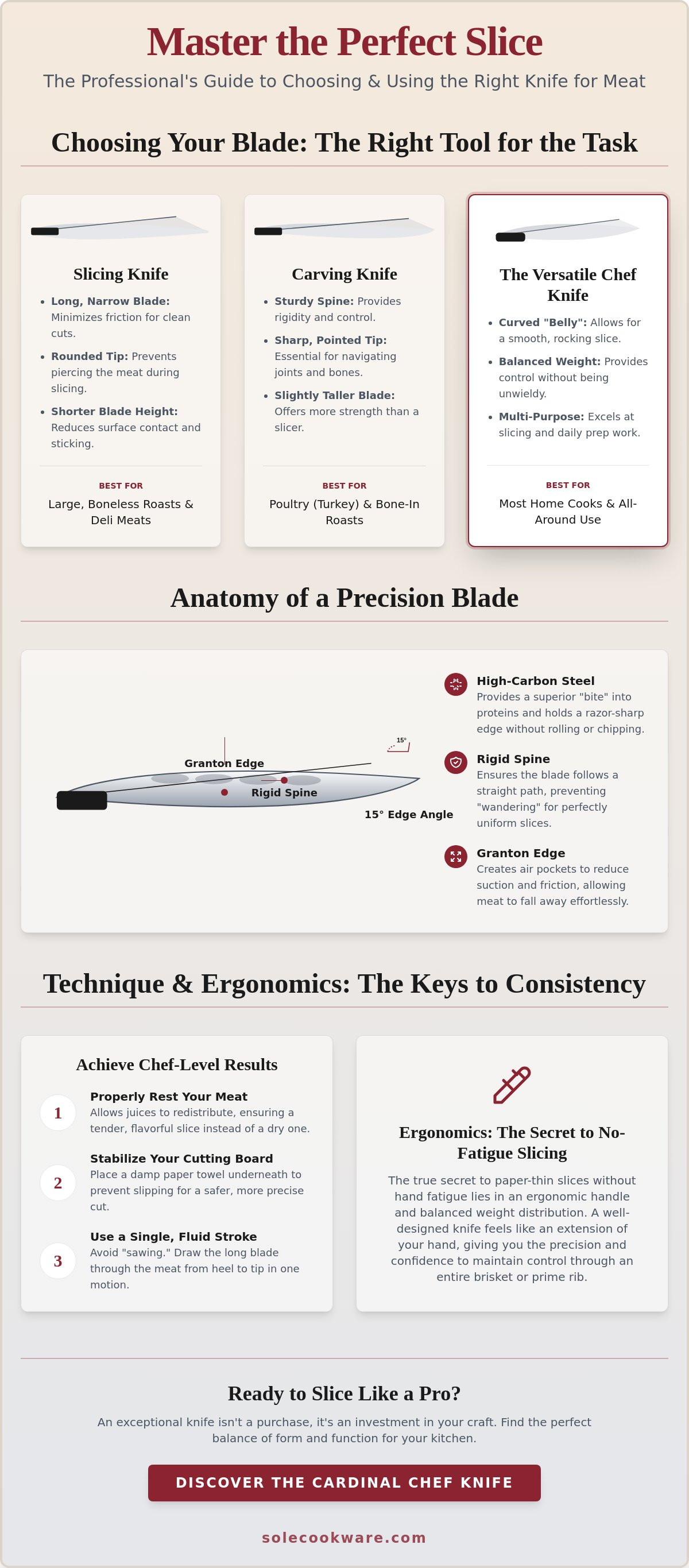
A slicing knife features a long, narrow profile designed to minimize friction. Most slicers have a rounded tip. This design choice prioritizes safety and ensures you don't accidentally pierce the meat as you draw the blade back. It's the ideal choice for large, boneless roasts like prime rib or cold deli meats. In contrast, a carving knife is built with a sturdier spine and a sharp, pointed tip. This tip is essential for navigating around joints and bones in a turkey or a leg of lamb. Blade height also plays a silent role. A shorter blade height means less surface area touches the meat, which prevents the protein from sticking to the steel during the cut.
When a Chef Knife is the Superior Choice
Many culinary guides suggest you need a specialized 12-inch blade for every roast. We disagree. For most home cooks, a precision-engineered 8-inch blade is often the more capable tool. The Cardinal Chef Knife is designed with a specific "belly" or curve that allows for a smooth, rocking slice. It provides the weight and balance necessary to glide through dense proteins without the unwieldy length of a traditional slicer. When choosing a knife for slicing meat, consider the frequency of your large-format cooking. Don't fall for the "unitasker" myth. Owning one exceptional knife that you handle with confidence is better than owning three mediocre specialized blades. A chef knife offers the control needed for paper-thin slices while remaining agile enough for daily prep work.
The Anatomy of a Precision Slicing Blade
The soul of a high-performance knife for slicing meat is found in its geometry and material composition. High-carbon stainless steel is the professional standard for a reason. It provides a unique "bite" into meat proteins. This hardness allows the blade to maintain a razor-sharp 15-degree angle. At this specific angle, the edge is thin enough to glide through delicate muscle fibers without crushing them. If the steel is too soft, the edge will roll. If it's too brittle, it may chip. Finding that balance is the mark of true craftsmanship. It's about creating a tool that feels reliable every time it touches the cutting board.
Rigidity is another critical factor in your selection. While a flexible blade is excellent for deboning, a slicing blade needs a certain level of stiffness. This ensures the knife follows a straight path through a large roast. When the blade is too thin or flexible, it can "wander" during the cut. This leads to uneven slices and wasted protein. A rigid spine gives you the authority to dictate exactly where the slice begins and ends. When combined with a fine edge, this rigidity allows for the expert technique of single-stroke slicing, which is the secret to maximum tenderness.
Granton Edges and Friction Reduction
You may have noticed "dimples" or hollowed-out grooves along the side of some blades. This is known as a Granton edge. These small indentations create tiny air pockets between the steel and the meat. This is vital when working with wet or fatty proteins like smoked brisket or moist turkey breast. Without these air pockets, the meat can create a "suction" effect against the blade. This suction increases drag and makes it difficult to achieve a clean release. A Granton edge ensures the meat falls away effortlessly. It transforms a potentially frustrating task into a rhythmic, satisfying experience. If you value a minimalist design that doesn't compromise on function, consider how the Cardinal Chef Knife balances blade height and surface finish to reduce this same friction.
Blade Length and Stroke Efficiency
Length is about more than just reach. It's about stroke efficiency. The "One-Stroke" rule is the gold standard for professional slicing. You want a blade long enough to complete a cut in a single, continuous pull motion. Sawing back and forth tears the delicate fibers and ruins the texture. For most home kitchens, an 8 to 10-inch blade provides the perfect balance. It's long enough to handle a standard prime rib but short enough to remain agile. Always ensure your cutting board setup allows for the full range of motion. An oversized blade in a cramped space is a safety hazard. A properly sized knife for slicing meat should feel like a natural extension of your arm, giving you total control over every millimeter of the cut.
How to Slice Meat Like a Professional Chef
Success in the kitchen is about more than just the steel in your hand. It's about how you use it. Even the best knife for slicing meat will struggle if the protein isn't prepared correctly. First, you must rest your meat. This isn't just a suggestion; it's a requirement. Resting allows the internal juices to redistribute through the muscle fibers. If you cut too soon, those juices end up on the board, leaving the meat dry and tough. Aim for at least 15 to 20 minutes for large roasts. Next, secure your workspace. Place a damp kitchen towel or paper towel directly under your cutting board. This simple step creates absolute stability. A sliding board is a recipe for uneven slices and potential injury.
Control starts with your grip. Many home cooks grip the handle like a hammer. This limits your range of motion and precision. Instead, try the "pinch grip." Place your thumb and the side of your index finger on the blade's heel, just in front of the handle. This connects you directly to the steel. It allows the knife to feel like a part of your hand. When seeking an expert recommendation for a slicing knife, you'll find that professionals prioritize this level of tactile feedback. It's the difference between forcing a cut and guiding it. It builds the confidence needed to handle large roasts with ease.
Step 1: Identify the Grain
Before the first cut, look closely at the meat. You'll see parallel lines running across the surface. These are the muscle fibers. Grain is the direction muscle fibers grow. To ensure every bite is tender, you must slice perpendicular to these lines. Slicing against the grain shortens the fibers. This makes the meat significantly easier to chew. It's the most effective way to improve the texture of any cut, regardless of the price point.
Step 2: The Draw-Cut Technique
Master the motion. Avoid the temptation to push down or saw through the meat. Instead, use a "draw-cut." Place the heel of the blade at the top of the roast. Pull the knife toward your body in one long, continuous motion. Use the full length of the edge. This technique uses the sharpness of the blade rather than brute force. Keep your blade at a consistent 90-degree angle to the board. This ensures your slices are uniform from top to bottom, giving you that professional, catered look at home.
Step 3: Managing the "Off-Hand"
Your non-cutting hand is just as important as the one holding the knife for slicing meat. Use the "claw grip" to stabilize the roast. Tuck your fingertips inward and use your knuckles to guide the blade. This keeps your fingers safe. If the meat is too hot or fatty, use a carving fork for extra stability. Safety is paramount. Never place your hand in the direct path of the blade's draw. Stay focused on the rhythm of the cut and let the tool do the heavy lifting.
Ergonomics: The Secret to Consistent, Paper-Thin Slices
Precision is a physical dialogue between your hand and the blade. While many enthusiasts focus solely on the sharpness of the edge, the architecture of the handle determines how long you can maintain that accuracy. Slicing a dense roast requires a steady, rhythmic motion that can last for several minutes. A poorly designed handle forces you to overcompensate with excessive grip strength. This often leads to the "death grip," a state of muscle tension that makes paper-thin slices nearly impossible to achieve. Understanding knife handle ergonomics is the first step toward effortless control in the kitchen.
When you use a high-quality knife for slicing meat, the handle should feel like a natural extension of your palm. It shouldn't feel like a separate object you're fighting to stabilize. Proper weight distribution ensures the knife does the heavy lifting for you. If a blade is too blade-heavy, your wrist must constantly pull upward to keep the tip from diving into the board. If it's too handle-heavy, you lose the necessary "bite" into the protein. A balanced tool feels weightless at the pivot point. This balance allows for a fluid, sweeping motion that results in clean, uniform cuts across the entire length of the roast.
The Science of the Pinch Grip
The pinch grip is the professional standard for a reason. By placing your thumb and forefinger on the blade itself, you shorten the lever between your hand and the cutting edge. The bolster design of the Cardinal Chef Knife is specifically engineered to encourage this proper finger placement. It provides a natural, secure resting spot for your grip. This proximity increases your tactile feedback. You can feel the resistance of the muscle fibers through the steel and adjust your pressure in real-time. This level of sensitivity is essential for achieving the consistent, thin slices that define a master-level presentation.
Counteracting Hand Fatigue
Fatigue is the enemy of precision. During large meal preparations, your hands often become greasy or wet from the natural fats in the meat. Traditional smooth handles can become dangerously slippery, forcing you to squeeze harder just to maintain control. A well-designed handle utilizes materials that maintain a secure grip even in these conditions. If you have smaller hands, don't settle for a bulky, one-size-fits-all tool. Seek out refined or modular designs that fit your specific anatomy. When your tool fits perfectly, your focus shifts from simply holding the knife to the beauty of the cut itself. Experience this level of personalized control by exploring our range of interchangeable handles designed for every hand size.
Maintaining Your Edge for Seamless Slicing
A razor-sharp edge isn't just a luxury. It's the foundation of every successful cut. When your knife for slicing meat is perfectly maintained, the blade does the work. You simply guide it. This relationship between user and tool is what creates the confidence to serve paper-thin slices at every meal. Precision requires a commitment to the steel that begins long before you step into the kitchen.
Many home cooks confuse honing with sharpening. Honing realigns the microscopic edge while sharpening removes metal to create a new one. Think of honing as a daily tune-up. It keeps the blade straight and effective between deeper maintenance sessions. Before you touch the meat, perform the "paper test." Hold a standard sheet of paper by one corner. Draw the blade through the edge of the paper using minimal pressure. A truly prepared edge will glide through without snagging or tearing. If it fails this test, your roast will likely suffer the same fate.
The Cardinal Chef Knife is engineered with high-carbon steel that offers superior edge retention. This means it stays sharper longer, even after multiple holiday roasts. High-quality steel responds beautifully to regular care, rewarding the user with a consistently predictable feel.
The Pre-Slicing Honing Ritual
Consistency is key. Hold your honing rod vertically against the cutting board for stability. Angle the blade at approximately 15 degrees. Draw the knife down the rod in a smooth arc from the heel to the tip. Repeat this five to ten times on each side. This simple ritual ensures your knife for slicing meat is perfectly aligned for the task ahead. It's a meditative moment that prepares both the tool and the chef for the work to come.
Protecting the Blade from Damage
Your choice of cutting surface matters. Never use glass, marble, or ceramic boards. These materials are harder than the steel and will dull your edge instantly. Stick to wood or high-quality composite boards that offer a bit of "give." When the meal is over, avoid the dishwasher at all costs. The high heat and harsh detergents cause microscopic rust and edge degradation. Hand-wash with warm water and dry the blade immediately. For storage, use a magnetic strip or a dedicated blade guard. This prevents the edge from knocking against other tools in a drawer, preserving that precision for your next masterpiece.
Mastering the Art of the Perfect Cut
Achieving professional results in your kitchen is a journey that begins with the right mindset and the proper tools. You now understand that the perfect knife for slicing meat is a balance of high-carbon steel and intentional ergonomics. By identifying the grain and mastering the draw-cut technique, you've moved beyond basic prep into the realm of culinary mastery. These skills transform a simple meal into a memorable experience. It's about the joy of the process and the satisfaction of a job well done.
The right tool should feel like a natural extension of your hand. Our brand was female-founded by a trained chef who understood that comfort is just as important as sharpness. We engineered our products with high-carbon steel to ensure a lasting, professional edge that stands up to the most demanding roasts. It's time to elevate your kitchen game with a tool designed for absolute control. Discover the Cardinal Chef Knife: Designed by Chefs for Precision Slicing and experience the difference that ergonomic engineering makes. Confidence comes with every slice. Keep practicing your technique and trust in your tools. You have everything you need to create beautiful, paper-thin results every time you step to the board.
Frequently Asked Questions
What is the best knife for slicing thin strips of raw meat?
A high-quality chef knife is the most reliable choice for slicing thin strips of raw meat. Its rigid spine and sharp edge allow you to maintain a straight path through the protein without the blade bending or wandering. If the meat is particularly soft, try placing it in the freezer for 15 to 20 minutes before cutting. This slight firming makes it easier to achieve uniform, stir-fry style strips with absolute precision.
Can I use a serrated bread knife to slice a roast?
You should avoid using a serrated bread knife for slicing a roast. Serrated edges work by sawing through tough crusts, which inevitably tears the delicate muscle fibers of cooked meat. This results in a jagged texture and causes the internal juices to escape. A straight-edge knife for slicing meat is essential for creating the clean, smooth surfaces that preserve tenderness and a professional presentation.
How long should meat rest before I start slicing it?
Large roasts like brisket or prime rib require at least 15 to 20 minutes of resting time before you begin slicing. Smaller cuts like steaks or pork tenderloins usually need about 5 to 10 minutes. This period allows the muscle fibers to relax and reabsorb the juices that were pushed to the center during cooking. Cutting too soon leads to a dry meal and a messy cutting board.
What does "slicing against the grain" actually mean?
Slicing against the grain means cutting perpendicular to the direction of the muscle fibers. You can identify the grain by looking for the parallel lines running across the surface of the meat. By cutting across these fibers, you shorten them significantly. This technique is the most effective way to make even the toughest cuts of beef feel tender and easy to chew for your guests.
Is a 12-inch slicing knife too big for a home kitchen?
A 12-inch slicing knife is often unwieldy for the average home kitchen and standard-sized cutting boards. While professionals use them for massive roasts, an 8 or 10-inch blade offers much better control and maneuverability in a residential setting. Most home cooks find that a versatile tool like the Cardinal Chef Knife provides enough length to handle a holiday turkey while remaining agile for daily tasks.
How do I stop my knife from slipping on fatty meat like brisket?
To stop your knife from slipping on fatty meats like brisket, always pat the surface dry with a paper towel before you start. You should also ensure your cutting board is stabilized with a damp towel underneath. Using a knife for slicing meat with a Granton edge helps by reducing suction. A handle designed with a secure, ergonomic grip is also vital for maintaining control when your hands become greasy.
Do I need a carving fork to get good slices?
You don't strictly need a carving fork to get good slices, but it provides valuable stability for large, bone-in roasts. For boneless cuts, many chefs prefer using their non-dominant hand in a "claw grip" to guide the blade. This offers more tactile feedback and better control over slice thickness. If the meat is too hot to touch, a fork is a safer way to hold the roast in place.