

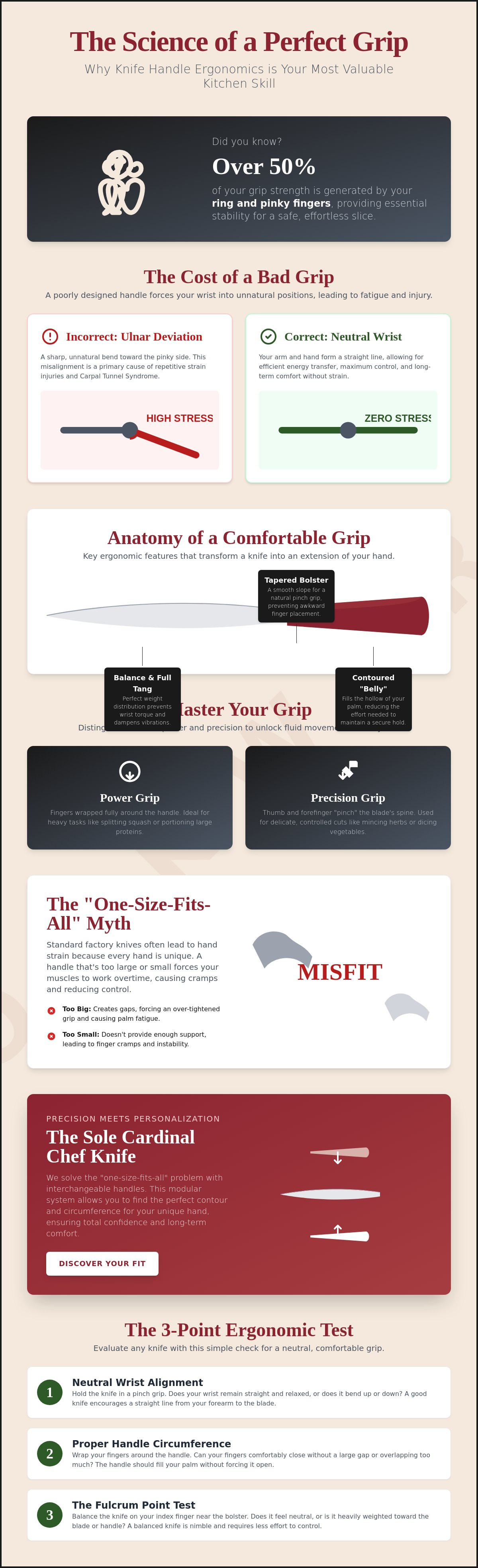
Did you know that over 50% of your grip strength is actually generated by your ring and pinky fingers? Most home cooks focus on the pinch grip at the blade, but the back of your hand provides the essential stability needed for a safe, effortless slice. When your tools don't account for this anatomy, you're left fighting against the blade rather than working with it. This is where the science of knife handle ergonomics becomes your most valuable kitchen skill.
You've likely felt that nagging cramp in your palm after a long prep session or worried about a handle becoming slippery when oily. It's frustrating to use a knife that feels too bulky for your hand. You deserve a tool that supports your technique instead of hindering your speed. This guide will show you how handle design impacts your precision and wrist health, helping you find a tool that feels like a natural extension of your body.
We'll explore the mechanics of a neutral wrist posture and how modular components, like the Cardinal Chef Knife and its interchangeable handles, allow you to customize your grip for total confidence and long term comfort.
Key Takeaways
- Distinguish between a power grip and a precision grip to unlock better control and fluid movement in every cut.
- Master the science of knife handle ergonomics by identifying the "handle belly" and bolster shapes that support your hand’s natural anatomy.
- Identify why a one-size-fits-all approach often leads to hand strain and how to find the perfect handle circumference for your unique grip.
- Perform a simple 3-point alignment test to ensure your knife encourages a neutral wrist position, protecting you from long-term injury.
- Discover how interchangeable handles on the Cardinal Chef Knife provide a personalized fit that standard factory knives simply cannot match.
The Biomechanics of the Kitchen: Why Knife Handle Ergonomics Matter
Ergonomics is more than just a design buzzword. It is the focused study of efficiency and physical comfort within a working environment. In the kitchen, your environment is centered on the cutting board. If your tools don't respect your body's natural mechanics, the simple act of dicing an onion becomes a chore. Proper knife handle ergonomics ensures that the energy you put into a slice isn't wasted fighting the tool itself. It creates a seamless bridge between your intent and the blade's movement.
To understand this relationship, you must recognize two primary grip styles. The "Power Grip" is used for strength. You wrap your fingers fully around the handle to tackle heavy tasks like splitting a winter squash. The "Precision Grip" is more delicate. It often involves a pinch grip where the thumb and forefinger guide the blade's spine. A poorly designed handle forces the wrist into ulnar deviation. This is a sharp, unnatural bend toward the pinky side of your arm. Over time, this misalignment is a primary culprit behind repetitive strain injuries like Carpal Tunnel syndrome.
The Cost of a Bad Grip: Fatigue and Precision
Hand fatigue isn't just about the weight of the steel. It's about muscle recruitment. When a handle doesn't fit your palm, your smaller stabilizing muscles work overtime just to keep the blade from wobbling. This leads to shaky, inconsistent cuts and increases the risk of the knife slipping. When you're constantly adjusting your grip to find a comfortable spot, your focus shifts away from the food. This mental load is just as taxing as the physical strain. A comfortable knife builds a quiet confidence that allows you to cook faster and with greater joy.
From Stone to Steel: A Brief History of Handle Design
The Anatomy of a Knife Handle has evolved significantly from basic wood sticks to the sophisticated contours we see today. Traditional Western handles often prioritized heavy bolsters and blocky shapes. These were built for durability in rugged environments, but they often ignored the long-term health of the hand. We've now entered an era of "Chef-designed" tools. These modern innovations, such as the Cardinal Chef Knife, prioritize the user's physical experience. By utilizing interchangeable handles and replaceable knife components, we can finally move past the era of one-size-fits-all manufacturing to achieve a truly custom fit.
Anatomy of a Comfortable Grip: Contours, Bolsters, and Balance
The physical shape of your knife determines how much energy reaches the cutting board. At the center of this relationship is the "handle belly." This is the subtle swell in the middle of the grip that fills the hollow of your palm. When a handle is perfectly contoured, it supports the hand's natural resting state. This reduces the mechanical effort needed to maintain a secure hold. Scientific research on handle diameter confirms that a properly sized grip significantly lowers muscle strain and prevents the hand from hollowing out during use.
A tapered bolster is another essential feature of superior knife handle ergonomics. The bolster is the transition point where the handle meets the blade. A smooth, sloped taper provides a natural ramp for your thumb and forefinger. This design encourages a proper pinch grip. Without this taper, your fingers hit a flat "wall," which forces your hand into awkward, strained positions. A well-designed bolster makes the transition from handle to steel feel seamless and intuitive.
Weight distribution is the final pillar of a comfortable grip. The "Fulcrum Point" is the spot where the knife balances perfectly on your finger. If a knife is too blade-heavy, it creates constant downward torque on your wrist. Your forearm muscles have to work overtime just to keep the tip from diving. Full tang construction, where the steel runs through the entire handle, provides the necessary counter-weight for a neutral feel. This solid core also dampens vibrations, ensuring that every chop feels stable rather than jarring.
The Role of Materials in Ergonomic Stability
Texture and temperature play a vital role in how a knife feels over time. Synthetic materials like G10 or Micarta are often superior to traditional wood because they don't warp or absorb moisture. These materials maintain a certain "tackiness" even when your hands are wet or oily. This prevents the dangerous over-gripping that leads to hand cramps. When you don't have to squeeze as hard to maintain control, you can prep for longer without discomfort. Choosing a knife with interchangeable handles allows you to select the exact material and texture that fits your unique grip preferences.
Understanding the Balance Point
You can find your knife's balance point with a simple finger test. Place your index finger under the bolster and see where the knife tips. A neutral balance point should sit right at the bolster. This equilibrium reduces the torque on your wrist during the rocking motion of dicing. It makes the blade feel like a natural extension of your arm. Longer blades require a heavier handle to maintain this balance. If the handle is too light, the knife will feel floppy and difficult to guide with precision. A balanced tool respects your body's limits while enhancing your natural skill.
Solving the Small Hand Struggle: Beyond the One-Size-Fits-All Myth
The culinary world has a long history of scaling tools for a specific demographic. Most professional knives are designed based on the hand measurements of high-volume line cooks, a group historically dominated by men. This legacy has left many home cooks, particularly women and those with petite hands, struggling with oversized equipment. When you use a tool that wasn't built for your anatomy, you lose the intuitive connection required for precise work. Masterful knife handle ergonomics should bridge this gap, ensuring the tool fits the user rather than forcing the user to adapt to the tool.
A primary hurdle is the "Circumference Problem." If a handle is too thick, your fingers cannot wrap around far enough to meet the base of your thumb. This creates a hollow space in your grip. To compensate for this lack of contact, you're forced to squeeze the handle with excessive force. This over-gripping is the direct cause of hand fatigue and cramping during long prep sessions. A handle with a more intentional, slimmer profile allows for a complete finger wrap, providing maximum stability with minimal effort.
There is a common myth that cooks with smaller hands should stick to smaller blades. This is a misconception that limits your efficiency. A full-sized chef knife offers the weight and length necessary for effortless dicing and slicing. The problem isn't the length of the steel; it's the lack of control provided by a bulky handle. By utilizing interchangeable handles, you can pair a professional-grade blade with a grip that truly fits your hand. This gives you the power of a large knife with the control of a small one.
The Feminine Perspective in Tool Design
Inclusive design is finally reaching the kitchen. For too long, "unisex" tools have simply been standard tools that ignore the nuances of hand width and finger length. Redesigning the kitchen from the hand up means acknowledging that a secure grip is the foundation of culinary confidence. When a tool is designed with chef expertise and a focus on diverse hand shapes, it transforms the cooking experience. It moves from a task of endurance to one of creative joy.
Identifying Pressure Points
Even a well-sized handle can be uncomfortable if the finishing is poor. Standard knives often have sharp angles where the spine of the blade meets the handle, creating friction during a pinch grip. A hot spot is a localized area of high pressure. To prevent these, look for knives with rounded spines and smoothed choils. These subtle refinements ensure that your fingers rest against soft, contoured surfaces rather than harsh metal edges. The Cardinal Chef Knife incorporates these ergonomic details to protect your hands from repetitive irritation during every session.
The 3-Point Ergonomic Test: Evaluating Your Knife Before You Buy
Choosing a tool based on aesthetics is a common mistake. A knife might look sleek on a magnetic strip, but its true value is revealed only when it meets the cutting board. To find a tool that truly fits, you need an objective way to measure knife handle ergonomics. This 3-point test allows you to evaluate any blade before you commit, ensuring it supports your body’s natural mechanics during real-world kitchen tasks.
The first step is the Wrist Alignment Test. Stand at your workstation and hold the knife in your preferred grip. Place the edge flat against the board. Your wrist should remain in a neutral, straight line from your forearm to your hand. If you find yourself "cocking" your wrist upward or downward to get the blade to touch the surface, the handle's angle is fundamentally mismatched to your height or arm length. This misalignment is a primary cause of the ulnar deviation discussed earlier in this guide.
Next, perform a Fatigue Simulation. Mimic a rapid rocking motion for thirty seconds as if you're dicing a large pile of herbs. Pay close attention to the contact points in your palm. If you feel a "hot spot" or localized pressure where the handle meets your skin, the contouring isn't effectively distributing the force of the chop. Finally, test the "Dry vs. Wet" grip. Safely dampen your hand with a small amount of water or oil and check if the material maintains its tackiness. A secure handle prevents the dangerous over-gripping that leads to muscle exhaustion.
Step 1: The Pinch Grip Alignment
To test the pinch grip, place your thumb and the side of your index finger on the blade's base, wrapping your remaining fingers around the handle. Check for knuckle clearance. There should be ample space between your fingers and the cutting board to prevent impact during a full stroke. The transition from the bolster to the blade must feel seamless. Any sharp edges or abrupt drops in this area will lead to calluses or irritation during long prep sessions.
Step 2: Assessing Static vs. Dynamic Balance
A knife that feels balanced while stationary may behave differently during high-speed movement. Pay attention to how the handle reacts when the blade strikes the board. If you feel a sharp "kickback" or excessive vibration in your palm, the knife lacks the necessary counter-weight or dampening properties. The handle should feel anchored and stable during rapid directional changes, never sliding or shifting in your grip. If your current tools fail these tests, explore our interchangeable handles to find a customized fit that passes every ergonomic requirement.
Precision Meets Personalization: The Sole Cardinal Chef Knife
The Cardinal Chef Knife represents a fundamental shift in culinary tool design. It isn't just another sharp blade; it's a response to the physical challenges cooks face every day. By integrating professional-grade materials with advanced knife handle ergonomics, this tool bridges the gap between the high-pressure environment of a commercial kitchen and the comfort of your home. It's a design born from necessity. It's built for those who find joy in the process of preparation.
Most knives on the market are static. They offer one shape and one weight, regardless of who is holding them. We believe the future of cooking is modular. Our system of interchangeable handles and replaceable knife components ensures that your tool adapts to you. This isn't just about aesthetics. It's about finding the precise physical alignment that prevents injury and enhances your natural skill. When your knife fits, your technique flourishes.
Designed for Every Hand
The development of the Cardinal was driven by chef-led testing. We spent years observing how different hand sizes interact with various contours to identify where standard designs fail. This research led to our signature handle shape, which specifically targets the pain points of hand fatigue and loss of control. One of our users described it perfectly: it's "the knife that feels like an extension of your hand." This sensation occurs when the handle belly and bolster taper work in total harmony with your unique grip.
We focused on eliminating the pressure points mentioned earlier by smoothing every transition. The result is a tool that feels supportive from the first slice to the last. Whether you have large hands or a more petite grip, our range of handles ensures you never have to settle for a "close enough" fit. You deserve a tool that honors your anatomy.
The Modular Advantage
A great knife should be a lifelong companion. Traditional knives are often discarded when the handle wears down or if the user's needs change. Our commitment to modularity changes that cycle. By offering replaceable parts, we ensure your investment remains viable for decades. It's a more sustainable, responsible way to approach craftsmanship. You're not just buying a knife; you're investing in a system that evolves with you.
Being able to swap handles also means your knife can grow with your skills. As you move from basic chopping to more intricate tasks, you might find you prefer a different texture or weight. Our system allows for that evolution without requiring a brand-new tool. You can maintain the blade you've come to trust while refining the grip that guides it. If you're ready to stop fighting your tools and start mastering your craft, Experience the ergonomic difference with the Cardinal Chef Knife today.
Master Your Grip for a Lifetime of Culinary Joy
We've explored how a subtle handle belly and a tapered bolster transform a blade from a simple tool into a natural extension of your hand. You now have a practical 3-point test to verify wrist alignment and balance in your own kitchen. Mastering the principles of knife handle ergonomics is about more than avoiding a cramp; it's about reclaiming the precision and confidence needed to truly enjoy the process of preparation.
The Cardinal Chef Knife was founded and tested by chefs to solve the exact pain points we've discussed. With its interchangeable handle system and precision-balanced design, it offers a level of personalization that standard factory knives simply can't provide. Discover the Cardinal Chef Knife: Designed for Comfort and find the perfect fit for your unique hand anatomy.
Your hands are your most vital tools. When you choose equipment that respects your body's mechanics, cooking becomes effortless. Take this knowledge to your cutting board and enjoy the mastery that follows.
Frequently Asked Questions
What is the most ergonomic handle shape for a chef knife?
The most ergonomic handle shape features a subtle swell in the center, known as a handle belly, paired with a tapered bolster. This combination supports the natural curve of your palm while allowing your fingers to transition seamlessly into a pinch grip. You should avoid slab-sided or perfectly square handles. These designs create harsh pressure points and force your hand into an unnatural, fatiguing position during long prep sessions.
Can a knife handle really cause carpal tunnel syndrome?
A poorly designed handle can contribute to carpal tunnel syndrome by forcing the wrist into a state of ulnar deviation. This occurs when you must bend your wrist toward the pinky to keep the blade flat on the board. Over time, this repetitive strain inflames tendons and compresses the median nerve. Prioritizing knife handle ergonomics helps you maintain a neutral wrist position, which is essential for protecting your long term joint health.
Should I choose a wood or synthetic handle for better grip?
Synthetic materials like G10 or Micarta typically offer a more secure grip than traditional wood. These materials are specifically engineered to maintain their texture even when your hands are wet or oily. While wood is aesthetically pleasing, it can become slippery or warp with age. High-quality synthetics provide the necessary stability to prevent over-gripping. This reduces the muscle tension that leads to hand cramps and premature fatigue during intensive tasks.
What is a 'pinch grip' and why does it require an ergonomic bolster?
The pinch grip is a professional technique where you place your thumb and the side of your index finger directly on the blade's base. This requires a tapered bolster to provide a smooth, ergonomic transition for your hand. Without this taper, your fingers rest against a sharp edge or a flat metal wall. A well-designed bolster eliminates these friction points, allowing for greater precision and control without irritating your skin.
How do I know if a knife handle is too big for my hands?
A handle is likely too big if your fingers cannot wrap far enough around the grip to touch the base of your thumb. This gap creates a hollow space in your palm, making the tool feel unstable. To compensate, you're forced to squeeze the handle with excessive force. If your hand feels cramped or tired after a short period of chopping, the handle circumference is likely too large for your hand size.
Does the weight of the handle affect the balance of the blade?
The weight of the handle is the primary factor in determining the knife's balance point. A properly balanced tool should feel neutral right at the bolster. If a handle is too light, the blade becomes tip-heavy. This creates downward torque that your wrist must constantly fight to stay level. A handle with the correct weight acts as a counter-balance, ensuring the knife moves effortlessly as an extension of your own arm.
Are ergonomic knives only for people with wrist pain?
Ergonomic knives are intended for all cooks, regardless of whether they currently feel pain. While they are a relief for those with existing conditions, their main goal is prevention and increased efficiency. A tool that fits your hand properly allows for faster, more accurate cuts. It reduces the physical effort required for prep work, ensuring that cooking remains an empowering and creative activity rather than a test of physical endurance.
What is a 'full tang' and does it make a knife more ergonomic?
A full tang refers to a blade where the steel extends through the entire length and width of the handle. This design enhances knife handle ergonomics by providing a solid foundation and better counter-weight for the blade. It dampens the vibrations from each chop, making the knife feel more stable and less jarring. This unified construction is essential for achieving the neutral balance point required for a safe and efficient rocking motion.