

The most expensive knife in your collection is likely the one you avoid using because it leaves your hand cramped and tired. True mastery in the kitchen isn't about owning every gadget on the market. It's about investing in high quality kitchen tools that serve as a natural extension of your own body. You've likely felt the frustration of a cluttered drawer full of single-use tools that lose their edge or cause unnecessary fatigue. It's a common hurdle for any dedicated home cook. We believe that the cooking process should be a source of joy rather than a cause of physical strain.
This guide will help you identify professional-grade equipment that balances ergonomic comfort with lifelong durability. You'll learn to spot the difference between a tool that is merely expensive and one that offers genuine mechanical advantage. We'll explore how to reduce physical stress while building confidence in your cutting technique. We will look at the essential elements of craftsmanship, including the benefits of interchangeable handles and replaceable components that keep your kitchen lean and efficient.
Key Takeaways
- Learn to identify high quality kitchen tools by evaluating the balance between material integrity and ergonomic precision.
- Discover how handle geometry dictates cutting force and learn to select tools that eliminate hand fatigue during intensive prep work.
- Understand the trade-offs in steel composition to find a blade that offers both exceptional edge retention and long-term durability.
- Explore the advantages of modularity and how replaceable components allow your tools to evolve alongside your culinary skills.
- Master the art of a curated kitchen by choosing fewer, better tools that prioritize functional beauty over single-use gimmicks.
Defining High-Quality Kitchen Tools in 2026
True quality is a quiet sensation. It's the moment you realize you've been chopping for twenty minutes and your wrist doesn't ache. In 2026, the definition of high quality kitchen tools has moved past mere aesthetics. It now sits at the intersection of material integrity, functional beauty, and ergonomic precision. We're seeing a profound shift in how people equip their homes. Cooks are moving away from 'disposable' gadgets that end up in landfills, choosing instead 'Buy It For Life' (BIFL) culinary investments. This trend is driven by a desire for sustainability and a rejection of the 'fast-fashion' equivalent in cookware.
There's a common misconception that professional-grade equipment must be heavy or industrial. That isn't the case. A tool designed for a chef is built for endurance and agility. It shouldn't feel like a weight; it should feel like a part of you. This is why the role of a trained chef is so vital in the design process. They understand that a tool must solve home-cook problems, like hand fatigue or cluttered drawers. A chef knows that a well-balanced knife does the work for you. It shouldn't require brute force to achieve a clean slice.
The Hallmarks of Premium Craftsmanship
Material excellence is the foundation. In light of the 2026 FDA scrutiny on lead leaching in certain alloys, choosing certified, high-grade materials is more important than ever. We've moved beyond basic stainless steel to embrace high-carbon specialized alloys that offer superior edge retention and safety. Manufacturing intentionality matters here. Small-batch production often beats mass-market alternatives because it allows for meticulous attention to detail. You can feel this difference through the 'Extension of the Hand' test. When you hold a kitchen utensil, the balance should feel centered. It shouldn't fight your natural movement. It should respond to your intent with precision.
Why 'Cheap' Tools Cost More Over Time
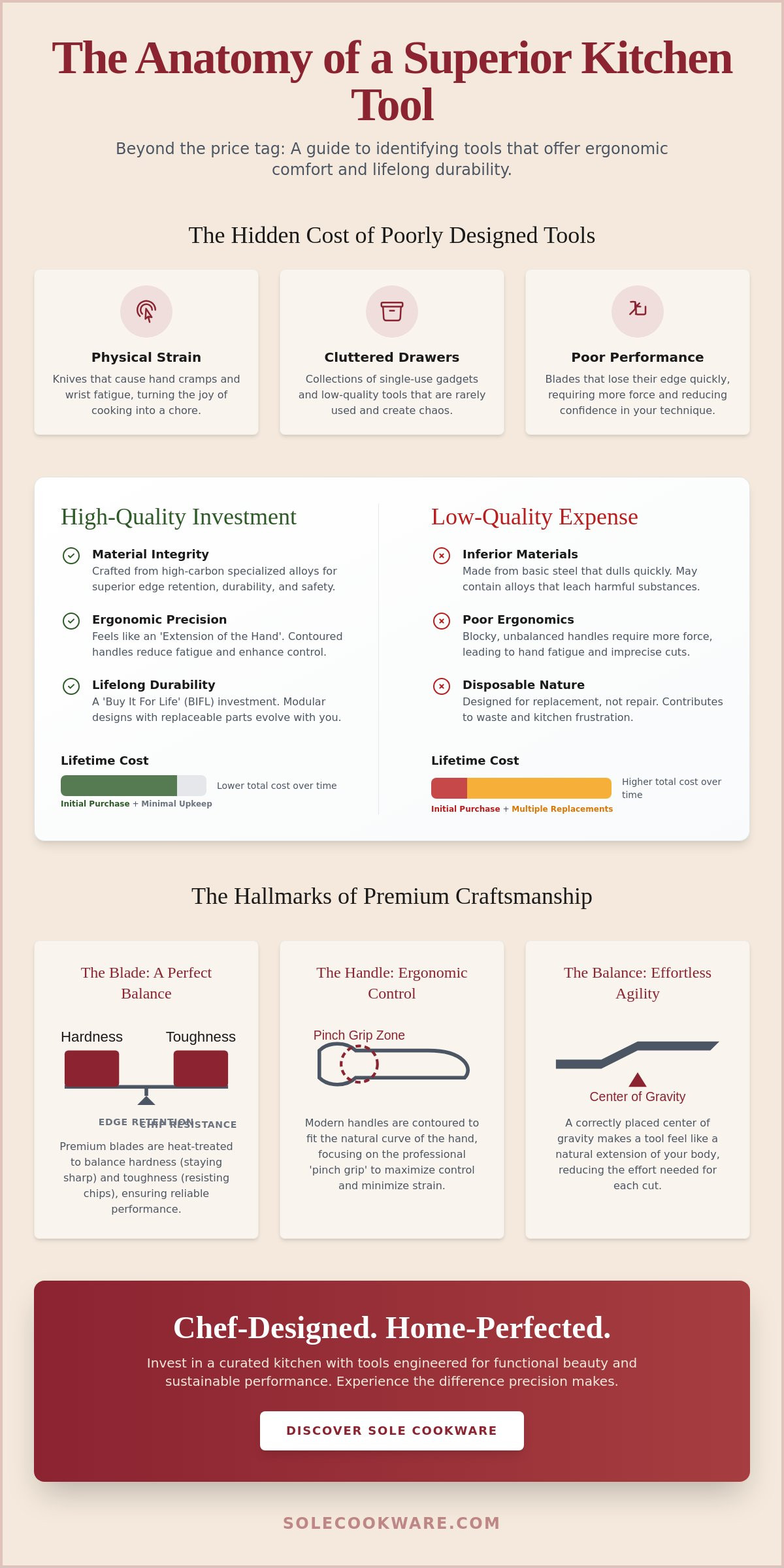
The sticker price of a budget tool is deceptive. There's a hidden cost in frequent replacements and poor performance that slows you down. Low-quality tools contribute to kitchen frustration. They can even cause you to lose confidence in your own technique. When a blade doesn't bite or a handle slips, the joy of cooking fades. A durable kitchen knife is an investment in both safety and longevity. By choosing high quality kitchen tools, you're investing in your own growth as a cook. You're ensuring that every session at the cutting board is productive, safe, and deeply satisfying. You're building a kitchen that works with you, not against you.
The Anatomy of Excellence: Materials and Ergonomics
A tool is only as effective as the control it grants you. When evaluating high quality kitchen tools, you must look beyond the surface shine to the mechanical principles at play. Excellence begins with the steel. A masterfully crafted blade balances two competing traits: hardness and toughness. Hardness allows the edge to stay sharp through hundreds of cuts; toughness ensures the metal won't chip when it meets a stubborn squash or a stray bone. This balance is achieved through precise heat treatment. It's a delicate process that transforms raw metal into a reliable partner for your culinary journey.
Weight distribution is the silent partner of performance. A well-balanced tool feels lighter than its actual weight because it works with the physics of your movement. When the center of gravity is correctly placed, the tool doesn't tip forward or pull back against your grip. This reduces the effort required for every slice. Hygiene is equally vital. High-performance tools should feature a seamless surface finish to prevent food particles from becoming trapped. Choosing materials from the list of FDA-authorized food contact substances ensures that your equipment is as safe as it is durable. If you're ready to feel this precision firsthand, our Cardinal Chef Knife was engineered specifically to harmonize these elements of weight and safety.
The Evolution of Knife Handle Ergonomics
Traditional kitchen knife handles were often simple, blocky rectangles. Modern design has evolved toward contoured shapes that mirror the natural curves of the human hand. Advanced knife handle ergonomics focus on the pinch grip, which is the preferred technique of professional chefs. By refining the bolster area where the blade meets the handle, designers can eliminate the friction points that cause blisters and wrist strain. A truly ergonomic handle doesn't just feel good; it dictates a safer, more efficient cutting force.
Material Science in the Modern Kitchen
In 2026, material choices have expanded to offer incredible longevity without the maintenance of the past. G10 and high-quality polymers have become favorites because they're nearly indestructible and won't absorb moisture like traditional woods. These materials are also highly stain-resistant, which is a non-negotiable feature for high quality kitchen tools used daily. While wood offers a classic aesthetic, modern composites provide a level of hygiene and structural integrity that lasts for decades. The result is a toolkit that remains as beautiful and functional on year ten as it was on day one.
Professional Grade vs. Home Utility: Finding the Balance
Heavy equipment isn't always better equipment. Many people assume that high quality kitchen tools must be bulky to be durable. That's a myth. In a commercial setting, tools are often built to survive the brutal pace of a twelve-hour shift. For the home cook, this results in equipment that is over-engineered and unnecessarily taxing. You don't need a culinary degree to appreciate the difference. True quality lies in finding the sweet spot where professional performance meets the unique comfort of your own kitchen. It's about precision, not just power.
The best tools are those that empower you to cook more often. If a knife feels like a chore to lift, it will stay in the drawer. We believe that professional-grade performance should be accessible to everyone, regardless of their training. A tool that is designed with the home environment in mind focuses on agility and ease of maintenance. It respects your space and your time. By choosing tools that bridge this gap, you gain the reliability of a chef's kit without the industrial weight that leads to fatigue.
Ergonomics for the Enthusiast
One-size-fits-all designs often fail the diverse range of people who love to cook. Standard handles are frequently too large for women or cooks with smaller hands, leading to a lack of control and increased risk of injury. We've addressed this by offering Interchangeable Handles that allow you to customize the grip to your specific palm size. This shift from raw utility to refined comfort is essential. When you have total control over the blade, your confidence in the kitchen grows. You're no longer fighting the tool; you're focused on the craft.
Aesthetic Functionality: The Beauty of Better Tools
A tool you love looking at is a tool you'll use more often. There is a psychological boost that comes from holding a piece of equipment that reflects your commitment to the culinary arts. Minimalist design is more than just a style choice. It's a cure for the cluttered drawers and "gadget fatigue" that can make prep work feel overwhelming. By investing in high quality kitchen tools that are as beautiful as they are functional, you create an environment that inspires creativity. Your kitchen becomes a place of intentionality, where every object has a purpose and a place.
Building a Sustainable Toolkit: Longevity and Modular Design
A legacy is built, not bought. It is the result of choosing equipment that can be maintained, repaired, and adapted over time. Most manufacturers treat a knife as a single, static object. When one part fails, the entire tool is discarded. We believe there is a better way. The shift toward modularity is the most significant advancement in high quality kitchen tools in recent years. By using Replaceable Knife Components, you ensure that your investment lasts for decades rather than just a few seasons. This 'Repair over Replace' philosophy is essential for the modern, eco-conscious cook who values both performance and sustainability.
Modular design allows for a personalized, evolving kitchen setup. Your needs as a cook will change. Your tools should be able to change with you. This isn't just about utility; it's about the psychological satisfaction of owning something that is built to endure. It's about the confidence that comes from knowing your equipment won't let you down when it matters most. Investing in high quality kitchen tools that offer modularity is the most effective way to reduce kitchen waste while maintaining a professional standard at home.
The Benefits of Modular Knife Systems
The ability to swap components is a game-changer for ergonomics. Our Interchangeable Handles allow you to adapt your tools to your personal style or hand size. You might prefer a different grip for delicate paring than you do for heavy-duty chopping. Modularity makes this possible. It allows you to maintain the 'soul' of the tool, the blade you've grown to trust, while refreshing the parts that see the most physical wear. This level of customization leads to a deeper physical connection with your equipment. It becomes truly yours.
Maintenance as a Pillar of Quality
Even the finest tools require a commitment to proper care. High-quality alloys are designed to be easier to sharpen and clean than their budget counterparts. They respond better to a honing rod and hold an edge with greater tenacity. Modularity ensures a tool remains a high quality chef knife for a lifetime by allowing you to replace specific elements without losing the entire piece. Proper maintenance isn't a chore; it's a ritual that honors the craftsmanship of your gear. Ready to start building your own sustainable toolkit? Explore our Replaceable Knife Components to see how modular design can elevate your culinary experience.
The Sole Cookware Difference: Chef-Designed for Your Kitchen
A professional chef knows the difference between a tool that works and a tool that inspires. Sole Cookware began with this specific realization. Our founder saw that home cooks were often forced to choose between flimsy, disposable gadgets and heavy, industrial equipment that simply didn't fit their hands or their lives. We set out to create high quality kitchen tools that offer a professional edge with a supportive, human touch. As a female-founded brand, we bring a unique perspective to tool geometry. We prioritize inclusivity because we know that a comfortable, secure grip is the foundation of culinary mastery. It is about making the professional standard accessible to everyone.
Our philosophy is rooted in the "master-to-apprentice" relationship. We don't just sell equipment; we provide the foundation for your growth. Every design choice we make is intentional. We focus on the fundamentals of balance, material integrity, and ergonomic precision. By stripping away unnecessary fluff, we've created a line of tools that feel purposeful and reliable. This commitment to quality ensures that your kitchen remains a place of joy and creativity rather than a source of physical strain. When you choose Sole, you're choosing a brand that values your long-term success and satisfaction.
The Cardinal Chef Knife: A Case Study in Quality
Our signature blade represents the pinnacle of our design philosophy. The Cardinal Chef Knife isn't just a tool; it's a study in precision and control. We've refined the weight distribution to ensure the physical sensation is one of total harmony. When you hold it, the blade feels like a natural extension of your own hand. This is where our modularity shines. By offering Interchangeable Handles and Replaceable Knife Components, we've revolutionized the 'Buy It For Life' concept. You can refresh the parts that see the most wear or swap handles to find your perfect ergonomic fit. It is a tool designed to evolve alongside your skills.
Join the Sole Community
Our commitment goes beyond the physical object. We act as a mentor to our community, providing the chef-informed education you need to use your high quality kitchen tools to their full potential. We believe that investing in Sole is a direct investment in your own culinary journey. You aren't just acquiring gear; you're gaining the confidence to master new techniques and explore ambitious recipes. We're here to support your progression from curious enthusiast to confident master. If you're ready to upgrade your prep work and experience true ergonomic comfort, explore the Cardinal Chef Knife collection here and discover the difference of intentional design.
Mastering Your Culinary Foundation
Your kitchen should be a sanctuary of skill and creativity. We've explored how high quality kitchen tools are defined by more than just their price tag or steel hardness. They're defined by how they feel in your hand during a long prep session and how they adapt to your evolving needs. By prioritizing ergonomic precision and modularity, you ensure that your equipment remains an asset for a lifetime. You're not just buying a knife; you're investing in your own comfort and confidence at the cutting board.
At Sole Cookware, we believe in tools that empower you. Our female-founded brand was born from a professional chef's desire to bring true balance and inclusivity to the home kitchen. Every detail of our modular, replaceable handle system is designed to provide a personalized fit that reduces fatigue. It's time to move beyond cluttered drawers and tools that fight your natural movement. Experience the precision of the Cardinal Chef Knife today. We're excited to see what you'll create with equipment that truly supports your journey toward mastery.
Frequently Asked Questions
What are the most essential high-quality kitchen tools for a beginner?
A versatile chef knife, a paring knife, and a solid cutting board are the core essentials for any new cook. You don't need a massive block set to start your journey. Focus on high quality kitchen tools that perform multiple tasks with precision. A single, well-balanced blade can handle nearly all your prep work. This minimalist approach reduces clutter and helps you master the fundamentals of knife skills without unnecessary distraction.
Is a more expensive kitchen knife always better quality?
Price does not always correlate with performance; sometimes you are paying for brand prestige or aesthetic flourishes. True quality is found in the integrity of the materials and the precision of the ergonomics. Look for tools that offer functional benefits, like modular components or superior heat treatment, rather than just a high price tag. A tool that is expensive but uncomfortable will ultimately hinder your progress and cause frustration.
How do I know if a knife handle is truly ergonomic for my hand size?
A handle is ergonomic for your hand size if you can maintain a secure pinch grip without feeling tension in your wrist or palm. Your fingers should wrap comfortably around the grip with a sense of total control. This is why we offer Interchangeable Handles to accommodate different palm widths. If the handle feels too bulky or too slim, it will cause fatigue and blisters during long prep sessions.
What is the difference between forged and stamped kitchen tools?
Forged tools are created from a single piece of heated metal and usually feature a bolster for better balance. Stamped tools are cut from a flat sheet of steel and are typically lighter in weight. While forging was once the only sign of quality, modern heat treatment has made high-end stamped blades incredibly durable. The choice often comes down to your personal preference for weight and the specific balance of the tool.
Can high-quality kitchen tools actually make my food taste better?
High-quality tools improve food taste by ensuring clean, precise cuts that preserve the structural integrity of your ingredients. A dull blade crushes cell walls, which can lead to bruising and lost juices in herbs or vegetables. When you use high quality kitchen tools, you maintain the moisture and texture of the food. This precision results in better browning and more vibrant, professional flavors in your finished dishes.
How often should I need to sharpen a professional-grade chef knife?
A professional-grade chef knife typically needs a full sharpening every six to twelve months depending on your volume of cooking. You should use a honing rod more frequently to keep the edge aligned between deep sharpenings. If you notice the blade sliding off a tomato skin or requiring more downward pressure, it is time for maintenance. Proper care ensures your blade remains a reliable and safe extension of your hand.
What materials should I look for in a long-lasting kitchen tool?
Look for high-carbon stainless steel for blades and durable composites like G10 or high-performance polymers for handles. These materials resist moisture and won't crack or warp over time like traditional wood might. Stainless alloys with specific heat treatments offer the best balance of edge retention and chip resistance. Choosing these materials ensures your toolkit remains functional and hygienic for decades of daily use in a busy kitchen.
Why is balance more important than weight in a kitchen knife?
Balance is more important than weight because it determines how much effort you must use to control the tool. A heavy knife that is poorly balanced will feel clunky and can even be dangerous to use. A well-balanced knife feels nimble and light regardless of its actual mass. When the center of gravity is correctly placed at the bolster, the knife does the work for you, significantly reducing hand and wrist strain.