

The most durable kitchen knife in your collection isn't necessarily the one with the hardest steel. While high-carbon blades are often praised for their edge, a tool that's too brittle will eventually chip when it hits a bone or a heavy cutting board. You've likely felt the frustration of a handle that loosens over time or a balance that leaves your wrist aching after a long session of prep work. It's a common struggle. We often buy tools expecting them to last a lifetime, only to find they aren't built for the rigors of a daily kitchen.
True longevity comes from a balance of engineering and thoughtful craftsmanship. In this guide, you'll discover the science behind structural integrity and what quality actually looks like in a professional tool. We'll explore the durability paradox of steel hardness, the essential role of full-tang construction, and how modular components can turn a single purchase into a lifelong companion. By the end, you'll know exactly how to choose a knife that feels like a natural extension of your hand and provides confidence in every cut.
Key Takeaways
- Understand that a durable kitchen knife is defined by more than a high price tag. It requires a harmony between material strength and structural integrity.
- Learn the trade-off between steel hardness and toughness. This helps you select a blade that stays sharp without being prone to chipping.
- Recognize ergonomics as a form of durability. It prevents user fatigue and ensures your tool remains a reliable extension of your hand.
- Discover how modular designs with interchangeable handles and replaceable parts extend the life of your cutlery. You'll learn why you don't have to discard a great blade.
Defining the Anatomy of a Durable Kitchen Knife
Durability in a professional tool is often misunderstood. It isn't just a measure of how hard the steel is or how much the box cost at a high-end boutique. Instead, true durability is the intersection of material strength, structural integrity, and long-term maintainability. A durable kitchen knife must survive the repetitive impact of the cutting board while remaining easy enough for the cook to care for over decades. Expensive knives often focus on aesthetics or extreme hardness, but those features can sometimes lead to brittleness. A tool that chips during a standard prep session isn't durable; it's delicate.
To understand what keeps a tool in service, we have to look at the three critical failure points where most knives eventually break down: the edge, the tang, and the handle scales. If any of these components fail, the tool becomes useless or, worse, dangerous. Understanding the Anatomy of a Durable Kitchen Knife allows you to see past the marketing and identify a tool built for a lifetime. When a knife is engineered correctly, it feels like a natural extension of your hand. It offers a sense of structural confidence that allows you to focus entirely on the ingredients rather than the limitations of your equipment.
The Role of the Tang in Structural Integrity
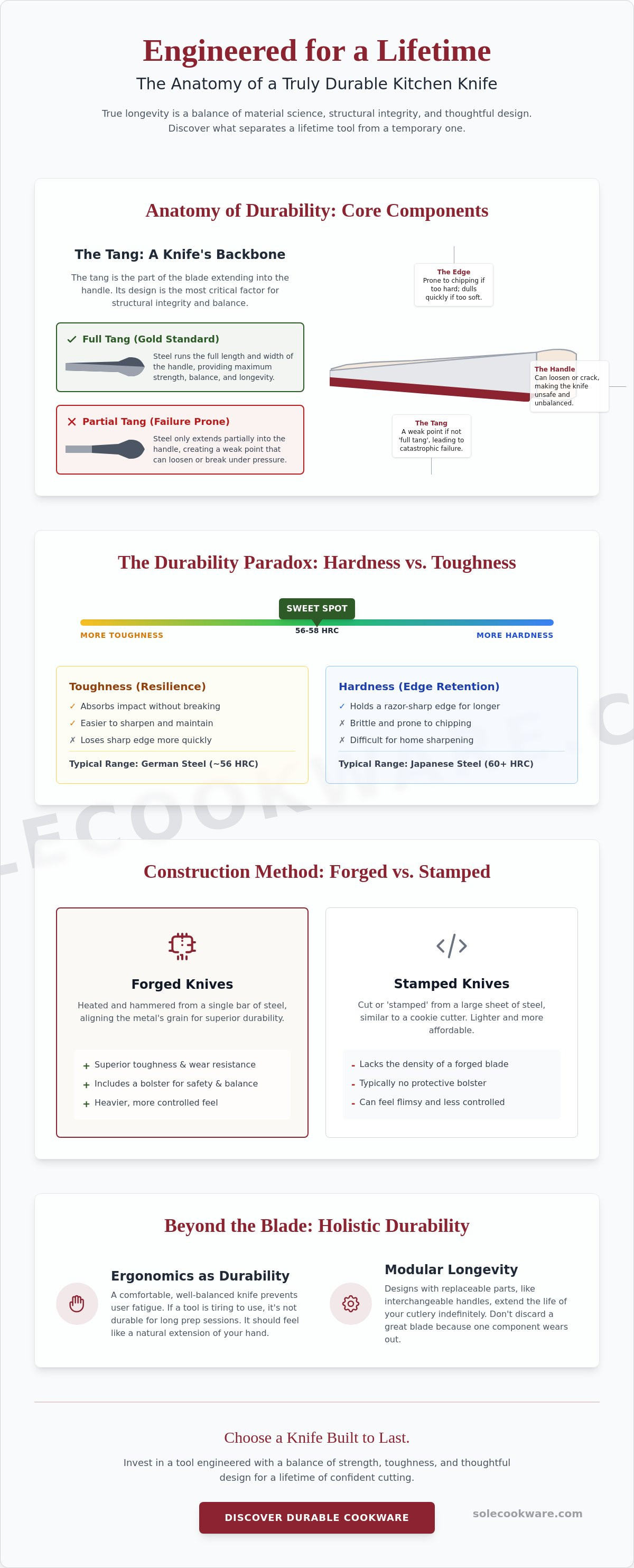
The tang is the portion of the blade that extends into the handle. For maximum longevity, a full tang is the gold standard. This means the steel runs the entire length and width of the handle, providing a solid backbone for the entire tool. A full tang ensures the knife can withstand lateral pressure without snapping at the junction where the blade meets the grip. It also shifts the balance point toward the palm. This creates a stable pivot point for precise work and reduces the strain on your wrist during heavy use. Partial tangs often loosen or break over time because they lack this continuous support.
Forged vs. Stamped: Which Lasts Longer?
Forging involves heating a single piece of steel and hammering it into shape. This traditional process aligns the molecular structure of the metal, which results in superior toughness and resistance to wear. Stamped blades are cut from a flat sheet of steel like a cookie cutter. While they're lighter and more affordable, they often lack the density and the protective bolster found in forged tools. A forged bolster acts as a physical shield. It protects your fingers from the blade and adds the necessary weight to improve the overall control of your durable kitchen knife. This weight isn't just for feel; it's a structural choice that reinforces the knife's most vulnerable area.
The Durability Paradox: Hardness vs. Toughness
Steel isn't a singular material. It's a spectrum of possibilities. On one end, you have hardness, which is the metal's ability to resist deformation. On the other, you have toughness, which is the ability to absorb energy without breaking. Most manufacturers measure this using the Rockwell C Scale (HRC). A high HRC means the steel is incredibly stiff. It will hold a razor-thin edge for a long time. However, that stiffness makes it prone to microscopic cracks and chipping. It's the ultimate trade-off in blade design.
A deep dive into The Durability Paradox: Hardness vs. Toughness shows that the most reliable tools live in the middle ground. For most home cooks, the "sweet spot" sits between 56 and 58 HRC. This range provides enough hardness to maintain a clean slice through a tomato, but enough toughness to survive a run-in with a hard squash. German steel typically lands around 56 HRC, making it exceptionally resilient. In contrast, Japanese blades often reach 60 to 62 HRC. They're sharper, but they demand much more care. When you invest in precision-forged cutlery, you're choosing a tool that balances these opposing forces for daily reliability.
Edge Retention vs. Ease of Sharpening
Ultra-hard steel stays sharp longer, but it's a nightmare to maintain. Once that edge finally dulls, you'll need professional equipment or hours on a whetstone to bring it back. A durable kitchen knife made from tougher, slightly softer steel is much more practical. You can easily "hone" the edge back to life using a simple steel rod. This process doesn't remove metal; it simply realigns the microscopic teeth of the blade. Edge geometry refers to the angle and thickness of the blade's primary grind, which dictates how much resistance you feel when slicing through a dense root vegetable. A well-designed, tough steel blade maintains this geometry without becoming brittle.
Resistance to the Elements: Rust and Corrosion
Durability also means resisting the environment. High-carbon stainless steel is the industry standard because it includes at least 12% chromium. This chromium creates an invisible "passive layer" that protects the iron from oxygen and moisture. Even the best steel can develop pitting if left in a damp sink or exposed to acidic juices for too long. Pitting is a form of localized corrosion that creates tiny holes in the blade's surface. To preserve your tool for decades, adopt a simple habit: wash by hand and dry immediately. This prevents moisture from breaking down that protective layer, ensuring your durable kitchen knife remains pristine through years of service.
Ergonomics as Durability: Protecting the User
A knife that keeps its edge but ruins your wrist is a failure of design. True durability must include the human element. If you can't use a tool comfortably for an hour of prep work, it won't stay in your kitchen for a lifetime. Good knife handle ergonomics are essential for long-term culinary success. They ensure the tool works with you, not against you. While some traditional brands focus on heritage aesthetics, those designs don't always account for the repetitive strain of modern home cooking or the needs of different hand sizes.
A secure grip is a safety feature for the blade too. Slippery or poorly shaped handles lead to accidental drops. When a durable kitchen knife hits a tile floor, the tip is often the first thing to break. By choosing a handle that offers a confident, non-slip texture, you're protecting the structural integrity of the steel itself. The physical relationship between the cook and the object is a vital part of the tool's longevity. A knife that feels secure is a knife that stays in your hand and out of harm's way.
Think of yourself as an apprentice learning from a master. One of the first things you'll learn is the "pinch grip." By gripping the blade at the bolster with your thumb and forefinger, you gain immense control over every slice. This technique also shifts the mechanical pressure away from the handle scales. It reduces the stress on the rivets or adhesive, helping the handle stay tight and centered for years. It's a simple habit that preserves both your comfort and the tool's structural health.
Handle Materials and Their Lifespans
Traditional wood handles are beautiful, but they require constant oiling and care. They swell and shrink when exposed to moisture. This movement eventually causes cracks or loosens the rivets, creating gaps where bacteria can grow. Synthetic and composite materials offer a more reliable path for a durable kitchen knife. These materials are non-porous and stable. They don't warp after exposure to water and stay hygienic over decades of use. Choosing a handle that resists the elements ensures the tool remains safe and functional for the long haul.
The Importance of Balance and Weight
Balance is the soul of a good knife. A front-heavy tool forces your wrist to do the extra work of keeping the tip up, which leads to rapid fatigue. A well-made knife should balance perfectly at the bolster, making it feel like a natural extension of your hand. Don't be fooled by bulk. A heavy, clunky knife isn't necessarily more resilient. A lightweight but perfectly balanced tool is often more durable because it allows for precise, controlled movements. This precision prevents the kind of erratic hacking that stresses the metal and leads to premature edge failure.
The Shift to Modular Longevity: Why Replaceable Parts Matter
Traditional knives are often treated as static objects. If the handle cracks or the rivets loosen, the entire tool usually ends up in a landfill. This is a massive waste of high-quality steel. A truly durable kitchen knife should be viewed as a repairable ecosystem rather than a single, unchangeable unit. By introducing modularity into culinary tools, we shift the focus from disposable consumption to long-term stewardship. It's about respecting the materials and the craft. Steel is resilient. It can be thinned, sharpened, and polished for decades. Handles, however, face constant moisture, heat, and physical impact. They are often the first part to fail.
Modular design allows you to replace the components that wear out without discarding the heart of the tool. This approach ensures your investment stays in your kitchen for the long haul. It's a revolutionary way to think about cutlery. Instead of buying a new knife every few years, you simply maintain the one you have. This philosophy of "buy once, maintain together" transforms the tool into a lifelong companion. It empowers you to take responsibility for your equipment, ensuring it always performs at its peak.
Ready to build a tool that evolves with you? Explore the Cardinal Chef Knife and our interchangeable handle system.
Beyond the Disposable Kitchen
The environmental cost of buy-and-toss cookware is significant. Most kitchen waste comes from products designed with planned obsolescence in mind. Modularity changes that cycle. Replacing the handle scales when they wear down effectively resets the clock on your tool. This system also allows for deep cleaning. You can remove the handle to reach the hidden areas where food particles and moisture often hide. This ensures your durable kitchen knife remains as hygienic as it is strong, preventing the internal corrosion that often kills fixed-handle knives from the inside out.
Customizing for Comfort
Your needs as a cook will change as you gain experience. You might start with a specific grip and realize later that a different texture or weight suits your evolving technique. Modular tools solve the dilemma of choosing one handle for every hand size in a household. You can swap components to fit a smaller or larger palm in seconds. This flexibility provides a psychological benefit too. There's a deep satisfaction in refreshing a tool you've used for years. It makes the knife feel brand new without losing the history you've built with the blade during thousands of meals.
The Cardinal Chef Knife: Engineered for a Lifetime
The Cardinal Chef Knife represents the physical realization of every principle we've discussed. It isn't just another blade in a drawer. It's a professional-grade instrument designed to handle the relentless pace of a commercial kitchen while remaining approachable for the home enthusiast. While many traditional brands rely solely on heritage, we focus on the future of your cooking. By combining a full-tang martensitic stainless steel blade with a modular handle system, we've created a durable kitchen knife that refuses to become obsolete. It's built to be maintained, not replaced.
Quality in the kitchen should be a constant, not a luxury that fades with time. Our approach centers on the idea of a "buy once and maintain together" philosophy. This means the heart of your tool, the forged steel, stays with you for decades. If the handle scales ever show signs of wear from years of heat and moisture, you don't toss the knife. You simply refresh the components. This commitment to structural integrity ensures that your tool remains a reliable partner through every meal you prepare.
Designed by a Chef, Refined for You
Sole Cookware was born from a simple observation: home cooks deserve the same reliability as executive chefs. Our female-founded team recognized that traditional designs often ignored the ergonomics of varied hand sizes. We designed the Cardinal handle-first. This ensures a proper grip and maximum control whether you're working in a professional galley or a family kitchen. Its specific shape is optimized for both the rhythmic rocking motion of a classic dice and the delicate precision of a julienne. It's a tool that respects the anatomy of the hand as much as the chemistry of the steel.
A Commitment to Culinary Mastery
Investing in a quality tool is an investment in your own growth as a cook. When you trust your equipment, your confidence in the kitchen expands. You stop worrying about the blade chipping or the handle loosening. You start focusing on the texture of the ingredients and the mastery of the technique. This is the true value of a chef-designed ecosystem. With interchangeable handles available in colors like Caviar, Cream, and Cherry, you can refresh your tool's aesthetic without losing the high-performance blade you've come to rely on. You deserve a durable kitchen knife that works as hard as you do. Join a community that values mastery over mindless consumption. Your journey toward culinary excellence starts with a tool built to finish the race with you.
Mastering the Long-Term Kitchen
Choosing a tool that lasts is a commitment to your craft. You now understand that a truly durable kitchen knife isn't just about the hardness of the steel. It's a delicate balance of toughness, structural integrity, and ergonomic comfort. By prioritizing modularity and repairable components, you're moving away from the cycle of disposable cookware and toward a more sustainable, intentional way of cooking. A great knife should be a steady presence on your cutting board for decades.
The right equipment empowers you to cook with confidence and precision. Our tools are chef-designed for home precision, ensuring that professional-grade quality is accessible to every enthusiast. With handles ergonomically optimized for all hand sizes and modular components for lifelong use, we've built a system that evolves with you. It's time to stop settling for tools that fail and start using ones that inspire mastery. Experience the Cardinal Chef Knife: The Last Knife You'll Ever Need to Buy. Your kitchen deserves a partner that works as hard as you do.
Frequently Asked Questions
What is the most durable material for a kitchen knife handle?
Non-porous synthetic materials and high-pressure composites are the most durable options for modern handles. Unlike natural wood, these materials don't swell, shrink, or crack when exposed to the moisture and heat of a busy kitchen. They provide a stable, hygienic grip that stays intact for decades. While wood offers a classic look, a durable kitchen knife designed for longevity often utilizes these advanced materials to ensure the handle remains structurally sound and securely attached to the tang.
How often should a durable kitchen knife be sharpened?
A quality knife typically needs sharpening every six to twelve months, depending on your frequency of use. However, you should hone your blade with a ceramic or steel rod every few uses to maintain the edge's alignment. This simple maintenance prevents the edge from rolling and keeps the tool performing at its peak. If you find yourself needing to sharpen more than twice a year, you might be using a cutting board that is too hard or applying excessive force during prep.
Does 'full tang' really matter for home cooks?
Yes, full tang construction is essential for anyone who wants a tool that lasts a lifetime. It means the steel extends through the entire handle, providing a solid backbone that prevents the blade from snapping under lateral pressure. This design also improves the knife's balance, shifting the weight toward your palm for better control. Without a full tang, the junction between the blade and the handle becomes a major failure point that can loosen or break over time.
Can a durable knife be washed in the dishwasher?
No, you should never put a high-quality knife in the dishwasher. The high heat can warp handle materials, while harsh detergents can cause the steel to pit or corrode. Additionally, the forceful water jets can knock the blade against other items, leading to chips in the edge. Hand washing with mild soap and drying immediately is the only way to preserve the integrity of your tool for the long haul. It's a small habit that prevents significant damage.
What is the difference between a chipped blade and a dull blade?
A dull blade has a rounded edge that has lost its "bite," while a chipped blade has actual missing pieces of metal along the edge. Dullness is a natural result of use and can be fixed with regular sharpening. Chipping usually occurs when a hard, brittle blade hits something equally hard, such as a bone or a frozen ingredient. While small chips can often be ground away, they represent a loss of material that eventually shortens the life of your durable kitchen knife.
How do I know if my knife handle is about to fail?
Look for visible gaps between the handle scales and the steel tang, or listen for a clicking sound when you apply pressure. These are clear signs that the rivets or adhesives are failing. If the handle feels loose or "wobbly" during use, it's no longer safe. Modular designs solve this problem by allowing you to replace the handle components entirely, ensuring your blade stays in service even if the original grip wears out after years of heavy use.
Is a heavier knife more durable than a lightweight one?
Weight is not a reliable indicator of durability. A heavy knife can still be brittle or poorly balanced, leading to premature failure and user fatigue. True durability comes from the quality of the steel and the precision of the construction rather than sheer mass. A lightweight, well-balanced knife made from high-quality forged steel will often outlast a clunky, poorly made heavy knife while being much easier and safer to use for daily tasks.
What does 'HRC' mean when looking at knife durability?
HRC stands for the Rockwell Hardness Scale, which measures how much resistance the steel has to permanent deformation. For a durable kitchen knife, an HRC between 56 and 58 is usually the ideal range for home use. This provides a balance of edge retention and toughness. Steels with a much higher HRC are harder and stay sharp longer, but they are also more brittle and prone to cracking when they hit a hard surface.