

The most dangerous tool in your kitchen isn't the sharpest blade. It's the one that forces your hand to fight against its own weight. Finding a knife that feels like an extension of your hand isn't a matter of luck or clever marketing; it's a precise calculation of physics and human anatomy. When your equipment resists your natural movement, you lose more than just speed. You lose the joy of the process.
We understand the frustration of hand cramps during long prep sessions and the hesitation that comes when slicing delicate ingredients. It's exhausting to feel intimidated by tools that should empower you. You deserve to experience the kitchen as a place of effortless creativity rather than physical strain. This guide will reveal the ergonomic secrets and design principles that bridge the gap between a heavy utensil and a seamless partner. We will explore how shifting the center of gravity and perfecting handle geometry can help you achieve professional-level precision and a true flow state at home.
Key Takeaways
- Understand the sensory shift from holding a heavy tool to experiencing "culinary flow," where the blade disappears into your natural movement.
- Learn why the center of gravity must align with your pinch grip to create a knife that feels like an extension of your hand.
- Identify the hidden "hot spots" in handle design that cause fatigue and how proper geometry reduces physical strain during long prep sessions.
- Master simple, at-home evaluations like the "Finger Balance" and "Pinch and Swing" tests to measure a tool's true maneuverability.
- Discover how the Cardinal Chef Knife uses intentional engineering to provide professional-level precision with accessible, ergonomic comfort.
What Does a Knife That Feels Like an Extension of Your Hand Actually Mean?
A great knife doesn't just cut; it communicates. When we speak about a knife that feels like an extension of your hand, we're describing a specific sensory experience often called "culinary flow." This is the moment the physical boundary between your palm and the steel blade seems to vanish. You stop thinking about how to hold the handle and start focusing entirely on the ingredients. It's the difference between a simple mechanical grip and a deep, intuitive connection.
Most home cooks are used to a "grip." You hold the tool, and the tool performs a task. However, a true connection implies a two-way conversation. The blade provides feedback through the handle, telling you exactly how the edge is meeting the carrot or the onion. This feedback is rooted in The Science of Flow, ensuring the tool is optimized for the human body rather than just being a sharp piece of metal. When the tool and user move as one, the kitchen transforms from a place of labor into a space of mastery.
The Psychological Benefit of Tool Synergy
Using a tool that fights you creates what we call "task anxiety." If you've ever felt a slight hesitation before starting a large prep session, it's likely because your equipment is demanding too much physical effort. Ergonomic comfort removes this mental barrier. When you trust your tool, you're more likely to experiment with new techniques or tackle complex recipes. We believe professional logic shouldn't be reserved for industrial kitchens. By bringing master-level design to the home, we empower you to move with quiet confidence. This synergy allows you to focus on the joy of the process, turning a chore into a creative exploration. It's about feeling capable and steady, even when the recipe gets demanding.
From Clunky Tool to Seamless Partner
You know a clunky knife by how it makes your wrist feel after ten minutes. Weight bias is often the culprit, where the blade feels too heavy or the handle feels too hollow. Friction against your knuckles or palm creates "hot spots" that distract from your work. The transition to a seamless partner happens when the tool stops being an obstacle. Synergy is the perfect alignment of weight and grip that allows the blade to fall exactly where you intend it to. Achieving this level of synergy is the core philosophy behind the Cardinal Chef Knife. It isn't just a product; it's a system designed to bridge the gap between your intent and the final cut. When you stop fighting the weight, you begin to experience guided precision.
The Three Pillars of Knife Ergonomics: Balance, Grip, and Weight
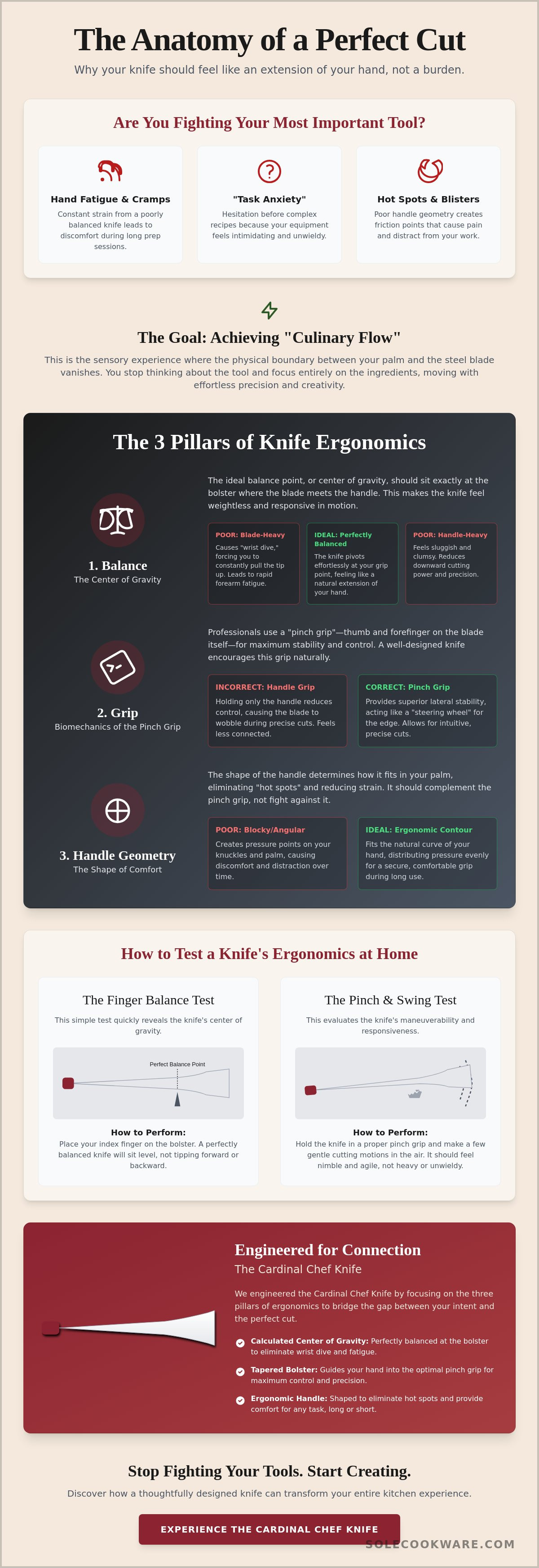
To find a knife that feels like an extension of your hand, we must look past aesthetics and into the physics of the tool. True ergonomics is built on three fundamental pillars: balance, grip, and weight. When these elements align, the knife becomes a lever that works with your body's natural mechanics. It stops being a separate object and starts responding to your smallest intent. Achieving this sensation requires a deep understanding of how a tool interacts with the human frame.
Finding the Sweet Spot: The Center of Gravity
The center of gravity is the specific pivot point where the knife feels weightless in motion. Ideally, this point should sit exactly at the bolster, where the blade meets the handle. If a knife is blade-heavy, it suffers from "wrist dive," forcing your forearm muscles to constantly pull the tip upward. This leads to fatigue before the meal is even prepped. Conversely, a handle-heavy knife feels sluggish and reduces your downward cutting power. Understanding knife handle ergonomics is essential because the handle acts as the counterweight to the steel, dictating where this pivot point sits in relation to your palm.
The Biomechanics of the Pinch Grip
Professional chefs don't just hold the handle; they use a pinch grip. By placing the thumb and forefinger on the blade itself, you create a "steering wheel" for the edge. A well-designed knife features a tapered bolster to encourage this grip naturally. This position provides maximum lateral stability, preventing the blade from wobbling during delicate tasks like julienning peppers. Solving the Friction through proper grip design is a recognized way to reduce the risk of repetitive strain in any hand-intensive activity. The right handle material also plays a role, providing a secure connection even when your hands are wet.
Weight distribution involves balancing the blade's "heft" with the handle's "anchor." You want enough weight in the blade to let gravity assist the cut, but not so much that you lose control. Handle geometry is the final piece of the puzzle. Contoured shapes that mirror the curve of your palm prevent the tool from rolling or twisting in your grip. These specific ergonomic factors ensure long-term comfort:
- Bolster Taper: Allows for a smooth, painless transition into the pinch grip.
- Handle Contour: Fills the palm to distribute pressure evenly across the hand.
- Tang Construction: Provides the structural balance needed for a steady, reliable feel.
By focusing on these pillars, you move from merely using a tool to experiencing true synergy. This commitment to balance is why the Cardinal Chef Knife is engineered with a specific weight-to-length ratio. It ensures that every slice feels guided rather than forced.
Solving the Friction: Overcoming Hand Fatigue and Strain
Friction is the silent thief of culinary joy. It starts as a dull ache in the palm and ends as a reason to cut the prep session short. When you use a knife that feels like an extension of your hand, you eliminate the physical resistance that leads to exhaustion. Achieving this requires more than just a sharp edge. It requires a handle that respects the delicate anatomy of the human grip and distributes pressure evenly across the skin.
The first step in solving friction is identifying "hot spots." These are concentrated areas of high pressure, usually where the fingers meet the bolster or where the butt of the handle presses into the palm. Poorly finished rivets or sharp, squared-off handle edges are the primary culprits. While some suggest masking the pain with a glove, we believe the solution lies in the geometry of the tool itself. A handle should be smooth and contoured, allowing for a relaxed hold that doesn't require constant micro-adjustments.
Handle diameter also plays a critical role in how quickly your hand tires. If a handle is too thin, your hand compensates by over-clenching. This creates a "death grip" that leads to rapid forearm fatigue. If the handle is too thick, you lose the fine motor control needed for precise tasks like mincing garlic. The goal is a diameter that allows your fingers to wrap naturally without overlapping or straining to reach the other side. When the fit is correct, your muscles remain relaxed and your rhythm remains steady.
Eliminating Wrist Strain through Alignment
Proper alignment ensures that the weight of your arm does the work rather than the muscles in your wrist. When a knife is balanced, the blade follows your lead with minimal effort. You don't have to force the tool through the food. This is why kitchen tools designed by chefs are so transformative for the home cook. They apply professional-grade logic to ensure the hand stays in a neutral position. This reduced strain allows you to maintain professional-level precision for much longer prep sessions.
Ergonomics for Every Hand
The culinary industry has long relied on a one-size-fits-all approach that often fails the average home cook. We recognize that hands come in all shapes and sizes, and a tool should accommodate that diversity. Research-backed handle contours and modular components, such as interchangeable handles, allow for a more personalized connection. A well-designed tool stays secure whether you prefer a full-handle grip or a professional pinch grip. By prioritizing accessibility, we ensure that every cook can find a tool that feels like it was made specifically for them.
How to Test if a Knife is Your Perfect Extension
Identifying a knife that feels like an extension of your hand requires more than a quick glance at the blade. It demands a physical conversation with the tool. Before you commit to a new piece of equipment, you must put it through a series of practical evaluations to see if its design aligns with your unique biomechanics. These tests move beyond surface-level comfort and into the realm of functional synergy.
A balanced tool is a predictable tool. To verify the center of gravity, perform the Finger Balance Test. Place your index finger directly under the bolster where the blade meets the handle. A perfectly balanced knife will remain horizontal, neither dipping toward the tip nor falling toward the handle. This equilibrium ensures that the knife doesn't fight your wrist during a cut. Next, try the Pinch and Swing Test. Use a professional pinch grip and move your wrist in a gentle arc. The blade should feel agile and responsive, like a natural continuation of your forearm rather than a heavy weight you're forced to drag.
The internal structure of the tool also dictates its long-term feel. Assessing the "tang," the portion of the steel that extends into the handle, is vital. A full tang provides the necessary counterweight to the blade, creating a solid, reliable foundation. Finally, perform a Sensation Check. Close your eyes and hold the knife. Does the handle demand your attention with sharp edges or awkward gaps, or does it effectively disappear? If you can feel the tool's individual components rather than a singular, smooth connection, it isn't the right fit for your hand.
The 5-Minute Biometric Evaluation
When testing a knife at home, pay close attention to the downward stroke. Your palm should maintain consistent contact with the handle without any gaps or pressure points. Move the knife through a "Dry Prep" session, mimicking your usual chopping motions without actually cutting food. Feel the transition between the bolster and the blade. It should be seamless, allowing your fingers to slide into a pinch grip without encountering any friction or sharp corners. If the handle feels like it's guiding your hand into the correct position, you've found a winner.
Precision in Action: Slicing and Chopping
The true test of a connection happens when the steel meets the ingredient. A well-balanced knife behaves differently when slicing meat compared to a heavy push-cut on a root vegetable. It should provide clear feedback from the cutting board, allowing you to feel the exact moment the edge completes its journey. Whether you prefer a rocking motion or a precise vertical chop, the knife should remain stable and secure. If you're ready to experience this level of intuitive control, explore the Cardinal Chef Knife, which is engineered to pass every one of these biometric tests with ease.
The Cardinal Chef Knife: Engineered for Seamless Connection
The search for a knife that feels like an extension of your hand often ends where professional expertise meets thoughtful engineering. We believe that a tool shouldn't just be sharp; it should be intuitive. The Cardinal Chef Knife represents the intersection of professional logic and home kitchen comfort. By aligning the center of gravity with your natural pinch grip, we've created a tool that responds to your smallest intent. It moves with you, not against you.
As a female-founded brand, we prioritize ergonomic accessibility in every design choice. Traditional kitchen tools are often built with a "one-size-fits-all" mentality that ignores the diversity of the people using them. We take a different approach. Our focus is on ensuring that every cook, regardless of hand size or experience level, feels a sense of quiet confidence. This chef-led design bridges the gap between the high-pressure demands of a professional line and the creative sanctuary of your home kitchen.
Customization is the key to a truly personal connection. This is why we offer interchangeable handles. This modular advantage allows you to tailor the fit of your knife to your specific palm width and grip preference. Instead of adapting your hand to the tool, the tool adapts to you. It’s a level of personalization that ensures long-term comfort and reduces the risk of fatigue during even the most ambitious prep sessions.
Design Highlights of the Cardinal
Every detail of the Cardinal has been refined for synergy. The specific bolster shape is tapered to guide your thumb and forefinger into a perfect pinch grip naturally. We use high-carbon steel for a lasting edge, paired with a balanced tang construction that provides a solid, reliable foundation. The handle's contour is molded to the natural arc of the human palm. This geometry ensures that the knife stays stable and secure, allowing for guided precision in every slice and chop. You don't have to think about the tool; you only have to think about the ingredient.
A Tool Built for Longevity and Confidence
A great tool should be a lifelong partner. We provide replaceable knife components to ensure your equipment grows with you as your skills evolve. This commitment to longevity means your "extension" will remain a reliable part of your culinary journey for years to come. Using a tool that respects your technique and your anatomy builds a unique kind of empowerment. It turns a routine task into a moment of flow. We encourage you to invest in tools that enhance the joy of your process. When your knife feels right, the kitchen becomes a place of endless possibility.
Master Your Kitchen with Intuitive Design
True culinary mastery begins with the right connection. You now understand how the center of gravity and handle geometry transform a tool from a heavy weight into a seamless partner. By testing for balance and eliminating friction, you've taken the first step toward reducing physical strain and achieving a flow state at your cutting board. These principles ensure that your focus remains on the ingredients rather than the effort required to slice them.
We are committed to making professional-level precision accessible to every home cook. As a female-founded brand, we focus on ergonomic details that others overlook. Our chef-designed Cardinal Chef Knife features a modular handle system, allowing you to create a custom fit that respects your unique grip. It is more than just equipment; it is a knife that feels like an extension of your hand. Experience the seamless grip of the Cardinal Chef Knife and rediscover the joy of effortless preparation. Your culinary journey deserves a partner that moves with you.
Frequently Asked Questions
What does it mean for a knife to be well-balanced?
A well-balanced knife has its center of gravity located precisely where the blade meets the handle. This alignment ensures that neither the tip nor the butt feels significantly heavier than the other. When you hold the tool, it should feel neutral in your palm. This balance allows the blade to move with agility, reducing the effort needed to lift and guide it through various ingredients.
Can a knife handle be too ergonomic?
A handle can be over-engineered if its shape is too restrictive. While deep finger grooves might feel comfortable for one specific task, they often prevent you from switching between a traditional grip and a professional pinch grip. True ergonomics should provide a supportive foundation without locking your hand into a single position. The goal is a shape that accommodates the natural movement of your palm during different cutting techniques.
Is a heavier knife better for control?
Weight and control are often misunderstood. A heavier knife can provide momentum for dense root vegetables, but excessive weight leads to fatigue and loss of precision. Control comes from the tool's balance rather than its mass. A knife that feels like an extension of your hand relies on a deliberate weight-to-length ratio. This ensures the blade is heavy enough to do the work but light enough to remain responsive.
How do I know if a chef knife is the right size for my hand?
You can evaluate the size by checking the relationship between the blade length and your forearm. Most home cooks find a 7 to 8 inch blade offers the best balance of power and maneuverability. However, the handle diameter is equally important. Your fingers should wrap comfortably around the handle without overlapping too far or straining to maintain a secure hold. If the handle feels too thin, your hand will over-clench and tire quickly.
Does the handle material affect how the knife feels as an extension of my hand?
Handle material significantly impacts the sensory connection between you and the tool. Materials like high-quality polymers or treated woods provide the necessary friction to prevent slipping, even when your hands are damp. This tactile feedback is essential for a knife that feels like an extension of your hand. The weight of the material also plays a role in the knife's overall balance, ensuring the tool feels anchored but not cumbersome.
Why do my hands hurt after chopping vegetables for a long time?
Hand pain is usually a sign of "hot spots" or an improper grip. When a handle doesn't fit your palm, you often compensate with a "death grip," which causes muscle strain in the forearm. Squared edges or exposed rivets can also create localized pressure points that lead to blisters. Using a tool with a contoured handle and a balanced pivot point allows you to relax your grip and let the tool do the work.
What is a pinch grip and why is it recommended by chefs?
The pinch grip involves placing your thumb and forefinger on the sides of the blade just past the handle. This technique moves your hand closer to the center of gravity, providing superior lateral stability and control. Chefs recommend it because it turns the knife into a precise lever rather than a simple hammer. It's a method that allows for finer motor control, making it much easier to achieve professional-level precision during delicate prep work.
Can I customize the feel of my existing chef knife?
Most traditional knives have a fixed construction that cannot be altered. We've addressed this limitation through our modular design. By using interchangeable handles and replaceable components, you can adjust the physical feel of your tool to match your preferences. This allows you to fine-tune the ergonomics without needing to purchase an entirely new knife. It's a practical way to ensure your tool evolves with your technique.