

The secret to total control in the kitchen isn't a shorter blade; it's the hidden math between the handle's grip and the knife's center of gravity. If you've ever wondered why your chef knife feels so heavy and hard to control, the answer is rarely the steel itself. Finding the right chef knife for small hands often feels like a frustrating compromise between professional performance and physical comfort. You've likely felt the familiar ache of a hand cramp after ten minutes of dicing. You've felt that a standard 8-inch blade is simply too much tool for your grip.
You deserve a tool that responds to your touch with precision and ease. We'll show you how to select a blade that acts as a natural extension of your arm, providing professional-grade sharpness without the typical wrist strain. This guide explores the best ergonomic picks for 2026. We'll look at how modular designs and proper balance ratios can finally give you the confident, fatigue-free experience you've been looking for.
Key Takeaways
- Understand why the "clumsy" sensation during prep is often a grip-to-handle mismatch rather than a lack of skill.
- Identify the ideal chef knife for small hands by prioritizing a tapered handle circumference and a precise balance point at the bolster.
- Master the "Palm to Heel" and "O-Ring" tests to accurately measure your hand for a perfect ergonomic fit.
- Discover how modular components and interchangeable handles can provide a tailored grip that evolves with your culinary technique.
Beyond the 8-Inch Standard: Why Grip Size Dictates Kitchen Confidence
For decades, the culinary world has treated the eight-inch blade as the universal gold standard. Most manufacturers design these tools based on the average male hand size, leaving anyone with a smaller grip struggling to keep up. When you use a tool that wasn't built for your anatomy, you don't just lose speed. You lose confidence. Understanding what is a chef's knife in its traditional sense helps explain why these dimensions evolved; however, it also highlights why they often fail petite cooks. A tool that feels "clumsy" usually isn't a reflection of your skill. It's a sign of a fundamental grip-to-handle mismatch.
The Myth of the "Standard" Knife Size
Western cutlery standards were forged in industrial kitchens where heavy, oversized tools were the norm. These designs prioritized mass to power through massive quantities of prep. For a person with smaller hands, this creates a state of ergonomic "over-reach." This means your muscles work twice as hard just to stabilize the blade. Instead of the knife doing the work, your hand is fighting the tool. Finding a chef knife for small hands is about reclaiming that energy. It marks the transition from you adapting to the knife to the knife finally adapting to you.
Signs Your Knife is Too Big for Your Hands
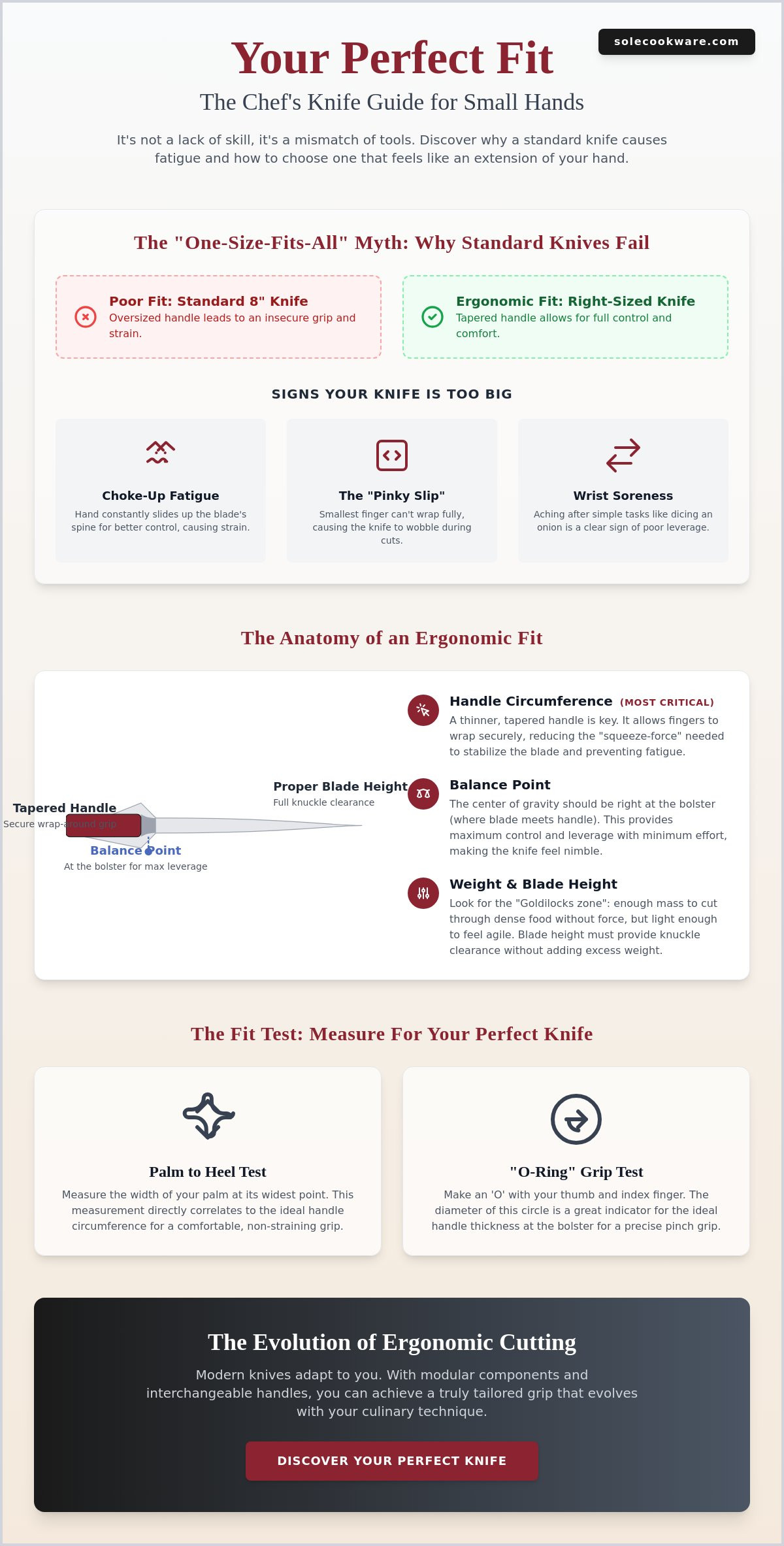
Identifying a poor fit is the first step toward better technique. Many home cooks assume they are simply "bad at chopping" when the culprit is actually the handle circumference. You can spot a mismatch by looking for these specific physical cues:
- Choke-up fatigue: You find your hand constantly sliding forward onto the blade spine to find stability.
- The "pinky slip": On oversized handles, your smallest finger can't wrap fully around the base, causing the knife to wobble during downward strokes.
- Wrist soreness: A sharp or dull ache after simple tasks, like dicing a single onion, is a clear sign of poor leverage.
A knife that is too large isn't just a nuisance. It's a genuine safety hazard. When your grip is insecure, the blade is more likely to twist or roll during a cut. This lack of control is how accidents happen. Choosing a chef knife for small hands ensures that the center of gravity remains under your command at all times. Professional performance should never come at the cost of your physical well-being. By focusing on the ratio of your palm size to the handle's girth, you can achieve a level of precision that a standard 8-inch blade simply cannot provide.
The Anatomy of Fit: What to Look for in a Chef Knife for Small Hands
Finding the right fit is about more than just reducing the length of the steel. It's a precise calculation of geometry and physics. While many retailers suggest a shorter blade is the only solution, the handle circumference is actually the most critical factor for control. A thinner, tapered handle allows your fingers to wrap securely around the grip. When a handle is too thick, your hand remains in a partially open, strained position. This leads to early fatigue. By choosing a chef knife for small hands with a slender profile, you reduce the "squeeze-force" required to keep the blade steady.
Balance is the next pillar of a well-fitted tool. The center of gravity should sit directly at the bolster, the point where the blade meets the handle. This placement provides maximum leverage with minimal effort. You also need to consider blade height. There must be enough clearance to keep your knuckles from hitting the cutting board, but excess height adds unnecessary weight. The "Goldilocks zone" for weight is a blade that feels agile and light enough to move quickly, yet possesses enough mass to slice through dense vegetables without forcing you to push down.
Handle Shape and Material Matters
The silhouette of the handle dictates your endurance. Traditional Western handles are often contoured but can be quite bulky for petite palms. In contrast, Japanese-style Wa-handles offer a minimalist, octagonal shape that provides multiple points of contact for a secure grip. Understanding Knife Handle Ergonomics 101 can help you visualize how different diameters interact with your hand's anatomy. Modern science shows that knife handle ergonomics directly impacts how long you can work before your muscles signal for a break. Look for textured materials that offer high friction without a rough finish to maintain a secure grip with less effort.
Balance and the Pinch Grip
The way you hold the knife is just as important as the knife itself. Most professionals use a pinch grip, holding the blade between the thumb and forefinger at the bolster. A chef knife for small hands should feature a tapered bolster to make this grip feel natural rather than forced. A forward-balanced knife actually helps you by using gravity to drive the edge through food. While the 8-inch blade is famous, many home cooks find that a 6-inch to 7-inch blade is the true sweet spot for maneuverability. For those seeking a truly customized experience, exploring ergonomic handle designs can help you find that elusive, perfect diameter.
Top 5 Chef Knives for Small Hands in 2026: A Comparative Roundup
Selecting the right tool involves balancing personal style with physical requirements. In 2026, the market has shifted away from simply "shrinking" standard knives. Instead, the best options now focus on intentional handle geometry and weight distribution. Finding a chef knife for small hands means looking for a tool that feels like an extension of your own reach. Here are the top five contenders that define the current landscape of ergonomic excellence.
- The Cardinal Chef Knife: This is the premier choice for those who refuse to choose between comfort and professional power. It features a unique handle-to-blade ratio that maximizes leverage.
- The 6.5-Inch Precision Blade: This shorter length is perfect for tight workspaces. It offers an ultra-lightweight feel that makes quick prep work effortless.
- The Japanese Santoku: With a flatter edge and a thinner spine, this style is ideal for vertical chopping. It suits cooks who find the rocking motion of a Western blade cumbersome.
- The Tapered-Handle Classic: This pick maintains the traditional Western aesthetic. However, it incorporates a much thinner grip to prevent hand fatigue during long sessions.
- The Modular Handle Option: A true innovation for 2026. These knives allow you to swap components to find the exact circumference that fits your palm perfectly.
The Cardinal Chef Knife: A Masterclass in Control
The Cardinal Chef Knife stands out because it was born from a specific need. Traditional tools often ignore the ergonomic reality of petite users. This female-founded design bridges that gap by prioritizing a slender grip and a balanced bolster. It's a chef-designed tool that brings professional precision to the home kitchen. The handle is crafted to encourage a proper pinch grip without forcing your fingers into an awkward stretch. It's about mastery. When you use a chef knife for small hands that was built with this level of intentionality, your technique improves naturally.
Comparison of Blade Geometry: Chef vs. Santoku
The curve of your blade dictates how you move. A traditional chef knife features a belly curve, which is designed for a rocking motion. This is highly efficient for mincing herbs but can feel unstable if the knife is too long for your arm's natural sweep. A Santoku, however, has a straighter edge. It's built for push-cutting, a motion that many people with smaller hands find easier to control. Weight distribution also plays a role here. Japanese-style blades are often lighter and harder, reaching 60-62 on the Rockwell Scale. Western-style blades are typically heavier and more durable. Your choice should reflect whether you value surgical precision or all-purpose toughness.
The Fit Test: How to Measure Your Hand for the Perfect Knife
Precision in the kitchen begins with a tool that respects your anatomy. You wouldn't wear shoes that are two sizes too large, yet many cooks struggle with a chef knife for small hands that is physically overwhelming. To find your ideal match, you need a repeatable way to measure fit. This isn't about guesswork. It's about data.
The "Palm to Heel" measurement determines handle length. Place your hand flat on a table and measure from the base of your palm to the tip of your middle finger. For most petite hands, this is typically between 6 and 7 inches. Your knife handle should offer enough real estate for a full grip without excess material protruding past your palm. Excess length can throw off the balance and catch on your clothing during quick movements.
Next, perform the "O-Ring" test to evaluate circumference. Form a circle with your thumb and index finger as if you're holding a small coin. A handle that's too thick will force this "O" to break or feel strained. You want a diameter that allows your fingers to touch comfortably. This ensures you aren't over-taxing your forearm muscles just to maintain a hold.
Finally, check for knuckle clearance and the balance point. Place the knife on a flat cutting board. If your knuckles hit the board while holding the handle, the blade height is insufficient. Lift the knife and place your index finger under the bolster. The knife should stay level. When these factors align, the tool seems to disappear in your hand. You can find this level of harmony by exploring The Cardinal Chef Knife, which was designed specifically to accommodate these ergonomic nuances.
Measuring Your Grip Circumference
To get a technical read on your needs, use a simple piece of string. Wrap it around your hand as if you're gripping a handle, then measure the string against a ruler. This gives you your ideal grip diameter. Most standard knives offer a one-size-fits-all approach that fails non-standard hand sizes. This is where modular handles become a game-changer. By choosing tools with interchangeable handles, you can select the specific circumference that matches your string measurement exactly.
Testing the Pinch Grip Comfort
A common mistake people make in stores is gripping a knife like a hammer. Instead, use a professional pinch grip. If the bolster feels too thick or sharp against your thumb and forefinger, it will cause blisters during long prep sessions. A proper fit provides an "extension of the arm" feeling. The knife should move where you look without a conscious thought about the weight. When the tool fits, the joy of cooking returns because you're no longer fighting your equipment.
Why the Cardinal Chef Knife is the Evolution of Ergonomic Cutting
Standard kitchen tools are frequently designed with a "one size fits most" mentality that actually fits very few. When manufacturers do address petite users, they often produce "mini" or "budget" versions that lack the steel quality of their full-sized counterparts. The Cardinal Chef Knife represents a departure from this trend. It's a professional-grade chef knife for small hands that refuses to compromise on materials or performance. It provides the same surgical sharpness found in elite kitchens but in a form factor that respects your anatomy.
Designed by a trained chef who experienced the limitations of standard equipment firsthand, this tool prioritizes the physical relationship between the cook and the blade. It's a product of a female-founded brand dedicated to inclusive design. By focusing on the nuances of grip and leverage, the Cardinal ensures that high-carbon steel is accessible to everyone, regardless of hand size. The inclusion of modular components and interchangeable handles means this isn't just a purchase; it's a long-term investment in your craft. You can swap grips as your technique evolves, ensuring a perfect fit for a lifetime of use.
Precision Meets Comfort
True comfort is found in balance. The Cardinal's weight distribution is engineered to feel centered and stable, which helps reduce the physical effort required for every slice. This thoughtful design allows for longer prep sessions without the typical aches associated with oversized handles. Beyond the physics, there's the aesthetic of functional beauty. Your tools should inspire you. With its sleek profile and replaceable knife components, this is designed to be the last chef knife you'll ever need to buy. It's built for longevity, precision, and the quiet confidence that comes from using a master-grade tool.
Invest in Your Culinary Confidence
There is a profound link between the quality of your tools and the joy you find in daily cooking. When a knife fits perfectly, meal prep stops being a chore and becomes a rhythmic, satisfying process. You gain the confidence to tackle complex recipes because you know your equipment won't fail you. The right tool removes the physical barriers to creativity and lets your skills shine. Finding a chef knife for small hands that actually performs at a professional level changes your entire perspective on time spent at the cutting board. If you're ready to feel the difference that intentional design makes, it's time to experience the Cardinal Chef Knife for yourself.
Reclaim Your Culinary Potential
Mastery in the kitchen isn't just about practice. It's about the silent harmony between your hand and your tools. You've learned that a successful grip depends more on handle circumference and balance than just blade length. By applying the "Palm to Heel" and "O-Ring" tests, you can stop guessing and start dicing with professional precision. Finding a chef knife for small hands shouldn't be a compromise between power and comfort. It's an essential step toward fatigue-free cooking.
We've focused on creating chef-designed tools that prioritize the home cook's experience. As a female-founded brand, we believe in inclusive design that accommodates every palm size. Our commitment to quality includes replaceable components and interchangeable handles, ensuring your knife remains a reliable partner for a lifetime of service. You deserve equipment that feels like a natural extension of your arm. Find your perfect fit with the Cardinal Chef Knife and experience the satisfaction of a truly balanced tool. Your best meals are waiting just beyond the right grip.
Frequently Asked Questions
Is a 6-inch chef knife too small for everyday cooking?
A 6-inch blade is not too small; it is often the perfect utility size for home cooks who find 8-inch blades unwieldy. While it has less surface area for massive prep, it handles 90% of daily tasks like dicing vegetables or trimming proteins with greater precision. It offers a sense of control that larger knives can't match for people with a shorter reach.
Can a chef knife with a small handle still be well-balanced?
A well-designed chef knife for small hands achieves balance by matching a lighter handle with a thinner, more agile blade. The center of gravity should still sit at the bolster to ensure the tool doesn't feel blade-heavy or butt-heavy. Proper engineering allows a slender grip to provide the same leverage as a bulkier one without requiring extra muscle force.
What is the best knife handle material for people with small hands?
Textured materials like G-10, Micarta, or high-quality resins are ideal because they provide a high-friction surface. A secure, non-slip texture is crucial when you have less palm surface area to grip the tool. It means you don't have to squeeze as hard to maintain control, which reduces muscle fatigue during long prep sessions. Look for matte finishes for better tactile feedback.
How do I know if my hand is considered "small" for a standard knife?
You likely have smaller hands if your fingers cannot comfortably overlap your thumb when wrapping around a standard handle. Another sign is the pinky slip, where your smallest finger loses contact with the grip or hangs off the end. If you find yourself constantly choking up on the blade to feel secure, it's a clear signal you need a more tailored fit.
Are Santoku knives better than chef knives for petite hands?
Santokus are often lighter and shorter, but their suitability depends on your preferred cutting motion. They are excellent for vertical push-cutting, but they lack the belly curve required for rocking cuts. A chef knife for small hands with a 7-inch blade offers the same maneuverability as a Santoku while retaining the versatility of a curved edge for mincing herbs and aromatics.
Does a lighter knife mean it is lower quality?
Weight is a design choice rather than a quality metric. High-performance Japanese steel is often significantly lighter than traditional German steel because it is harder and can be forged thinner. A lighter knife allows for faster, more precise movements without sacrificing the edge's durability or sharpness. Modern professional blades prove that agility is a hallmark of premium craftsmanship and intentional design.
How does handle shape affect wrist pain in the kitchen?
Handle shape dictates your wrist alignment during every cut. If a handle is too bulky or improperly contoured, it forces your wrist into an unnatural angle to maintain a grip. This tension travels up the arm and leads to chronic strain. A tapered or ergonomic handle allows for a neutral wrist position, letting the larger muscles of your arm do the work safely.
Can I use a paring knife for tasks usually reserved for a chef knife?
It's best to avoid using a paring knife for board work because it lacks the necessary knuckle clearance and leverage. While it feels safe because of its size, your knuckles will hit the board, causing the blade to tilt. Instead, choose a 6-inch or 7-inch chef knife. These sizes provide the safety of a full-height blade while remaining manageable for smaller grips.