

Have you ever wondered why a simple onion feels like a stubborn obstacle rather than a basic ingredient? Most home cooks blame their technique or their patience when a recipe feels like a struggle. You've likely felt the dull ache of hand fatigue after a long prep session. You've surely felt frustrated when your fresh vegetables look more mushed than sliced. It's easy to assume you just aren't a natural in the kitchen, but the truth is often much simpler. This is exactly why your kitchen knife matters. Your blade is the primary interface between your creative intent and the final plate.
When you're inspired by the creative recipes and kitchen hacks on So Yummy, the last thing you want is a dull blade holding you back from achieving those professional results at home.
You deserve to feel capable every time you step to the counter. The right tool transforms cooking from a daily chore into a precise, confident, and joyful craft. We'll explore how professional-grade balance and ergonomic design lead to faster meal prep and better-looking dishes. You'll learn how to move beyond the fear of a slipping blade and start feeling like a real cook in your own home. It's time to stop fighting your tools and start enjoying the process of creation.
Key Takeaways
- Learn how a reliable blade reduces the mental effort of cooking, allowing you to focus on the joy of the recipe rather than the struggle of the cut.
- Understand the science of food preservation and how a sharp edge keeps your ingredients vibrant by preventing juice loss.
- Discover why your kitchen knife matters as a natural extension of your hand that eliminates physical strain and builds intuitive confidence.
- Gain a practical checklist to evaluate blade construction so you can distinguish between tools built for longevity and those that will fail over time.
- Explore how professional-grade precision can be adapted for the home kitchen to elevate your daily meal preparation into a masterful craft.
The Psychology of the Blade: How a Knife Transforms Your Cooking Experience
The kitchen is a place of immense potential, yet for many, it feels like a daily battlefield. You stand at the counter with a pile of fresh vegetables and a dull, flimsy "supermarket" blade that feels more like a toy than a professional tool. This frustration is valid. You aren't bad at cooking; you are simply using equipment that works against you. The Chef's knife is the most vital instrument in your culinary kit. It's the primary bridge between your creative intent and the final dish. When you truly understand why your kitchen knife matters, you stop fighting against your ingredients and start working with them.
Consider the mental energy required for a complex recipe. You have to time the stove, balance delicate flavors, and follow multi-step instructions. If you're also worried about your knife slipping or struggling to push through a simple onion, your "cognitive load" spikes. A reliable tool carries that weight for you. It allows your mind to stay on the creative process rather than the physical struggle. You move from a state of stress to a state of flow. The process becomes methodical and calm.
From Chore to Craft: The Confidence Connection
Precision creates predictable results. When every slice is uniform, your food cooks evenly and looks professional. This consistency is the foundation of mastery. Many home cooks suffer from the "fear factor" without even realizing it. You hesitate because you don't trust the blade to go where you direct it. A poor knife requires excessive force, and that's exactly when accidents happen. Cooking confidence is the intersection of skill and reliable equipment. Once you trust your tool, the act of preparation shifts from a tedious chore into a rewarding craft.
Why Sharpness is Only Half the Story
A sharp edge is essential, but balance and weight are the silent partners of a great blade. Cheap knives often require a "hacking" motion. You're using brute strength to force the metal through the food, which leads to fatigue and "mushed" results. A high-quality tool encourages a natural "slicing" motion. The weight of the knife does the heavy lifting for you. This physical relationship between the user and the object is what professionals rely on during twelve-hour shifts. Bridging the gap between pro-gear and the home kitchen isn't about chasing luxury. It's about essentiality. It's about knowing why your kitchen knife matters for your own long-term success at the cutting board.
Precision, Flavor, and Science: Why the Quality of Your Cut Matters
Most home cooks view a knife simply as a way to make big things smaller. In reality, your blade is a scientific tool that directly dictates the flavor and texture of your meal. A clean cut does more than just look nice; it preserves the structural integrity of your ingredients. This is why your kitchen knife matters for the actual chemistry of your cooking. When you use a high-quality edge, you aren't just prepping; you're protecting the essence of your food.
We often forget that we eat with our eyes first. A dish featuring uniform, sharp edges looks intentional and professional. It signals a level of care that transforms a standard weeknight dinner into a refined experience. Beyond aesthetics, the quality of your cut determines how seasoning and sauces adhere to your ingredients. Smooth surfaces created by a sharp blade allow for even coating, while jagged, crushed surfaces absorb salt and acid unevenly, leading to a muddled flavor profile.
The Science of the Slice: Protecting Cellular Integrity
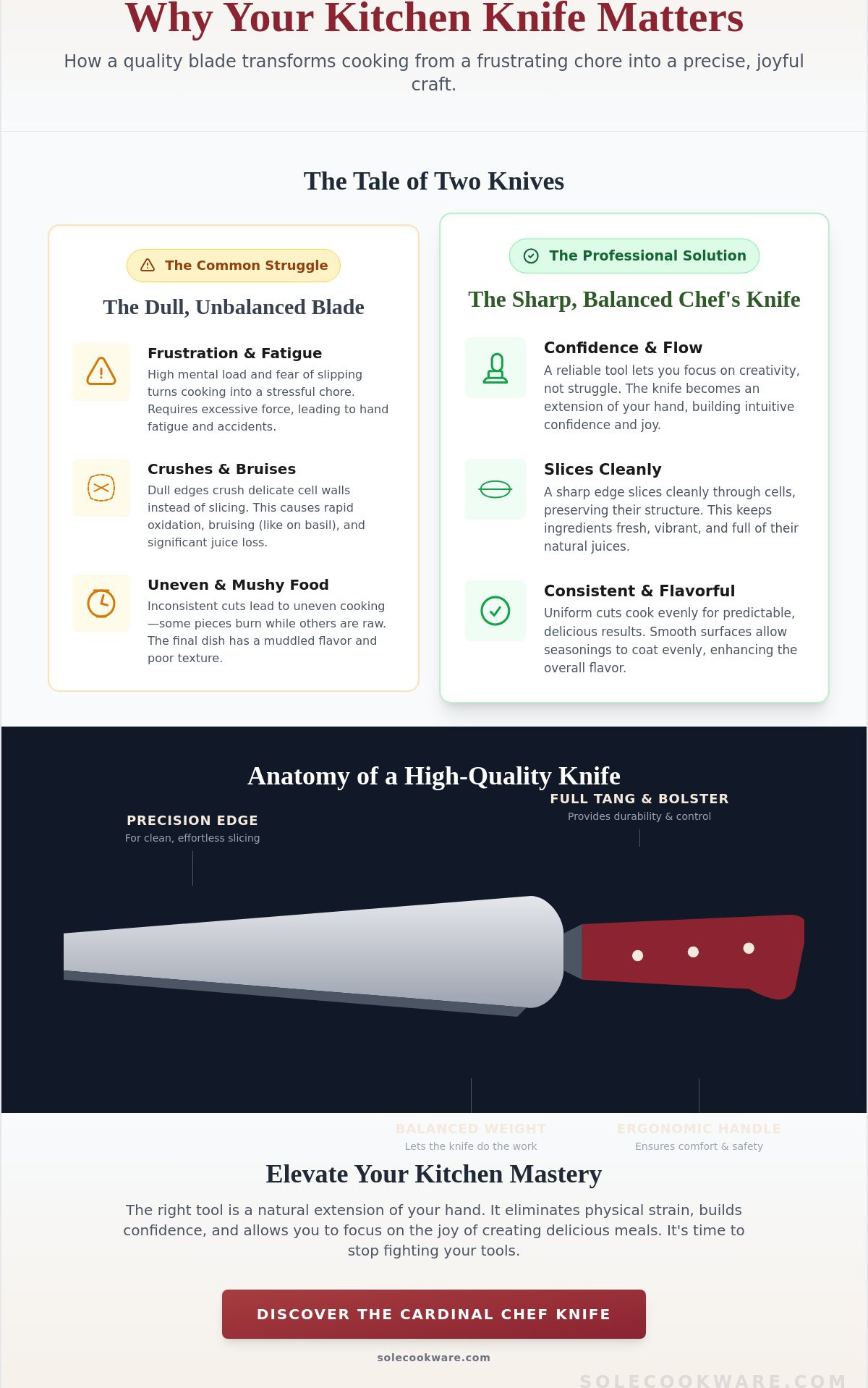
Every vegetable and piece of meat is composed of delicate cells. When a blade is dull or poorly made, it doesn't actually slice through these cells; it crushes them. This "cellular damage" is the primary reason why fresh herbs like basil often turn black and bruised shortly after they're chopped. A dull edge causes rapid oxidation by rupturing the cell walls and exposing the enzymes to air. By using a precise tool, you keep the juices inside the food where they belong. Your tomatoes stay firm, your onions stay crisp, and your steak retains the moisture that makes it tender.
Uniformity and Heat: The Key to Consistent Results
Consistency is the hallmark of a great cook. Imagine roasting a tray of carrots where some pieces are thick chunks and others are thin slivers. By the time the thick pieces are tender, the thin ones are burnt. This creates a dish that is frustrating to eat and impossible to season correctly. Precision cutting allows for total heat control in the pan. When every piece is the same size, they all reach the perfect internal temperature at the exact same moment. Professional-grade tools, such as the Cardinal Chef Knife, make this level of uniformity achievable even for beginners. This mastery over the physical shape of your ingredients is why your kitchen knife matters for achieving a balanced, predictable result every time you light the stove.
Ergonomics and the 'Extension of the Hand' Philosophy
A knife shouldn't feel like an external object you are merely holding. It should feel like a natural extension of your arm. When you achieve this level of physical synergy, your movements become fluid and your cuts become intuitive. This seamless connection is why your kitchen knife matters for your daily experience at the cutting board. Many people assume that professional-grade ergonomics are only necessary for chefs who spend ten hours a day prepping. This is a common misconception. Even a twenty-minute meal prep session can lead to micro-strains if your tool isn't designed to support your body's natural mechanics.
Poorly designed handles force your hand into awkward, cramped positions. You find yourself gripping the knife too tightly to compensate for a lack of balance. This tension travels up your arm, leading to hand fatigue and wrist strain. You shouldn't have to manhandle your ingredients. A tool with intentional design does the work for you, allowing you to maintain a light, controlled touch. This is where the transition from a generic blade to a precision tool becomes most apparent. You stop gripping for dear life and start guiding with ease.
Solving the Strain: Why Handle Shape Impacts Wrist Health
The most effective way to control a blade is the "pinch grip." You choke up on the knife, gripping the base of the blade between your thumb and forefinger. A well-designed bolster supports this grip naturally, providing a comfortable resting point that prevents your fingers from slipping. This placement creates a perfect fulcrum; it's the balance point that allows the knife to rock effortlessly. By prioritizing ergonomic design, you protect your long-term wrist health. You reduce the repetitive stress that leads to discomfort, making every cooking session a pleasure rather than a physical tax.
The Lightweight Advantage for Home Cooks
There is a persistent myth that a heavy knife equals high quality. This simply isn't true. While some weight can help with heavy-duty tasks, excessive mass often leads to a loss of control during intricate work. A lighter, balanced knife offers superior maneuverability for tasks like dicing shallots or trimming herbs. This is particularly vital for cooks with smaller or petite hands who often find traditional knives cumbersome. Tools like the Cardinal Chef Knife address this by offering Interchangeable Handles, ensuring the grip fits the user perfectly. When the handle matches the hand, you gain a level of mastery that a one-size-fits-all knife can never provide. This personalized fit is another reason why your kitchen knife matters for building true cooking confidence.
The Anatomy of a High-Quality Chef Knife for Home Cooks
Understanding the physical build of your tool is the next logical step in realizing why your kitchen knife matters for your long-term culinary success. You don't need to be a metallurgist to spot quality. You simply need to know what a professional-grade tool looks like under the surface. A chef-designed knife isn't just about a brand name; it's about intentional engineering that supports every slice you make. When you evaluate a knife, look for these four markers of integrity:
- Full Tang Construction: The steel of the blade should run through the entire length of the handle. This provides essential strength and prevents the tool from snapping under pressure.
- Forged over Stamped: Forged knives are hammered from a single bar of steel, creating a denser grain structure. They are significantly more durable and hold a sharper edge than knives stamped out of a flat sheet.
- A Tapered Bolster: This is the thick transition point between the blade and the handle. It should feel smooth and provide a comfortable resting spot for your fingers.
- High-Quality Steel: The metal should be hard enough to stay sharp but resilient enough to avoid chipping during standard use.
Materials and Craftsmanship: Beyond the Surface
The choice of metal dictates how often you'll need to maintain your edge. High-carbon steel is the gold standard for professionals because of its exceptional edge retention. Standard stainless steel is rust-resistant, but it often loses its sharpness quickly. You might see the term "HRC" on a product description. This stands for the Rockwell Hardness Scale, which measures the steel's resistance to deformation. A higher HRC number means the knife stays sharp longer. Forged knives offer superior durability because the hammering process aligns the internal structure of the metal. This craftsmanship ensures your tool remains a reliable partner for years rather than months.
Balance and Weight: Finding Your Perfect Match
Balance is the secret to a knife that feels weightless in your hand. You can test this yourself with the "finger balance test." Place your index finger under the bolster where the blade meets the handle. A well-balanced knife will stay relatively level. This center of gravity is crucial because it dictates how the knife rocks during a chop. If the knife is too heavy in the blade, it feels clunky. If it's too heavy in the handle, it feels sluggish. This is why your kitchen knife matters when you are aiming for effortless precision. Modern innovation has introduced the benefit of modularity to the kitchen. You can now customize your experience by choosing The Cardinal Chef Knife with Interchangeable Handles. This allows you to adjust the weight and grip to suit your specific hand size and preference, ensuring your tool remains perfectly balanced for your unique needs.
Elevating Your Kitchen Mastery with the Cardinal Chef Knife
Mastery in the kitchen is often seen as a distant goal. It feels reserved for those with years of professional training. Sole Cookware was founded to change that narrative. Our chef-founder recognized a significant gap between intimidating pro-gear and flimsy, supermarket alternatives. The Cardinal Chef Knife was born from this vision. It serves as the bridge between professional precision and the practical needs of the home cook. This intentional design is why your kitchen knife matters for your daily progress. It isn't just about cutting food. It's about empowering the person holding the handle.
As a female-founded brand, we prioritize functional beauty. We believe a tool should perform flawlessly while looking like it belongs in a modern, curated home. This isn't about chasing trends. It's about perfecting the fundamentals. We focus on the physical relationship between you and the blade. Every curve of the Cardinal is designed to feel natural and supportive. You aren't just buying a knife; you're investing in a mentor that guides your hand through every recipe.
Designed by a Chef, Perfected for Your Home
Professional expertise informed every millimeter of the Cardinal's shape. Chefs know that a blade's profile affects how it moves through different textures. We've optimized this geometry specifically for the everyday cook. Our focus remains on reducing hand fatigue during those long Sunday prep sessions. We don't just sell a product. We provide a functional kitchen tool that supports your growth. You'll notice the difference in how much lighter your tasks feel when the tool is designed to work with your body's mechanics.
A Tool for a Lifetime: Quality You Can Feel
Most modern products are built to be replaced. We've taken a different path. By offering Interchangeable Handles and Replaceable Knife Components, we ensure your tool grows with you. This modularity is a core part of why your kitchen knife matters as a long-term investment. You don't need a drawer full of mediocre blades. You need one exceptional tool that you can maintain and customize over a lifetime. This approach values your success and the longevity of your equipment over quick, disposable sales. It's a commitment to quality that you can feel every time the blade touches the board.
Experience the difference with the Cardinal Chef Knife and start your journey toward true culinary confidence today.
Master Your Kitchen with the Right Tools
Cooking is an act of creation that begins with a single slice. You now understand how a precise tool protects the cellular integrity of your ingredients. You know how ergonomic design preserves your long-term physical health. When you move past the struggle of dull, unbalanced blades, you reclaim your mental energy for the creative parts of a recipe. This fundamental shift is why your kitchen knife matters for your growth as a cook. It's the difference between guessing and knowing.
The Cardinal Chef Knife was built to bridge the gap between professional performance and home comfort. Chef-founded and rigorously tested, it utilizes high-quality materials to ensure you feel in total control at the board. You deserve a tool that feels like a natural extension of your own hand. It's time to stop fighting your equipment and start trusting your craft. By investing in a tool designed for maximum comfort, you're investing in your own capability.
Discover the Cardinal Chef Knife: Designed for Confidence
Step into your kitchen with a new sense of capability. Your best meals are waiting.
Frequently Asked Questions
Why is a sharp knife safer than a dull one?
A sharp knife is safer because it requires significantly less pressure to cut, which prevents the blade from slipping off the food. When a blade is dull, you're forced to use brute strength to push it through the ingredient. This extra force often leads to the knife skidding toward your fingers. A sharp edge bites into the surface immediately. This predictable behavior is a core reason why your kitchen knife matters for your physical safety.
How do I know if a chef knife is the right size for my hands?
The right size is determined by how comfortably you can maintain a pinch grip without overextending your reach or cramping your palm. If the blade feels too long, you'll lose precision during small, intricate tasks. If the handle is too thick, your hand will tire quickly. You should look for options like Interchangeable Handles. These allow you to customize the grip to your specific hand size for a secure, natural fit.
What is the most important feature to look for in a kitchen knife?
Balance is the most critical feature because it dictates how much effort you expend during prep. A well-balanced knife stays level when held at the bolster, allowing the weight of the metal to do the work for you. This synergy between the blade and handle prevents wrist strain and ensures fluid movement. While sharpness is vital, a poorly balanced knife will always feel like a struggle to use regardless of its edge.
Does the weight of a knife really affect how I cook?
Weight directly impacts your speed and the amount of fatigue you experience during a meal. A lighter, well-balanced knife offers superior maneuverability for intricate dicing and trimming. Heavy knives can feel powerful for large tasks but often lead to hand cramps during long sessions. Choosing a weight that matches your physical strength and cooking style is essential for maintaining a steady, confident pace. It's about finding a tool that supports your rhythm.
How often should I actually sharpen a high-quality chef knife?
You should hone your knife with a steel every few uses and sharpen the edge once or twice a year depending on your frequency of use. Honing realigns the microscopic teeth of the blade to keep it feeling crisp. Actual sharpening removes a small amount of metal to create a fresh edge. This maintenance schedule ensures your tool remains a reliable partner. Understanding why your kitchen knife matters means respecting the care it requires to perform at its peak.
Can a better knife really make my food taste better?
A high-quality knife improves flavor by creating clean, precise cuts that preserve the juices inside your ingredients. Dull blades crush food cells, causing moisture and essential oils to bleed out onto the cutting board. This loss of juice leads to dryer meats and bruised, oxidized vegetables. When you slice cleanly, you keep the flavor locked inside each piece. This results in a more vibrant and delicious final dish for your guests.
What is the difference between a forged and a stamped knife?
Forged knives are created from a single piece of heated steel that is hammered into shape, resulting in a stronger and denser blade. Stamped knives are cut out of a flat sheet of metal like a cookie cutter. Forged blades typically feature a bolster and a full tang, offering superior balance and longevity. While stamped knives are often lighter and less expensive, the durability of a forged tool makes it a better long-term investment for any serious home cook.