

What if your knife felt weightless in your hand? Most home cooks believe that hand fatigue is just a natural part of the process, especially when dicing a mountain of root vegetables. It isn't. You've likely experienced that dull ache in your wrist or forearm after only fifteen minutes at the cutting board. It makes your cuts inaccurate and turns a joyful meal prep into a physical chore.
Mastering the search for a well balanced chef knife is the secret to reclaiming your kitchen confidence. A truly balanced blade doesn't fight your movement; it follows your lead with quiet, steady precision. This guide explores the physics of blade equilibrium and provides a simple test to ensure your tool feels like a natural extension of your hand. You'll learn how to see past marketing claims and find a tool that offers genuine culinary control. We're here to help you move from fighting your equipment to mastering your craft.
Key Takeaways
- Locate the center of gravity at the bolster to find a tool that moves with your hand rather than against it.
- Identify which of the three balance profiles best matches your unique cutting technique to find your perfect well balanced chef knife.
- Master a simple, safe tactile test to evaluate the equilibrium of any blade before you bring it into your kitchen.
- Reduce physical strain and eliminate the subtle wrist micro-adjustments that cause fatigue during repetitive chopping tasks.
- Explore how intentional design and ergonomic components can transform your kitchen experience from a chore into a craft.
Defining the Well Balanced Chef Knife: Beyond the Marketing Buzz
A well balanced chef knife is more than just a luxury; it's a fundamental requirement for anyone serious about their time in the kitchen. In technical terms, true balance is achieved when the center of gravity sits precisely at the bolster. This is the thick junction where the blade meets the handle. When you hold a knife with this specific equilibrium, the weight of the metal seems to vanish. It transforms from a heavy tool into a natural extension of your hand. Professional chefs prioritize this sensation because it allows for hours of work without the nagging physical resistance that a poorly made blade provides.
Many mass-produced blades found in standard block sets fail this basic test. They often feel clunky or "tip-heavy," forcing you to fight the tool with every slice. This imbalance isn't just an annoyance; it is a barrier to your culinary growth. When your tool works with you, you gain a renewed sense of culinary confidence. You stop worrying about the mechanics of the cut and start focusing on the texture and beauty of the ingredients. A balanced blade gives you the freedom to master your technique without the distraction of a tool that feels like it's working against your wrist.
The Pivot Point Principle
The bolster of a Chef's knife acts as a fulcrum during the rocking motion of chopping. If the pivot point is misplaced, your forearm muscles must constantly overcompensate to keep the blade steady. This creates unnecessary tension that radiates from your palm up to your elbow. When the weight is distributed correctly, the knife maintains its own stability. Fulcrum balance is the key to effortless slicing. By aligning the weight at the center, the knife does the heavy lifting while you simply guide the direction of the cut.
Why Balance is the Foundation of Mastery
Precision starts with stability. When you are mincing garlic into a fine paste or dicing shallots for a delicate vinaigrette, a balanced tool provides the accuracy needed for consistent, uniform results. It removes the mental drag that occurs when you're subconsciously correcting for a wobbly or uneven blade. This foundation is built on more than just the steel itself; knife handle ergonomics play a vital role in how that balance is perceived and maintained throughout the cooking process. A tool that feels right in the hand encourages you to experiment and refine your skills. It turns a daily chore into a rewarding practice of mastery and creative expression.
The Three Profiles of Knife Balance: Blade, Handle, and Neutral
The weight of a well balanced chef knife isn't a static measurement. It's a dynamic relationship between the tool and your hand. While many believe there is one "perfect" balance point, the reality is more nuanced. The ideal equilibrium depends on your specific cutting technique and the ingredients you prepare most often. Physical construction choices, such as the length of the tang or the density of the handle material, significantly shift the center of gravity. Research into an ergonomic and biomechanical approach to design suggests that how a tool interacts with your unique grip determines your long-term comfort and efficiency. Modern lightweight chef knives often achieve a neutral profile more easily because they use less total mass, making the distribution of weight more manageable for the user.
Blade-Heavy: Power for Heavy Prep
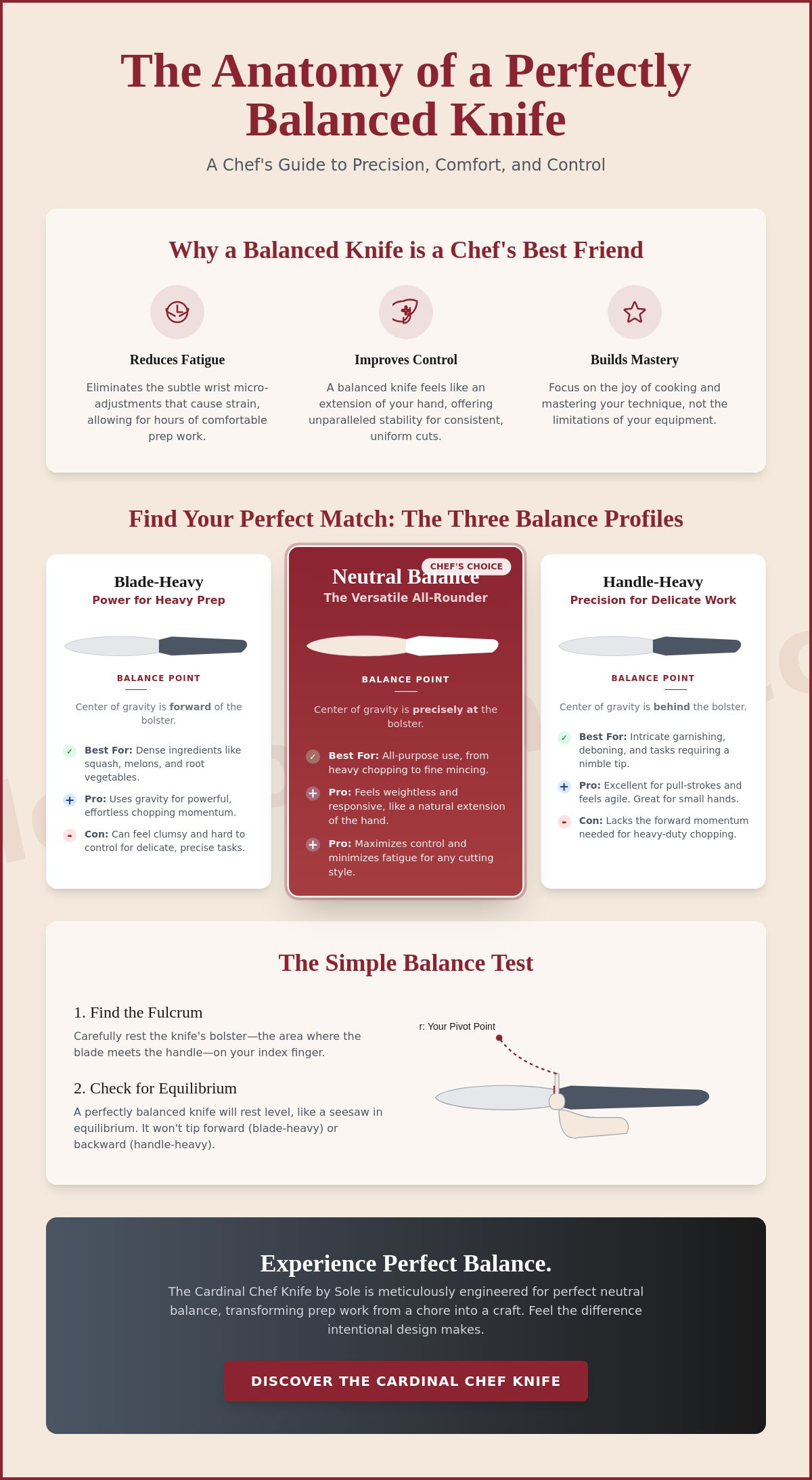
A blade-heavy knife has a center of gravity that sits forward of the bolster. This profile is common in traditional Western knives designed for heavy-duty tasks. The extra weight toward the tip provides a natural, gravity-assisted momentum when cutting through dense ingredients like butternut squash or large melons. It allows the steel to do more of the work. However, you should be cautious of excessive forward weight. A knife that is too blade-heavy can "nose-dive" during delicate tasks, making fine dicing or precise mincing feel clumsy and difficult to control.
Handle-Heavy: Precision for Delicate Work
Knives with a handle-heavy profile feel exceptionally nimble and light in the tip. This balance is often preferred by those who use a "pull" stroke rather than a rocking motion. It provides a sense of extreme control for detail-oriented tasks like deboning or intricate garnishing. This profile is frequently cited as the best chef knife for small hands because it allows the user to guide the blade with minimal wrist pressure. While it offers great agility, it may require more physical effort from the user when tackling tougher, larger vegetables.
Neutral Balance: The Versatile All-Rounder
Neutral balance is the "sweet spot" for the vast majority of home kitchen tasks. In this profile, the weight is distributed so evenly that the knife feels like a natural extension of your arm. It offers enough power for chopping while maintaining the agility needed for fine work. The Cardinal Chef Knife is engineered to achieve this versatile equilibrium, providing a reliable foundation for any recipe. If you only want one "do-it-all" tool in your drawer, a neutral balance is the most logical choice. You can further customize this feel by exploring interchangeable handles to find the exact grip that suits your palm.
How to Test Your Knife's Balance at Home: A Step-by-Step Guide
You don't need a laboratory to find a well balanced chef knife. You just need a steady hand and a few moments of focus. Most people choose a tool based on how it looks in a showroom or how heavy it feels in the box. The real truth reveals itself when you isolate the center of gravity. Testing your equipment at home allows you to understand why certain tasks feel like a struggle while others feel effortless. It's about moving beyond guesswork and relying on the tactile feedback of your own hands.
Safety is the primary concern when performing these evaluations. Before you begin, it's helpful to review Ten Safe Handling Hints for Knives to ensure you're following best practices. Always conduct these tests over a stable, soft surface like a large wooden cutting board. This protects the blade if it slips and keeps your workspace secure. Gather every knife you currently own so you can compare the weight distribution between different styles and brands.
The Bolster Balance Test
The bolster test is the most direct way to find the physical center of a blade. Follow these steps to evaluate your tool:
- Step 1: Place your index finger horizontally under the bolster. This is the thick area where the steel blade meets the handle material.
- Step 2: Slowly release your other hand while keeping your index finger steady. Watch the movement of the knife closely.
- Step 3: Evaluate the result. A perfectly balanced knife will stay level on your finger without tipping.
If the tip dives toward the cutting board, the knife is blade-heavy. If the handle slides toward your palm, it's handle-heavy. This test identifies the static equilibrium of the tool before you even start chopping.
The Pinch Grip Alignment Check
The static test shows the physics, but the alignment check shows the reality of your technique. Hold the knife in a professional pinch grip by placing your thumb and forefinger directly on the blade just past the bolster. This is how most chefs maintain control during high-speed prep. Pay close attention to the sensation in your palm. Does the knife feel like it wants to rotate or twist out of your hand? If the handle feels like it's pulling away, the balance is working against your natural grip. You're looking for a sensation of stillness. A well balanced chef knife should feel like a natural extension of your arm, requiring zero effort to keep it perfectly aligned with your target.
The Ergonomic Impact: How Balance Prevents Wrist Fatigue and Injury
Many home cooks believe that ergonomic design is a luxury reserved for professional kitchens. They assume that because they only spend fifteen minutes dicing onions, the balance of their blade doesn't matter. This is a common misconception. Even ten minutes of repetitive motion can lead to cumulative strain if your tool is fighting your hand. A well balanced chef knife acts as a partner in your prep work, whereas an unbalanced one creates a "kickback" effect. This occurs when the wrist must make constant, microscopic adjustments to keep the blade level. These tiny corrections might seem insignificant in the moment, but they add up to significant fatigue by the time the meal is ready.
The relationship between weight and balance is often misunderstood. A physically heavy knife can actually feel lighter than a stamped, lightweight blade if the weight is distributed perfectly. When a tool is balanced, the work shifts from the delicate joints of the wrist to the larger muscle groups of the shoulder and elbow. This mechanical advantage allows you to drive the cut with your entire arm, protecting your smaller joints from premature wear. You'll find that you don't need to press down as hard because the tool's own equilibrium assists the downward motion.
Reducing Counter-Leverage Strain
Counter-leverage occurs when a blade-heavy knife pulls the tip downward, forcing your hand to pull upward to compensate. This constant tug-of-war is the primary cause of "Chef’s Wrist" and can aggravate existing conditions like carpal tunnel syndrome. By choosing a tool with a centered pivot point, you eliminate this unnecessary resistance. A well-balanced knife doesn't just cut food; it protects the person holding it. Investing in a tool designed with these principles ensures that your passion for cooking isn't sidelined by preventable physical discomfort.
The Psychology of a Secure Grip
Balance also plays a critical role in your mental state at the cutting board. When a knife feels unstable, most users instinctively over-grip the handle, a phenomenon known as "white knuckle" syndrome. This excessive tension makes your movements jerky and increases the risk of the blade slipping. A secure, balanced feel allows for a more relaxed, professional cutting technique. You'll find that you can maintain a light but firm touch, which significantly improves your accuracy and speed. To experience the difference that professional-grade equilibrium can make, consider the Cardinal Chef Knife for your next kitchen upgrade. It's designed to provide the stability you need for a truly effortless prep experience.
Mastering Balance with the Cardinal Chef Knife: Chef-Designed Precision
This chef knife represents the culmination of every ergonomic principle we've explored. It isn't just another piece of cutlery. It's a tool born from professional kitchens but refined specifically for the home environment. Because our brand, Sole Cookware, is female-founded and chef-designed, we focused on "real-world" balance that accounts for the variety of tasks a home cook faces daily. We understand that you aren't just dicing for speed; you're cooking for family, for health, and for the joy of the process. Finding a well balanced chef knife that accommodates these realities is essential for long-term culinary enjoyment. We want to help you transition from merely using a knife to truly mastering a tool.
Most mass-produced knives are designed for the average, which often means they fit no one perfectly. Our design philosophy rejects this compromise. By prioritizing the physical relationship between the user and the object, we've created a blade that feels intuitive from the first slice. This sense of capability is what allows a cook to move from following a recipe to expressing their own creativity. When the tool disappears into the hand, the focus remains entirely on the ingredients and the technique.
The Ergonomics of Our Chef Knife's Handle
The handle of this chef knife is a study in functional beauty. Its specific contouring promotes a natural pinch grip, placing your hand in the most powerful and stable position. We didn't choose the handle material and weight by accident. Every component was carefully calibrated to achieve a neutral balance point that sits right at the bolster. This ensures the knife doesn't feel tip-heavy or sluggish in the back. The aesthetic appeal of the knife is a natural byproduct of this intentional design. It looks professional because it is built to perform with quiet, steady confidence.
Modular Design and Customizing Your Control
Traditional fixed-handle knives offer zero flexibility. If the balance doesn't suit your hand size or grip style, you're forced to adapt to the tool. Sole Cookware's modular system flips this dynamic through modularity. By offering interchangeable handles and replaceable knife components, we empower you to personalize your tool. This is a significant advantage for home cooks who have previously struggled with standard "one size fits all" equipment. Whether you need a different grip texture or a specific weight distribution, these modular parts ensure your well balanced chef knife remains a high-performing asset for years to come. You can maintain the integrity of your tool as your skills evolve. Experience the perfect balance of Sole Cookware's chef knife today.
Master Your Craft with the Perfect Balance
Finding a well balanced chef knife is more than a technical upgrade; it's a commitment to your own culinary growth. You've learned that true equilibrium sits at the bolster and that a neutral profile offers the most versatility for your daily prep. By understanding the physics of your tools, you move from fighting resistance to enjoying the rhythmic flow of the kitchen. You don't have to accept wrist fatigue as a side effect of a good meal. Proper ergonomics and intentional design ensure that every cut is precise, safe, and entirely within your control.
At Sole Cookware, we've poured professional expertise into creating a tool that supports your journey toward mastery. As a female-founded brand, we're dedicated to helping home cooks find the same precision that professionals rely on every day. Our chef-designed blade is ergonomically tested to reduce hand fatigue, allowing you to focus on the joy of creating. It's time to equip yourself with a tool that feels like a natural extension of your hand. Discover the Precision of the Cardinal Chef Knife and experience the difference of a truly balanced blade. Your next masterpiece begins with a single, effortless slice.
Frequently Asked Questions
Is a heavier knife better for balance?
No, weight and balance are distinct qualities that interact to create the tool's feel. A heavy knife can feel remarkably agile if its center of gravity is correctly positioned. Conversely, a lightweight blade can feel clumsy and difficult to control if the weight is distributed poorly. You should look for a tool that feels stable in your hand rather than focusing solely on its mass.
Where should the balance point of a chef knife be located?
The ideal balance point for most tasks is at the bolster. This is the junction where the blade meets the handle material. When the center of gravity sits here, the knife acts as a neutral lever. This placement allows for a fluid rocking motion and reduces the effort required to lift the tip during repetitive dicing.
Can a poorly balanced knife cause wrist pain?
Yes, an unbalanced tool forces your wrist to compensate for the blade's natural tendency to tip. These constant micro-adjustments create tension in the forearm and can lead to repetitive strain injuries. A well balanced chef knife allows the larger muscles of your arm to drive the motion, protecting the delicate joints in your wrist from unnecessary stress.
How does a pinch grip affect the balance of my knife?
A pinch grip places your hand directly over the center of gravity at the bolster. This increases your leverage and makes the blade feel like a natural extension of your arm. By choking up on the blade, you gain superior control and minimize the "wobble" often felt with a standard handle grip. It turns a good tool into a precision instrument.
What is the difference between blade-heavy and handle-heavy knives?
Blade-heavy knives have a center of gravity forward of the bolster, providing more power for gravity-assisted cuts. Handle-heavy knives feel lighter in the tip, making them more agile for intricate, detail-oriented tasks. Most home cooks find a neutral balance to be the most versatile choice for daily meal preparation. It offers a reliable middle ground for both power and precision.
Do I need a well-balanced knife if I only cook occasionally?
Yes, because even ten minutes of poor ergonomics can lead to physical discomfort. Using a balanced tool makes the cooking process more enjoyable and less of a chore. Quality equipment encourages you to practice your skills more often. You deserve a tool that supports your technique, whether you're preparing a quick weeknight dinner or a holiday feast.
How do I fix a knife that feels 'unbalanced' in my hand?
Standard knives with fixed components cannot be easily adjusted once they're manufactured. However, you can choose a modular system that offers more flexibility. The Cardinal Chef Knife features interchangeable handles and replaceable knife components, allowing you to customize the tool's feel to your preference. This modularity ensures the well balanced chef knife remains a perfect fit for your hand as your technique evolves.
Are Japanese knives more balanced than German knives?
Neither style is inherently "more" balanced; they simply prioritize different types of equilibrium. Japanese blades are often designed with a slight forward balance to assist with precise, thin slicing. German knives typically feature heavier handles and bolsters, resulting in a more neutral or handle-heavy feel. The best choice depends on whether you prefer a nimble tip or a robust, rocking motion.