

You've likely been told that a heavy knife does the work for you. It's a common belief, yet that extra mass is often the very thing holding your skills back. If you've ever finished a long meal prep session with a dull ache in your wrist or felt the blade wandering during a delicate slice, you know the frustration of a tool that works against you. A lightweight chef knife isn't a compromise on quality. It's a deliberate ergonomic choice designed to shift the burden of work from your joints to the blade's edge.
We understand that cooking should be a source of joy, not a cause of physical strain. You deserve a tool that feels safe, responsive, and natural in your hand. In this guide, we'll break down the science of why less mass leads to more mastery. You'll discover how the right balance can eliminate hand fatigue and give you the precision needed for effortless dicing and slicing. It's time to move past the heft myth and embrace a more agile, confident way to cook.
Key Takeaways
- Learn why a lightweight chef knife weighing between 5 and 7 ounces offers superior control compared to traditional heavy blades.
- Discover how high-carbon steel and thin spines provide the strength you need without unnecessary bulk.
- Understand why edge sharpness is more important than mass. It's the key to effortless slicing and reduced hand fatigue.
- Find out how to match a knife's weight to your specific hand size to prevent long-term wrist strain.
- Explore how professional design choices in the Cardinal Chef Knife prioritize balance for more confident kitchen skills.
The Weight of Mastery: Why Knife Mass Matters for Home Cooks
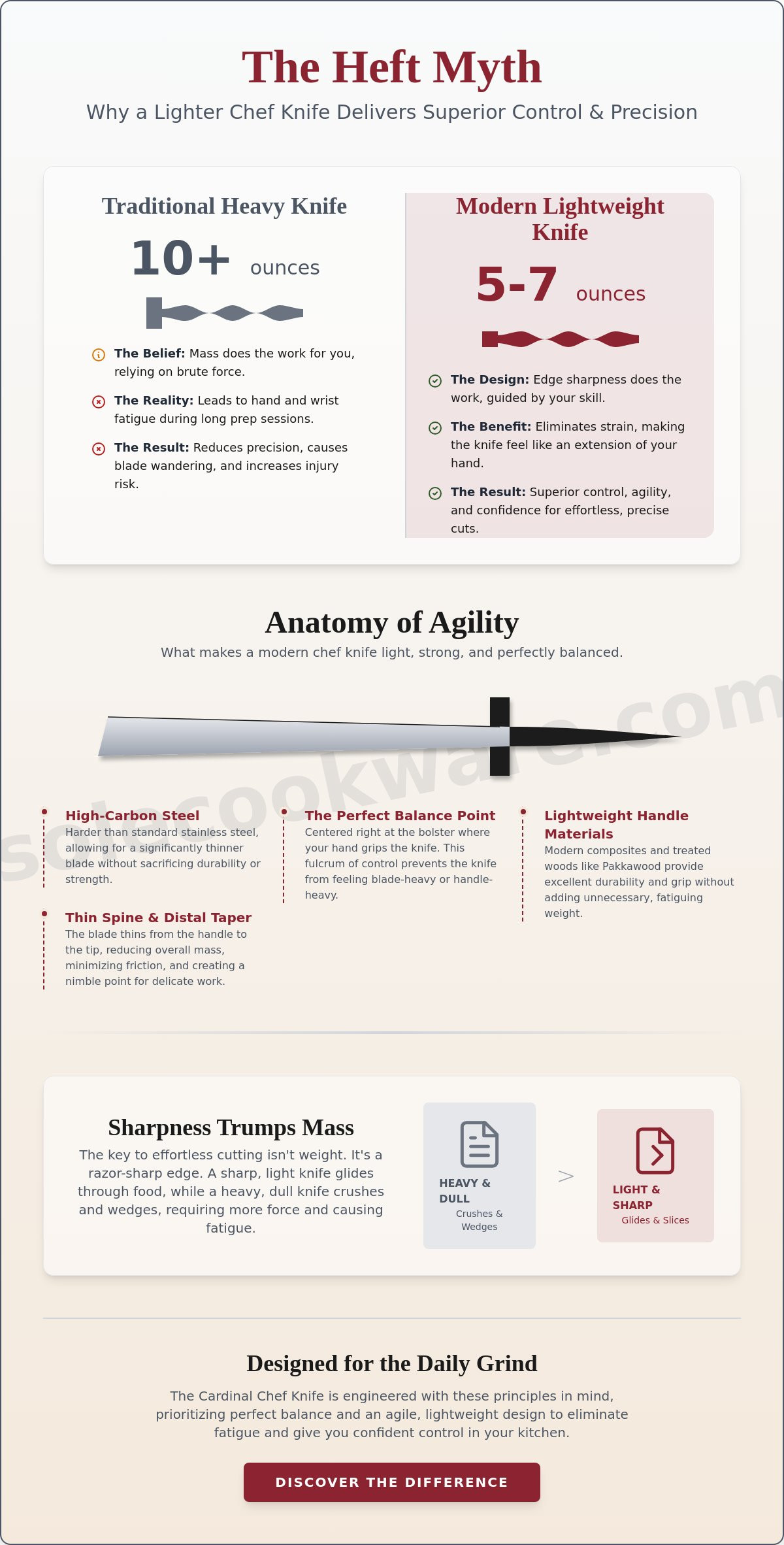
A true lightweight chef knife typically weighs between 5 and 7 ounces. This is a significant departure from traditional Western blades that often tip the scales at 10 ounces or more. For decades, the culinary world pushed the idea that a heavy blade was a superior blade. They called it "heft." They claimed that a heavy knife did the work for you. In reality, that extra mass often creates a physical barrier between the cook and the ingredient. When a tool feels cumbersome, the cook becomes hesitant. A lighter tool invites exploration. It builds immediate confidence because it responds to the slightest movement of your wrist without resistance. When your tool feels like an extension of your arm, you stop fearing the blade and start focusing on the technique.
The Cumulative Toll of Hand Fatigue
Think about a standard 30-minute meal prep session. You might make hundreds of repetitive cuts during that time. While a heavy blade feels manageable for the first few minutes, the weight adds up. This cumulative strain dulls your fine motor skills. Precision dicing becomes difficult when your hand starts to cramp or your grip begins to slip. According to the University of Rochester Medical Center, using excessive force increases the risk of kitchen injuries. A heavy, poorly balanced tool forces you to grip tighter, which leads to fatigue and a loss of control. By choosing a lightweight chef knife, you preserve your energy and your safety. You can maintain the same level of precision on the last onion as you did on the first.
Why Home Cooks Aren’t Line Chefs
Professional line chefs often prefer a "workhorse" knife for high-volume tasks. They might spend eight hours breaking down dozens of chickens or dicing ten pounds of root vegetables. Their physical needs are different from yours. At home, you switch between tasks quickly. You might mince garlic, then slice a delicate tomato, then trim a small roast. Agility is your greatest asset in a home kitchen. Modern Chef's knife construction has evolved to favor these varied, fast-paced tasks. Today's home culinary design focuses on nimbleness and speed rather than sheer crushing power. A heavy blade can be a liability when you need to move quickly and safely through a recipe. Mastery isn't about muscle; it's about the ease of the process. When you aren't fighting the weight of the steel, you can focus on the beauty of the cut.
Anatomy of Agility: What Makes a Chef Knife Genuinely Lightweight?
A truly agile tool starts with the steel. While standard stainless steel is common, it often requires a thicker blade to maintain structural integrity. High-carbon steel changes the equation. It's harder and more resilient. This allows manufacturers to forge a thinner spine without sacrificing durability. A thinner spine directly translates to less mass. When you hold a lightweight chef knife, you're feeling the results of this material precision. The reduction in thickness isn't just about weight; it's about reducing friction as the blade passes through food. It glides rather than wedges.
Handle choice is equally critical. Heavy, dense woods or solid metal handles can pull the center of gravity toward the palm. Modern composites and treated woods like Pakkawood offer a lighter alternative. These materials provide the necessary durability and grip without the anchor-like weight of traditional designs. Understanding knife handle ergonomics is vital for ensuring your tool feels secure during long prep sessions. It's about finding that sweet spot where the handle fills the hand without adding unnecessary bulk.
The Taper and the Tang
Many believe a full tang is the only way to ensure quality. While it does provide strength, a poorly designed full tang can make a knife feel sluggish. Expert bladesmiths use a distal taper to solve this. This technique thins the blade from the bolster toward the tip. It keeps the strength where you need it but lightens the front of the knife for delicate work. These are the key attributes of a quality chef's knife that separate a professional tool from a generic one. A well-executed taper ensures the tip is nimble enough for shallots while the heel remains sturdy for larger vegetables.
Balance: The Fulcrum of Control
Total weight is only half the story. Balance is the other. If a knife is blade-heavy, it feels like it's dragging your wrist down. If it's handle-heavy, you lose the "bite" at the edge. A perfect balance point usually sits right at the bolster. This creates a fulcrum that makes the knife feel like a natural extension of your hand. You don't have to fight the tool to keep it level. This distribution of weight is why the Cardinal Chef Knife feels so intuitive from the first slice. It rewards your technique rather than demanding your strength. When the balance is right, the knife doesn't just feel lighter; it feels smarter.
The Heft Myth: Why Heavier Is Not Always Better for Precision Prep
Many cooks believe that a heavy blade is necessary for cutting power. They assume that gravity and mass will do the work for them. This is a fundamental misunderstanding of physics. In reality, cutting efficiency is driven by edge geometry and sharpness, not sheer bulk. A thick, heavy blade often wedges into dense vegetables like carrots or potatoes. A thin, lightweight chef knife glides through them. When the blade is thin, there is less surface area creating friction. This means you actually apply less force to achieve a cleaner cut.
Safety is another area where the heft myth fails. A heavier knife has more momentum. Once it starts moving, it's harder to stop. If your hand slips, that extra mass becomes a liability. A lighter tool is more responsive to your nervous system. You can make micro-adjustments in a fraction of a second. This control is a key safety feature for home cooks who might not have the forearm strength of a professional butcher. Understanding the science of knife steel reveals that modern alloys can maintain incredible strength even at a reduced weight. You don't need a heavy tool to tackle a butternut squash; you need a sharp, well-engineered edge that won't get stuck.
Lightweight vs. Heavyweight: A Comparative Framework
Traditional Western "workhorse" knives often weigh 8 ounces or more. They're designed for durability and can handle tasks like splitting a chicken carcass. However, for the vast majority of kitchen tasks, this weight is unnecessary. Japanese-style "lasers" and modern hybrids prioritize agility and extreme sharpness. These tools excel at precision work where a heavy knife feels clumsy. If you're breaking down a whole cow, reach for the weight. For everything else, the nimbleness of a lighter blade is superior. It's about choosing the right tool for the job.
The Precision Factor
Mass interferes with tactile feedback. When you use a heavy knife, the weight of the steel masks the sensation of the blade hitting the cutting board. You lose that vital connection to your ingredients. A lighter tool allows you to feel exactly what you're doing. It encourages a proper pinch grip, which is the foundation of professional knife skills. This grip shifts your control point forward, making the knife feel like a natural part of your hand. Mincing delicate herbs or creating paper-thin slices of radish becomes an intuitive process rather than a struggle against a heavy tool. When you can feel the board, you can cook with true mastery.
Choosing Your Edge: How to Match Knife Weight to Your Anatomy
Selecting the right tool requires an honest assessment of your own physical needs. A lightweight chef knife is often the best choice for those managing limited grip strength or recovering from wrist injuries. When a tool is too heavy, the muscles in your forearm must work overtime just to keep the blade level. This tension travels up the arm and can lead to long term discomfort. Before you buy, consider your daily energy levels and the typical length of your prep sessions. If you find yourself putting the knife down to stretch your hand every ten minutes, your current tool is likely too heavy for your anatomy.
Blade length also plays a significant role in how you perceive weight. An 8-inch blade is the industry standard, but it can feel like a lever that pulls your wrist forward. A 6-inch blade reduces that leverage, making the tool feel even lighter and more responsive. It's about the "swing weight." This is how the knife moves when you are actually in motion. A shorter, lighter blade allows for faster transitions between different types of cuts. It gives you the agility to move from dicing a large onion to mincing a single clove of garlic without feeling like you're over-handling the steel.
The Petite Hand Perspective
Standard professional knives are often designed with a "one size fits all" approach that favors larger hands. For many women and petite cooks, these handles are too thick to wrap the fingers around comfortably. This forced "death grip" creates tension before you even start cutting. A lightweight chef knife with a slightly narrower handle diameter allows for a more relaxed, natural grip. This ergonomic alignment is essential for maintaining control without strain. If you've struggled with bulky tools in the past, exploring a chef knife for small hands can be a transformative experience for your kitchen confidence.
Beyond the Scale: The Feel Test
Total weight is just a number on a box. To truly understand a knife, you must find its balance point. Rest the bolster on your index finger. If the knife tips sharply forward or backward, you'll be fighting that imbalance with every slice. You should also check for "hotspots." These are sharp corners or rivets on the handle that dig into your skin. A well-designed handle uses smooth transitions and thoughtful textures to keep the knife secure with minimal pressure. If you're ready to experience a tool designed for effortless balance, consider the Cardinal Chef Knife for your daily prep. It's built to feel like an extension of your hand, not a weight on your wrist.
Designed for the Daily Grind: The Sole Cookware Approach to Balance
Sole Cookware was founded on a simple realization. Most high-end kitchen tools are designed for a professional environment that doesn't mirror the reality of the home cook. A female chef's perspective was the catalyst for change. She understood that a tool shouldn't just be sharp; it must be approachable. This insight led to a design philosophy that rejects professional kitchen tropes in favor of what actually works at home. We believe a lightweight chef knife should be an ally, not a burden. It's about functional beauty. This means creating tools that look as stunning as they perform, ensuring you feel inspired every time you step into your kitchen.
Our focus is on the "daily grind." This isn't about breaking down massive quantities of protein in a windowless basement. It's about the evening meal. It's about dicing vegetables for a family soup or slicing fruit for a quick snack. These tasks require nimbleness and comfort. By prioritizing balance over sheer mass, we've created a tool that respects your energy. You shouldn't have to adapt to your knife. Your knife should be designed to support you.
The Cardinal Chef Knife: A Study in Equilibrium
The Cardinal Chef Knife represents our commitment to ergonomic perfection. We've utilized specific design features to reduce overall weight while maintaining the durability you expect from a premium tool. The ergonomic handle is shaped to provide a secure, intuitive grip, reducing the need for excessive force. One of the most innovative aspects of our design is the use of interchangeable handles and replaceable knife components. This modularity allows you to customize the tool to your specific hand size and ensures a lifetime of use. It's a sustainable approach to craftsmanship that values longevity over disposable trends.
Master Your Kitchen with Confidence
True mastery comes when you trust your own intuition. You don't need to follow "pro" standards that don't fit your body or your lifestyle. If a lighter tool makes you feel safer and more precise, then it's the right tool for you. To keep your high-quality lightweight chef knife in peak condition, remember to hand wash and dry it immediately after use. This simple habit preserves the integrity of the steel and the handle material for years to come. We invite you to explore the Sole collection and discover how a tool designed with your needs in mind can transform your cooking experience. It's time to feel empowered at the cutting board.
Master Your Craft with Agility
Choosing the right tools is the first step toward finding your flow in the kitchen. We've explored how a lightweight chef knife transforms the cutting experience by prioritizing balance and precision over sheer bulk. By reducing the mass at the spine and focusing on ergonomic handle design, you can eliminate the hand fatigue that often cuts a prep session short. Mastery isn't about working harder. It's about using a tool that respects your anatomy and responds to your touch. It's about the confidence that comes from a blade that feels like a natural extension of your hand.
As a female-founded brand, Sole Cookware focuses on precision and the practical needs of the home cook. The Cardinal Chef Knife is chef-designed to offer maximum control through its thoughtfully engineered handle and interchangeable components. This isn't just about making cooking easier; it's about making it more joyful and sustainable for years to come. You deserve a tool that empowers your skills every time you reach for the cutting board. Experience the perfect balance of the Cardinal Chef Knife and start your journey toward effortless mastery today. Your kitchen is waiting for its new favorite tool.
Frequently Asked Questions
Is a lightweight chef knife less durable than a heavy one?
A lightweight chef knife is not inherently less durable than a heavy one. Durability depends on the quality of the steel and the heat treatment process rather than the mass of the blade. High-carbon steels allow for thinner, lighter profiles that maintain exceptional edge retention and structural integrity. While they shouldn't be used as a pry bar, these knives are built to withstand the rigors of daily meal preparation for a lifetime.
How much should a lightweight chef knife actually weigh?
A standard lightweight chef knife typically weighs between 5 and 7 ounces. For comparison, traditional Western knives often exceed 10 ounces. This specific weight range provides the ideal balance of agility and strength for home cooks. It's light enough to prevent fatigue during long prep sessions but substantial enough to feel secure and balanced in your hand. The Global 8-inch model is a well known example, weighing approximately 5.5 ounces.
Are Japanese chef knives always lighter than German ones?
Traditionally, Japanese knives are lighter than German ones due to their thinner blades and harder steel. German knives were historically designed with a thick bolster and heavy spine for crushing tasks. However, modern culinary design has seen a shift toward hybrids. Many manufacturers now combine Japanese-style lightness with more forgiving steel. This evolution ensures that "German-style" no longer automatically means "heavy" in the current market.
Can a lightweight knife cut through meat and bone?
These knives excel at slicing through proteins and trimming fat with extreme precision. However, you should avoid using a thin blade to cut through thick bones or frozen foods. The edge is designed for agility and clean cuts rather than high-impact chopping. For heavy-duty tasks involving bone, a dedicated meat cleaver is the safer and more appropriate tool to protect your knife’s fine edge from chipping.
Does a lighter knife require more frequent sharpening?
Weight does not dictate how often a knife needs sharpening. Edge retention is a result of the steel's hardness and the angle of the grind. Many lightweight models use high-carbon steel that actually holds a sharp edge longer than softer, heavier stainless steel alternatives. While a thin edge might feel more delicate, its ability to stay sharp depends on your cutting surface and how well you maintain the blade between uses.
Is a lightweight knife better for beginners?
A lighter tool is often superior for beginners because it encourages proper technique and builds confidence. Heavier knives can feel intimidating and may lead to a tight grip that causes hand fatigue. A lighter blade allows a new cook to focus on their pinch grip and the rhythm of the cut without fighting the weight of the steel. This responsiveness makes the learning process safer and more enjoyable from day one.
How do I know if my current knife is too heavy for me?
You'll know your knife is too heavy if you experience a dull ache in your wrist or forearm after just fifteen minutes of prep. Another sign is a loss of precision toward the end of a task. If the blade feels like it's dragging or if you find yourself constantly readjusting your grip to find comfort, the tool is working against your anatomy. A well-fitted knife should feel like an extension of your arm.
Will a lightweight knife help with my carpal tunnel or wrist pain?
Switching to a more balanced tool can significantly reduce the repetitive strain that exacerbates wrist pain. By shifting the work from your joints to a sharp, efficient edge, you minimize the force required for every cut. While a lighter knife isn't a medical cure, it's a proactive ergonomic choice. If you struggle with carpal tunnel, a tool that requires less grip pressure can make cooking a much more comfortable experience. Always check with a medical professional regarding chronic pain.