

Most home cooks are one purchase away from never needing a bulky knife set again. It's a common misconception that more blades lead to better meals. In reality, finding the best chef knife for home cooks is about selecting a single, high-quality tool that masters every task. You deserve a blade that feels safe and balanced. You shouldn't have to endure hand fatigue or feel lost in technical jargon like Rockwell hardness while trying to prepare dinner.
We believe the kitchen is your sanctuary. It's where precision meets passion. This guide will help you choose a professional-grade chef knife that balances ergonomic comfort with the sharpest precision for the ultimate home cooking experience. We'll explore the 2026 market of hybrid blades and German durability to ensure your next tool is one you're proud to own. From understanding why Japanese steel often hits 60 on the HRC scale to finding a handle that fits your unique grip, you're about to transform your prep work into an effortless, joyful ritual.
Key Takeaways
- Master the three pillars of knife quality, edge retention, balance, and ergonomic fit, to ensure your tool performs as a natural extension of your hand.
- Distinguish between Western durability and Japanese precision to find the hybrid advantage that matches your specific cooking rhythm and technique.
- Learn why handle ergonomics are the secret to confidence, helping you avoid fatigue and the dangerous "death grip" during long prep sessions.
- Use our 5-point evaluation framework to select the best chef knife for home cooks by prioritizing high-carbon steel and essential full-tang construction.
- Discover how the Cardinal Chef Knife brings professional mastery to your kitchen through its purposeful design and interchangeable components.
Defining the Best Chef Knife for Home Cooks in 2026
A great meal begins with a single, confident cut. For most enthusiasts, the search for the best chef knife for home cooks starts with a simple desire for better results and less frustration. Your knife isn't just another kitchen gadget. It's the most essential tool you'll ever own, handling roughly 90% of all kitchen prep. When you hold a tool that's truly designed for your hand, the act of cooking shifts from a chore to a ritual.
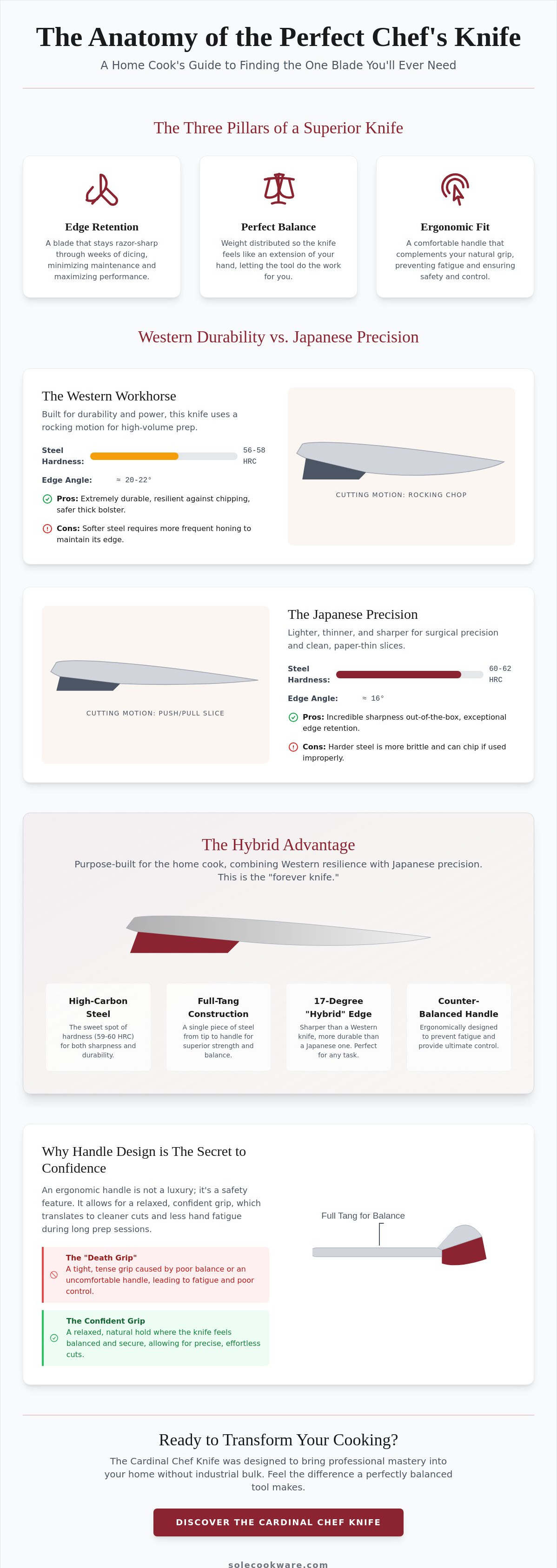
We define the "best" through three non-negotiable pillars: edge retention, balance, and ergonomic fit. Edge retention ensures your blade stays sharp through weeks of dicing. Balance means the weight is distributed so the knife does the work for you. Ergonomic fit ensures the handle complements your natural grip rather than fighting it. This transition from viewing a knife as a simple utility to an investment tool changes your entire kitchen psychology. You stop struggling with ingredients and start working with them.
Modern kitchens are evolving. We are seeing a significant shift toward chef-designed tools that prioritize the user's physical relationship with the object. This isn't about chasing trends. It's about perfecting the fundamentals of craftsmanship and longevity.
Essential vs. Overkill: What Home Cooks Actually Need
Many people believe they need a 15-piece block set to be a "real" cook. That's a myth. A single, high-quality 8-inch Chef's knife is far more effective than a dozen mediocre blades you'll never use. Professional kitchens require tools that can withstand 12-hour shifts of industrial volume. In a home setting, you need the "sweet spot" of weight and length. An 8-inch blade provides enough surface area for large vegetables while remaining nimble enough for delicate shallots. It's the ultimate best chef knife for home cooks because it masters the widest range of tasks without feeling unwieldy.
The Gap Between Professional Tools and Home Comfort
Traditional professional knives are often designed for large hands and high-volume industrial use. They can feel cold, heavy, or even intimidating for daily home use. This is where purposeful design makes a difference. The Cardinal Chef Knife was created specifically to bridge this gap. By focusing on home cook pain points, such as hand fatigue and safety, a chef-founded brand approaches design with a master-to-apprentice warmth. It's about bringing professional mastery into your home without the industrial bulk. You deserve a tool that feels safe, balanced, and beautiful.
Understanding Knife Anatomy: Western vs. Japanese vs. The Hybrid Advantage
Choosing the right tool requires an understanding of where it comes from. For decades, the debate over the best chef knife for home cooks was split between two distinct philosophies: the rugged durability of the West and the surgical precision of the East. Each style dictates how you move in the kitchen. Understanding these differences helps you identify which blade will feel like a natural extension of your arm.
Western Durability and the Rocking Cut
German and French blades are the workhorses of the culinary world. They typically feature a curved belly designed for a rhythmic rocking motion. This shape is perfect for mincing herbs or dicing onions with speed. These knives use slightly softer steel, often measuring 56 to 58 on the Rockwell Scale (HRC). While they require more frequent honing, they're remarkably resilient. They don't chip easily when they hit a bone or a hard squash. The thick bolster, which is the junction where the blade meets the handle, provides a physical barrier that keeps your fingers safe during high-volume prep.
Japanese Precision and the Push-Cut
Japanese knives, such as the popular Gyuto, offer a different sensation. They're lighter, thinner, and significantly sharper than their Western counterparts. These blades use harder steel, often reaching 60 to 62 HRC. This allows the edge to be ground to a much steeper angle, usually around 16 degrees. While often highlight their impressive out-of-the-box sharpness, there's a trade-off. Harder steel is more brittle. If you aren't careful, the edge can chip. They're designed for a push-cut or pull-cut rather than rocking, making them the favorite for enthusiasts who value clean, paper-thin slices.
The Hybrid Evolution: Why Choice Matters
By 2026, the lines between these styles have blurred to create a superior middle ground. Modern hybrids combine the ergonomic comfort of a Western handle with the thin, high-performance edge of Japanese steel. This evolution means you no longer have to choose between a knife that's easy to maintain and one that's incredibly sharp. High-quality stainless steel has become the gold standard for home longevity because it resists rust while holding a formidable edge. If you're ready to experience this balance, exploring the Cardinal Chef Knife reveals how chef-led design can solve the age-old conflict between durability and precision.
Ergonomics and Control: Why Handle Design is the Secret to Cooking Confidence
Confidence in the kitchen isn't just about your skill with a recipe. It's about how your tools respond to your touch. While most people focus on the sharpness of the steel, the best chef knife for home cooks is often defined by its handle. Ergonomics is the science of how a tool interacts with the human body; it's the difference between a knife that feels like a heavy burden and one that feels like a natural extension of your arm. A scientific Ergonomic analysis of modern day kitchen knives suggests that the way a handle distributes pressure directly impacts both safety and efficiency.
When a handle is poorly designed, you might find yourself using "the death grip." This happens when you clutch the handle too tightly to compensate for a lack of stability. This tension leads to blisters, hand fatigue, and a loss of precision. A well-designed tool encourages the "pinch grip," where your thumb and forefinger rest on the blade's bolster. This technique provides maximum control. For a knife to feel truly weightless, it must be perfectly balanced at this junction. When the weight is distributed correctly, the blade does the work, and you simply guide it.
Solving Hand Fatigue and Wrist Strain
The circumference and shape of a handle determine how much muscle tension is required to hold it. If a handle is too thin or too thick, your hand muscles work overtime just to keep the blade steady. Understanding knife handle ergonomics can prevent long-term repetitive strain that often discourages people from cooking more at home. Neutral wrist alignment is the goal for any home cook. By maintaining a straight line from your forearm through your wrist, you reduce the risk of injury and stay comfortable through even the longest prep sessions.
Inclusivity in Design: Knives for Small and Large Hands
The "one size fits all" approach in the culinary world often fails more than 50% of home cooks. Many traditional professional knives are built for larger, industrial-sized hands, which can make them feel intimidating or clumsy for those with petite palms. This lack of inclusivity leads to a loss of control and an increased fear of slips. Modern design focuses on contouring that accommodates different palm sizes. A tapered handle allows for a secure grip regardless of hand size, ensuring that every cook feels empowered. By choosing a tool with a thoughtful, inclusive shape, you ensure that cooking remains a joyful, accessible experience for everyone in the household.
How to Choose Your Forever Knife: A 5-Point Evaluation Framework
Finding the best chef knife for home cooks is an act of intentionality. It isn't just about buying a tool; it's about investing in a partner for your culinary journey. To cut through the marketing noise, you need a structured way to evaluate quality. We use a five-point framework to ensure every blade meets our standards for mastery and longevity.
First, prioritize high-carbon stainless steel. This material offers the surgical sharpness of carbon steel with the rust-resistance of stainless. Second, insist on a full-tang design. This means the steel runs from the tip of the blade through the entire handle, providing essential balance and durability. Third, consider the weight. A knife should feel substantial in your hand, but it shouldn't drag on your wrist or cause fatigue after ten minutes of prep. Fourth, test for versatility. A true chef knife handles a tough butternut squash just as easily as a delicate shallot. Finally, look for personalization. The handle must fit your unique hand shape, not a generic industry template.
Blade Material and Edge Geometry
In 2026, the gap between forged and stamped blades has narrowed, but forged blades remain the gold standard for durability. A forged blade is hammered from a single piece of steel, resulting in a stronger, more resilient tool. We recommend an 8-inch blade length for 95% of kitchen tasks. It is the perfect middle ground for both safety and efficiency. Regarding edge retention, a high-quality blade should only need professional attention once or twice a year if you use a honing rod regularly at home. This ensures your tool remains sharp without constant maintenance.
The Future of Kitchen Tools: Modular and Sustainable
The culinary industry is moving away from disposable culture. We believe in tools that evolve with you. The rise of the replaceable handle chef knife represents a shift toward sustainability and lifelong use. Modularity allows you to swap components as your needs change. If you develop a different grip style or simply want to refresh the look of your kitchen, you don't need to buy a whole new knife. Investing in parts rather than products is the most responsible choice for the modern home. It ensures your tool remains a "forever knife" regardless of how your cooking style matures.
Ready to build a tool that lasts a lifetime? Explore the Cardinal Chef Knife and discover the power of modular design.
The Cardinal Chef Knife: Professional Precision Reimagined for the Home Kitchen
The Cardinal Chef Knife is the culmination of our commitment to functional beauty. It isn't just a tool; it's a reimagined standard for your countertop. We believe that the best chef knife for home cooks should offer more than just a sharp edge. It must offer a sense of belonging in your hand. By combining high-carbon stainless steel with a modular design, we've created a blade that mirrors the precision of a professional kitchen while prioritizing the comfort of your home. This signature tool from Sole Cookware brings professional mastery to every enthusiast, regardless of their formal training.
Our unique value proposition lies in personalization. The Cardinal features interchangeable handles that allow you to define your own grip. Most manufacturers expect you to adapt to their design. We've flipped that script. By offering replaceable knife components, we ensure that your tool can evolve alongside your skills and preferences. This is craftsmanship meets modern utility. You get the edge retention of a master-grade blade with the ergonomic flexibility that modern cooking demands. It's a tool you'll be proud to own for a lifetime.
The Cardinal Difference: Designed for Comfort and Control
Every slice should feel effortless. The Cardinal’s weight distribution is meticulously calibrated to reduce the physical effort required for prep work. When the balance is centered at the bolster, the knife feels lighter and more responsive. As a female-founded brand, we recognized that the industry often ignores the needs of diverse users. Standard pro knives can be bulky and intimidating. This is why the Cardinal is frequently cited as the best chef knife for home cooks with petite hands. We've focused on a contoured grip that provides security without requiring a "death grip." Our mission is to empower you to cook with confidence and joy, free from the distraction of hand fatigue.
Building Your Ultimate Kitchen Kit
Your culinary journey starts with the right foundation. While a chef knife is your most versatile asset, it's just the beginning of a purposeful kitchen. Pairing your Cardinal with other functional tools allows you to tackle any recipe with ease. We suggest starting with tools that grow with you. As you master new techniques, your equipment should remain a reliable constant. Our modular system ensures that if your needs change, your knife can change too. You're investing in a legacy of quality and a community that values the process as much as the result. Experience the comfort of the Cardinal Chef Knife today.
Elevate Your Culinary Ritual
A well-made tool transforms your time in the kitchen. We've explored how the right balance and ergonomic design prevent fatigue while ensuring every slice is precise. You now understand that the best chef knife for home cooks isn't a generic standard; it's a personal choice that honors your unique grip and style. By choosing high-carbon stainless steel and a modular construction, you invest in a tool that remains sharp and adaptable for years to come.
The Cardinal Chef Knife was built to bridge the gap between industrial performance and home comfort. It features interchangeable handles for a personalized fit and was chef-designed to prioritize your safety and control. This isn't just about dicing vegetables. It's about the confidence you feel when your equipment responds perfectly to your touch. Your journey toward culinary mastery deserves a partner that grows with you.
Shop the Cardinal Chef Knife: Designed for Your Hand and rediscover the joy of effortless preparation. We can't wait to see what you create next.
Frequently Asked Questions
What is the best chef knife length for a beginner home cook?
An 8-inch blade is the ideal length for almost every beginner. It provides enough surface area to handle large produce like cabbage while remaining nimble enough for mincing garlic. This length is widely considered the standard for the best chef knife for home cooks because it offers the most versatility. Choosing a shorter blade often limits your power, while longer blades can feel intimidating and difficult to control during delicate tasks.
Is a heavier or lighter chef knife better for chopping vegetables?
A lighter knife is generally better for chopping vegetables because it reduces hand fatigue during repetitive motions. While heavier Western knives use their mass to fall through tough ingredients, a lightweight blade allows for greater precision and speed. The key is ensuring the weight is distributed properly. A well-balanced, lighter tool feels like a natural extension of your arm, making long prep sessions feel effortless rather than like a workout.
What is the difference between a forged and a stamped chef knife?
A forged knife is hammered from a single piece of steel, while a stamped knife is cut out of a large sheet. Forged blades are typically stronger and feature a bolster that protects your fingers. Stamped knives are often lighter and more affordable, but they usually lack the structural integrity and balance of a forged tool. For long-term value and performance, a forged blade is the superior choice for a serious kitchen.
How do I know if a chef knife is well-balanced?
You can test a knife's balance by resting the bolster on your index finger. If the blade stays level without tipping forward or backward, it's perfectly balanced. This equilibrium is vital because it ensures the knife doesn't feel "blade-heavy" or "handle-heavy" during use. A balanced tool makes dicing feel intuitive, as the weight of the knife does most of the work for you. It's the hallmark of a professional-grade instrument.
Can a chef knife be used by someone with small hands comfortably?
Yes, a chef knife can be incredibly comfortable for small hands if the handle is designed with inclusivity in mind. Traditional handles are often too bulky, leading to a loss of control. Tools with interchangeable handles or tapered grips allow you to customize the fit to your specific palm size. This personalization ensures that the best chef knife for home cooks provides a secure, confident grip for every user in your household.
How often should I sharpen my professional chef knife at home?
You should seek professional sharpening once or twice a year, depending on how often you cook. Between those sessions, use a honing rod every few times you use the knife to keep the edge aligned. Honing doesn't remove metal; it simply straightens the microscopic teeth on the blade. Regular maintenance ensures your professional-grade tool remains a joy to use and performs with surgical precision every time you step into the kitchen.
What is a full-tang knife and why does it matter for home cooks?
A full-tang knife features a single piece of steel that extends from the tip of the blade all the way through the handle. This construction is essential for home cooks because it provides superior balance and prevents the handle from snapping off under pressure. It adds a level of durability and structural integrity that cheaper alternatives lack. When you invest in a full-tang tool, you're choosing a piece of equipment built for a lifetime of service.