

What if the source of your kitchen frustration isn't your technique, but a tool that has simply reached its limit? You know the feeling. The dull resistance of a blade through a tomato. The nagging ache in your palm after dicing a single onion. That split second of fear when a knife slips on a smooth surface. It's easy to blame your own skill for a slow prep session. However, these are often the quiet signals that it's time to upgrade your kitchen knife to something that actually respects your effort.
You deserve a tool that feels like a natural extension of your hand rather than a weight to manage. We'll identify the exact signs that your current equipment is holding you back. You'll learn how to select a professional-grade blade designed specifically for home comfort and longevity. We'll explore the 2026 essentials for a superior grip, from the benefits of interchangeable handles to the precision of modern hybrid designs. This checklist ensures your next investment brings effortless joy and renewed confidence back to your cutting board.
Key Takeaways
- Learn how to perform the "Tomato Test" to identify if your current blade is failing the most basic kitchen tasks.
- Discover the specific balance and material requirements that define a professional-grade tool in 2026.
- Identify the ergonomic flaws in standard handles that lead to hand fatigue and how a better shape protects your wrist.
- Master the 80/20 rule of kitchen tools to understand why you should upgrade your kitchen knife rather than buying an oversized set.
- Explore how modular innovation and interchangeable handles allow a single knife to feel like a custom extension of your hand.
Signs It Is Time to Upgrade Your Kitchen Knife
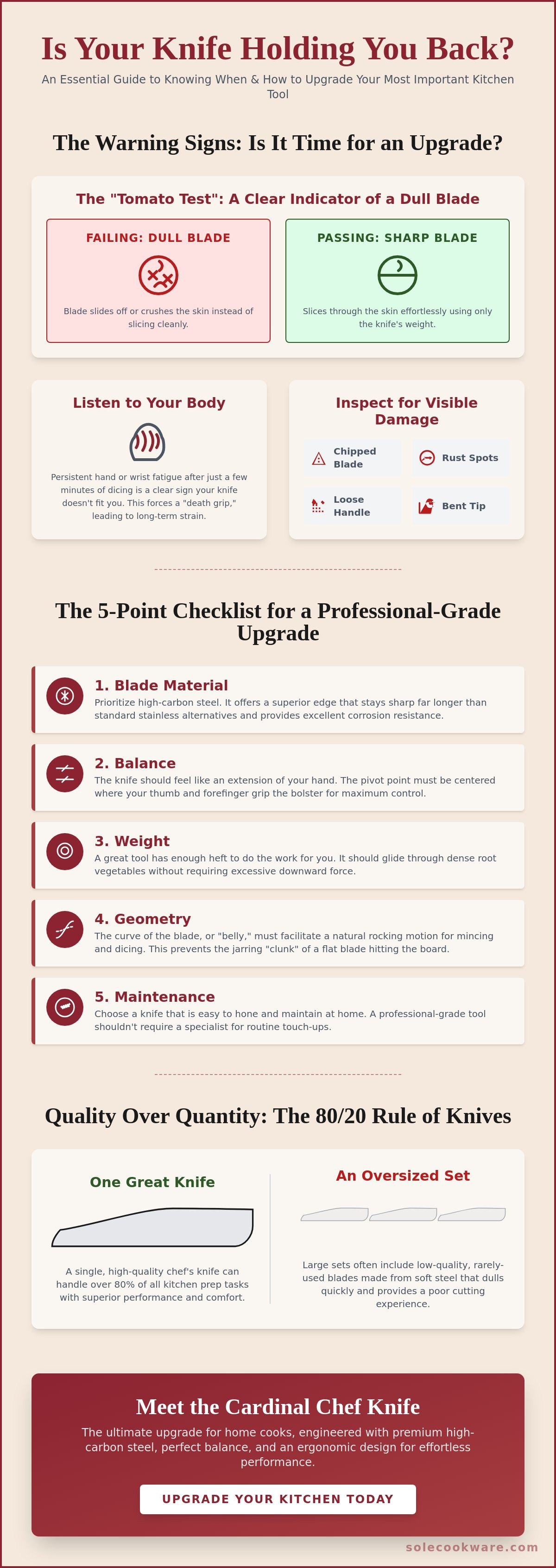
A kitchen knife should be a silent partner in your culinary journey. If you find yourself fighting against the blade, the partnership has ended. One of the clearest indicators is the "Tomato Test." Place a ripe tomato on your board and try to slice through the skin using only the weight of the knife. If the blade slides off or crushes the flesh before piercing the skin, the edge is fundamentally compromised. While sharpening can help, a blade that fails this test repeatedly often has underlying geometry issues or poor steel quality.
Beyond the blade's edge, listen to your body. Persistent fatigue in your hand or wrist after just five minutes of dicing is not a sign of your weakness. It is a sign of a tool that doesn't fit your anatomy. When you decide to upgrade your kitchen knife, you'll see that understanding the different types of kitchen knives is essential to choosing the right tool for your hand. You might notice visible wear that signals the end of a tool's life:
- Small chips in the steel that catch on fabric or food.
- Rust spots that reappear even after careful cleaning.
- A loose handle that shifts slightly during a heavy cut.
- A bent tip from previous drops or misuse.
These are more than just cosmetic flaws; they are safety hazards. A loose handle can lead to a slip, and a chipped blade can catch on tough vegetables, causing unpredictable movements. If the tool feels clunky or disconnected from your movements, it's time for a change.
The Physical Toll of Outdated Tools
Using a dull blade is dangerous because it forces you to use dangerous downward pressure. Instead of a smooth, gliding motion, you end up hacking at your ingredients. This often leads to the "death grip," where you overcompensate for a slippery or poorly shaped handle by squeezing too hard. This tension travels up your arm, causing long-term strain. If you find yourself avoiding recipes that require heavy prep, like dicing butternut squash or finely mincing herbs, your tools are likely the culprit.
Performance Gaps in Mass-Market Steel
Many home cooks fall for the marketing myth of "never-sharpen" knives. These blades are often made from soft steel with serrations that tear food rather than cutting it. They lack true edge retention. Edge retention is the ability of a blade to maintain its sharpness through repeated use. Budget-tier blades lose this ability quickly, requiring you to work twice as hard for the same result. When you choose to upgrade your kitchen knife, you invest in high-carbon steel that holds its line, allowing for a more rhythmic and satisfying cooking experience.
The 5-Point Checklist for a Professional-Grade Upgrade
Finding the right replacement is a methodical process. It requires looking past the brand name to the actual engineering of the tool. When you prepare to upgrade your kitchen knife, you should evaluate five specific criteria to ensure the tool serves you for a lifetime. Precision in selection leads to mastery in application.
- Blade Material: Prioritize high-carbon steel. It offers a superior edge that stays sharp longer than standard stainless alternatives.
- Balance: The knife should feel like it is floating in your hand. The pivot point should be centered exactly where your thumb and forefinger grip the bolster.
- Weight: A great tool provides enough heft to do the work for you. It should glide through a root vegetable without requiring you to push.
- Geometry: The curve of the blade, often called the "belly," must facilitate a natural rocking motion. This prevents the "clunk" of a flat blade hitting the board.
- Maintenance: Choose a knife that is designed to be easily honed. A professional-grade tool shouldn't require a specialist every time it needs a touch-up.
Understanding these factors is the first step toward proper knife handling and long-term culinary success. When the tool is right, the technique follows naturally.
Understanding Steel Quality in 2026
In 2026, the best blades find a sophisticated middle ground. High-carbon stainless steel provides the razor-sharp precision of carbon with the rust resistance of stainless. Heat treatment is the invisible hero of this process. It determines whether a blade is brittle or resilient. A well-treated blade feels effortless during prep because it resists the microscopic folding that dulls cheaper tools. If you are looking for this level of precision, the Cardinal Chef Knife utilizes premium materials designed for this exact balance of durability and performance.
The Importance of Balance and Geometry
A tip-heavy knife is a physical burden. It pulls your wrist downward, forcing you to fight the tool with every slice. You can test your current equipment at home with a simple finger test. Place the bolster of the knife on your index finger; it should stay level without tipping forward or back. This balance, combined with a "rocker" geometry, transforms your workflow. The curve ensures the blade maintains consistent contact with the cutting board. This creates a rhythmic, efficient slice that is essential for the high-volume vegetable prep that defines modern cooking.
Handle Ergonomics: The Secret to Cutting Without Pain
Pain is often the first signal that your equipment is mismatched with your anatomy. Many home cooks assume that hand fatigue is just a natural part of a long prep session. It isn't. Most mass-market knives feature a standard round or blocky handle designed for a generic, often larger, hand. These shapes frequently fail to provide the necessary support for diverse hand sizes. When a handle doesn't fit, your muscles overcompensate. You squeeze tighter just to keep the blade from rolling or slipping. This unnecessary tension is exactly why you should upgrade your kitchen knife to a tool designed with ergonomic health as a priority.
A chef-designed handle follows the "extension of the hand" philosophy. It shouldn't feel like you are holding a heavy tool; it should feel like your hand has simply gained a sharp, precise edge. This level of comfort is essential for those with smaller or petite hands who often find traditional professional knives cumbersome. By accommodating diversity in hand size and grip style, modern ergonomics turn a repetitive chore into a focused, meditative practice. Mastery begins with a tool that feels like it belongs in your palm.
Solving the Problem of Hand Fatigue
The science behind knife handle ergonomics focuses on reducing the force required to maintain control. When a handle is contoured to fit the natural arches of your palm, you don't need excessive grip strength to stay safe. Texture also plays a critical role in this equation. A handle that provides traction even when your hands are wet or covered in oil ensures the knife stays exactly where you intend. This shift in design is the ultimate upgrade for anyone who finds their hands cramping or shaking halfway through a complex recipe.
Wrist Health in the Kitchen
Long-term wrist health depends on the alignment of your joints during repetitive motions. Professionals use a "pinch grip," where the thumb and index finger choke up onto the blade for maximum precision. A poorly designed handle creates a hard, uncomfortable ledge that discourages this technique. Proper ergonomics support this transition, allowing for a seamless flow from the handle to the steel. A properly shaped handle allows for a neutral wrist position during all cutting tasks. By maintaining this alignment, you significantly reduce the risk of carpal tunnel syndrome and other repetitive strain injuries. When you choose to upgrade your kitchen knife, you aren't just buying a sharper blade; you're investing in the longevity and health of your own hands.
Quality Over Quantity: Why One Great Knife Beats a 12-Piece Set
The 80/20 rule is a fundamental truth in the kitchen. You will likely find that you use a single, reliable knife for 80% of your daily tasks. Whether you're slicing garlic, dicing onions, or carving a roast, that one tool becomes your constant companion. Many retailers push massive sets as a complete solution, yet these collections often prioritize volume over value. When you decide to upgrade your kitchen knife, you aren't just buying steel. You're choosing a philosophy of essentiality. Investing in a single masterpiece allows you to focus your budget on the highest quality materials rather than spreading it thin across a dozen mediocre blades.
There is a hidden cost to the standard knife block. You're paying for the bulky wooden storage, the serrated bread knife you use once a month, and the small utility blades that simply take up space. This clutter doesn't just eat your counter space; it distracts from the joy of cooking. A minimalist approach is both financially wise and environmentally responsible. By selecting one exceptional tool, you reduce waste and ensure that every dollar spent contributes directly to your performance on the cutting board. It's about owning less, but owning better.
The Myth of the 'Essential' 10-Piece Block
Most home cooks actually only need three tools: a primary chef knife, a paring knife, and a serrated blade. The rest of the typical 10-piece set is often filler. These extra blades are designed to fill slots in a wooden block rather than meet a genuine culinary need. A single premium chef knife is far more versatile than five mediocre blades that struggle to hold an edge. Reclaiming your counter space from a bulky block creates a cleaner, more intentional environment where you can focus on the craft of cooking. Mastery requires focus, not a drawer full of unused steel.
Investing in Your Primary Tool
Your primary knife touches nearly 90% of your ingredients. It's the bridge between your intention and the final dish. Allocating your entire budget to this one tool ensures you receive professional-grade steel that will last decades, not months. A professional tool elevates your entire process by removing the friction of a dull or poorly balanced blade. It's a long-term investment in your own capability. If you're ready to move toward a more purposeful kitchen, you can start your journey with the Cardinal Chef Knife and begin building a custom collection that actually fits your life.
Meet the Cardinal: The Ultimate Upgrade for Home Cooks
The transition from a struggling home cook to a confident master begins with a tool that understands your environment. Most professional knives are designed for the high-intensity, industrial setting of a restaurant line. They are often too heavy, too long, or too rigid for the nuanced needs of a home kitchen. The Cardinal Chef Knife represents a fundamental shift in this tradition. It is a tool engineered to bridge the gap between surgical precision and the warm, daily reality of home cooking. When you decide to upgrade your kitchen knife, you should look for a tool that empowers your movements rather than dictating them.
Why the Cardinal Chef Knife is Different
The Cardinal Chef Knife was born from the direct experience of a trained chef who recognized that home cooks were being underserved by traditional designs. As a female-founded brand in an industry that has long prioritized a singular, often masculine grip profile, Sole Cookware brings a necessary perspective to the cutting board. This isn't just about aesthetics. It is about a signature blade crafted with the exact balance and geometry required for effortless prep. The result is a tool that feels intuitive from the first slice, offering a level of control that builds genuine confidence in every recipe you attempt.
The Future of Customizable Cutlery
True innovation lies in the ability of a tool to evolve with its user. The Cardinal introduces modularity to the kitchen through its system of interchangeable handles and replaceable knife components. This design choice addresses the common frustration of outgrowing a tool or needing to replace an entire knife because of a single worn part. If your style changes or you simply want to refresh your kitchen's look, you can swap the handle without losing the high-carbon steel blade you have come to master. It's a sustainable, long-term approach to kitchenware that values longevity over quick replacement.
Quality is a commitment to the details. By focusing on replaceable parts, we ensure that your primary tool stays in peak condition for a lifetime of service. This modular approach is the future of sustainable cutlery. It allows you to maintain a professional edge without the waste of traditional products. You have seen the signs that it is time for a change. Now, you can take the next step and upgrade your kitchen experience with the Cardinal Chef Knife to rediscover the joy of a perfectly executed cut.
Master Your Kitchen with the Right Tool
Cooking should be a source of pride and relaxation, not a struggle against your equipment. You now know how to spot the signals of a failing blade and why a single, high-quality tool is far more valuable than a cluttered block of mediocre steel. By focusing on ergonomic health and professional-grade materials, you reclaim your confidence at the cutting board. It's time to move beyond the frustration of dull edges and hand fatigue. When you choose to upgrade your kitchen knife, you're investing in a more intentional and joyful culinary practice.
The Cardinal Chef Knife was created by a trained chef to bring professional precision to your daily routine. Its modular components ensure lifelong use, while the ergonomically engineered handle provides lasting comfort for every home cook. Experience the difference of a chef-designed tool, Shop the Cardinal Chef Knife. Your journey toward mastery is just beginning. We're here to provide the tools that grow with you.
Frequently Asked Questions
How do I know if my current kitchen knife is high quality?
A high-quality knife is defined by its balance, material, and performance under pressure. You can identify quality by performing the "Tomato Test" mentioned earlier; a superior blade will glide through the skin using only its own weight. High-quality tools typically feature high-carbon steel and a seamless transition between the blade and the handle. If your knife feels tip-heavy or the steel appears dull immediately after sharpening, it likely lacks the professional-grade engineering required for serious cooking.
Is it better to buy a knife set or one expensive chef knife?
Investing in one exceptional chef knife is almost always better than purchasing a multi-piece set. Most sets include "filler" blades that rarely leave the block, meaning you pay for tools you don't need. When you choose to upgrade your kitchen knife, focusing your entire budget on a single, premium tool ensures you receive the best possible steel and ergonomics. You can always add a paring knife or a serrated blade later to build a custom collection that fits your specific needs.
What is the best type of steel for a home kitchen knife?
High-carbon stainless steel is the gold standard for the modern home kitchen. It offers the incredible sharpness and edge retention of carbon steel while maintaining the rust resistance of stainless steel. This hybrid material ensures your blade stays sharp through long prep sessions without requiring the high-maintenance care of traditional carbon blades. It provides a professional experience that is both durable and accessible for everyday use.
How often should I realistically upgrade my kitchen knives?
You should consider an upgrade when your current tool begins to cause physical discomfort or no longer holds a sharp edge despite regular honing. While a well-made knife can last decades, budget-tier blades often reach their limit within a few years of heavy use. If you notice persistent hand fatigue or visible damage like a loose handle, it is a clear signal that your equipment is holding you back. Upgrading to a modular system can extend this lifespan even further by allowing you to replace individual components.
Can a better knife actually make me a faster cook?
Yes, a superior knife significantly increases your prep speed by reducing resistance and increasing your confidence. When a blade is perfectly balanced and razor-sharp, you spend less time fighting with tough ingredients and more time focused on the rhythm of the cut. Effortless slicing allows you to move through vegetables and proteins with precision and ease. This efficiency transforms a long chore into a quick, satisfying part of your culinary process.
What should I look for in a knife handle if I have small hands?
Look for a handle with a smaller circumference and a contoured shape that mimics the natural grip of your palm. Traditional professional knives are often designed for larger hands, which can lead to a "death grip" and hand cramping for those with smaller hands. A chef-designed tool with a tapered bolster allows you to use a proper pinch grip comfortably. Modular systems with interchangeable handles are especially helpful, as they allow you to find the exact fit for your specific anatomy.
Why do professional chefs prefer high-carbon steel over standard stainless?
Professional chefs prioritize high-carbon steel because of its superior edge retention and precision. Standard stainless steel is often too soft to maintain a razor-sharp edge through hours of repetitive dicing. High-carbon steel is harder, which allows the blade to be ground to a much finer, sharper angle. This hardness ensures the knife stays sharp for longer periods, providing the consistent performance required in a high-volume environment.
How do I maintain my new knife once I've upgraded?
Proper maintenance begins with hand washing and immediate drying to prevent any microscopic corrosion. Avoid the dishwasher, as the heat and harsh detergents can damage both the steel and the handle material. Regularly hone your blade with a ceramic rod to keep the edge aligned between deeper sharpenings. If you upgrade your kitchen knife to a modular model, you can also maintain peak performance by replacing specific components, such as handles or fasteners, as they show signs of wear over the years.