

The most expensive knife in a luxury retail store isn't priced for its edge retention or balance. It's priced to cover the overhead of a physical showroom and the layers of middlemen between the forge and your kitchen. This realization is fueling the rise of the chef knife direct to consumer model. By cutting out the traditional retail markup, innovative brands are finally prioritizing the human hand over the retail shelf. It's a shift that moves away from mass-produced tools toward intentional, chef-designed instruments. These tools feel like a natural extension of your arm.
You've likely felt the fatigue of a heavy blade that leaves your wrist aching after a single onion. It's common to feel overwhelmed by technical talk of Rockwell hardness when you just want a tool that works. We believe your primary kitchen tool should be a source of confidence, not confusion. This article will show you how the direct-to-consumer revolution delivers professional-grade materials and ergonomic precision directly to your doorstep. We will explore why modular designs and chef-led engineering are creating "forever" knives that outperform heritage brands while providing a better fit for every cook.
Key Takeaways
- Learn why bypassing traditional retail markups allows for superior materials. You'll understand how to get professional-grade steel without paying for a middleman's overhead.
- Master the essentials of blade geometry and steel quality. We'll help you find a chef knife direct to consumer that balances edge retention with ease of maintenance.
- Discover how to choose a knife based on your unique ergonomics. Finding a tool that matches your hand size and primary tasks is the key to preventing kitchen fatigue.
- Explore the future of modular kitchen tools. See how interchangeable handles and replaceable components can transform a single knife into a lifelong, customized partner.
What is a Direct-to-Consumer Chef Knife?
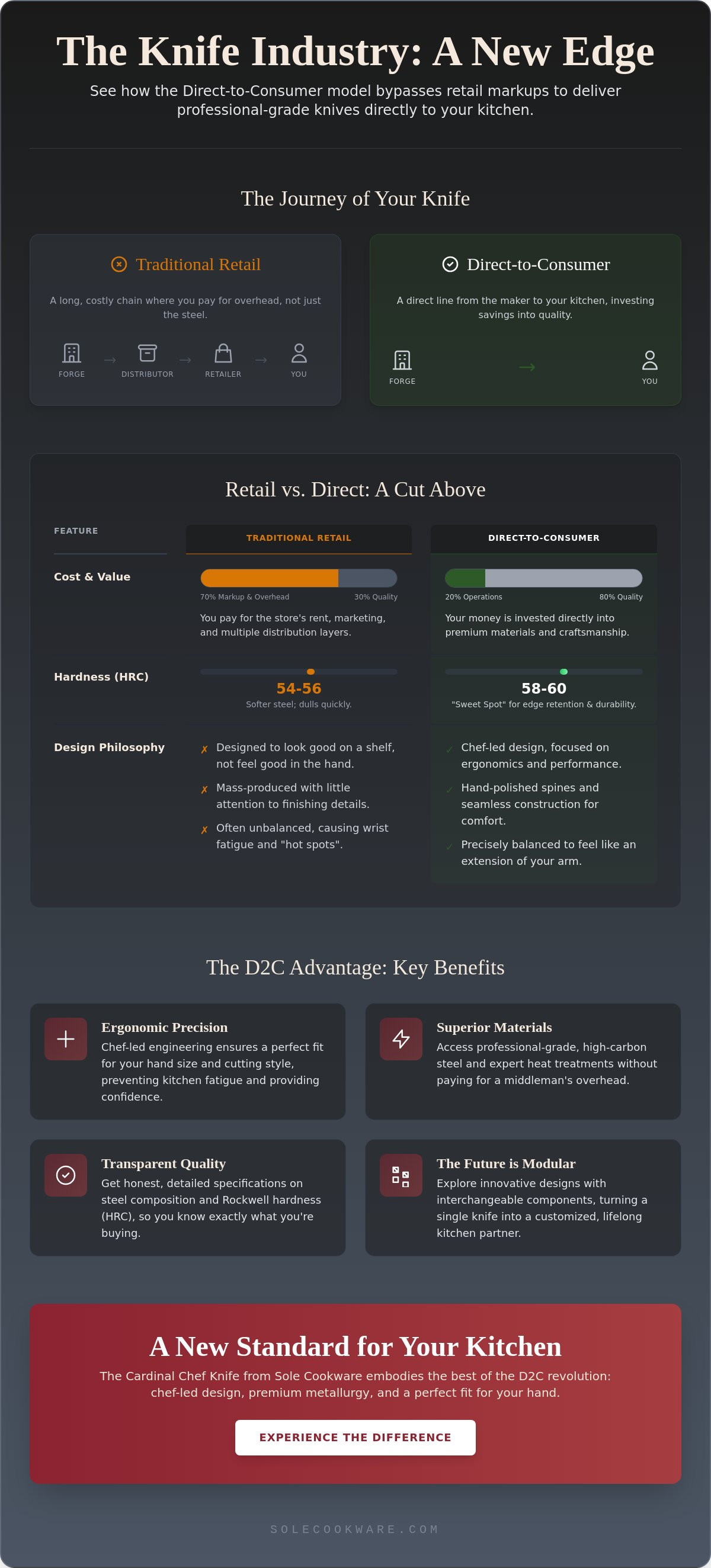
A direct-to-consumer chef knife is a tool born from a simple idea: the person who makes the blade should speak directly to the person who uses it. In a traditional retail model, a knife travels through a long chain of distributors, wholesalers, and physical storefronts before it reaches your kitchen. Each step adds a layer of cost. By the time you pick it up from a shelf, you're often paying for the store's rent and the distributor's logistics rather than the quality of the steel itself.
The chef knife direct to consumer model flips this structure. It removes the friction between the forge and the home cook. This digital-first approach allows brands to focus on small-batch intentionality. Instead of producing millions of identical units for mass-market appeal, makers can prioritize high-grade materials and precise engineering that would be too expensive for traditional retail shelves. It's a shift toward a more transparent, value-driven way of building kitchen tools.
The Death of the Middleman Markup
Traditional kitchenware stores typically add a markup of 50% to 100% to the products they sell. This isn't because the knife is inherently more valuable. It's because the retail ecosystem is expensive to maintain. When you buy a chef knife direct to consumer, those savings are often reinvested directly into the product. This shift means that "affordable" no longer signals "low quality." Instead, it represents a more efficient way to access premium metallurgy. Savings that used to go toward wholesale marketing now go toward high-carbon steel and expert heat treatments.
A standard Chef's knife found in a big-box store is often designed to meet a specific price point for the masses. In contrast, the D2C model allows for the use of superior alloys that hold a sharper edge for longer. It's a move toward craftsmanship that values longevity over high-volume turnover. You're getting a tool built for the long haul, not just for the next sales cycle.
The Chef-Led Design Advantage
Design starts with the user. Many mass-produced knives are designed by industrial engineers who prioritize how a product looks on a display rack. Chef-led design is different. It's rooted in the reality of a twelve-hour shift. These tools are tested in high-pressure environments to ensure they feel like a natural extension of the hand. They focus on the fundamental needs of a home cook, like a comfortable pinch grip and a balanced heel, rather than passing aesthetic trends. This practical expertise ensures your tool remains a joy to use, year after year. It's about perfecting the fundamentals of weight, balance, and edge geometry.
Comparing D2C Quality vs. Traditional Retail Brands
The price you pay at a boutique kitchen store often buys you a brand name rather than better metallurgy. Retail brands frequently hide behind vague labels like "professional grade" or "high-quality stainless." When you search for a chef knife direct to consumer, you encounter a level of transparency that is rare in big-box stores. This shift is a central part of the Direct To Consumer Revolution. Makers are now sharing exact steel compositions and heat treatment details. This isn't just for show. It provides the cook with a predictable, reliable edge that performs consistently every time it touches the cutting board.
A vital metric for any blade is the Rockwell Hardness Scale (HRC). Many mass-market retail knives sit at a lower HRC, often around 54 to 56. This makes the steel tough but means it dulls quickly under daily use. High-end D2C tools typically aim for the "sweet spot" of 58 to 60 HRC. This specific range offers exceptional edge retention without the brittleness found in ultra-hard professional blades. You get a professional experience that remains manageable for home maintenance. It's about finding the perfect equilibrium between sharpness and durability.
Fit and finish also set these modern models apart. Machine-stamped knives from retail giants often have sharp, uncomfortable edges on the spine or a rough transition between the handle and the blade. In contrast, intentional D2C brands prioritize hand-polishing and seamless construction. These small details prevent the "hot spots" and blisters that occur during long prep sessions. Quality is something you should feel in your palm, not just see on the blade. If you want to experience this level of intentional design, the Cardinal Chef Knife demonstrates how professional standards can be brought into the home kitchen.
Metallurgy for the Modern Kitchen
High-carbon stainless steel has become the gold standard for the versatile home kitchen. It combines the surgical sharpness of carbon steel with the rust resistance of chromium. This material ensures your knife stays sharp through crates of produce while resisting the stains that plague traditional carbon blades. It's the ideal choice for a busy kitchen where tools must perform without constant pampering. You spend less time at the sharpening stone and more time enjoying the process of cooking.
Balance and Control in Every Cut
A sharp blade is only half of the equation. True control comes from a balanced tang and a well-designed bolster. Proper weight distribution moves the center of gravity to where you actually grip the knife. This reduces wrist strain and makes the tool feel like a natural extension of your arm. This physical relationship is a core principle of knife handle ergonomics. When a tool is balanced, it feels lighter and more responsive, allowing for precision in every slice.
The Hidden Benefits of Buying a Chef Knife Direct
Buying a knife is often seen as a simple transaction. You walk into a store, pick a box, and leave. But when you choose a chef knife direct to consumer, you aren't just buying a product. You're entering a partnership with the makers. This relationship bypasses the silence of retail shelves. It allows for a direct feedback loop where your experiences as a cook inform future designs. This level of engagement is a core strength of the Direct-To-Consumer (DTC) model. It ensures that the tools in your hand are shaped by the community that uses them every day. You become part of the design process.
Traditional retail logistics are often inefficient. Products travel from factories to international distributors, then to regional warehouses, and finally to local storefronts. Each stop adds waste. D2C brands cut these steps out. By shipping directly from the maker to your door, the carbon footprint is reduced. Packaging is often more intentional too. You won't find excessive plastic or unnecessary filler. Instead, you receive a tool protected by minimalist, sustainable materials that reflect the quality of the blade inside. It's a cleaner way to shop that aligns with a more conscious kitchen.
Education Over Transaction
Mastery takes time. A high-quality blade is only as good as the hand that holds it. D2C brands embrace a master-to-apprentice philosophy. They don't just sell you a tool and disappear. Instead, they provide ongoing education. You gain access to detailed care guides and sharpening tutorials that are designed to help you succeed. This support builds your confidence in the kitchen. It transforms the act of cooking from a chore into a practice of precision and joy. You learn the "why" behind every design choice, from the curve of the belly to the angle of the edge.
Sustainability and Longevity
We design for decades, not for seasons. The "forever knife" philosophy is about more than just durable steel. It's about a tool that can be maintained and updated. Modular innovation is at the heart of this. By offering Replaceable Knife Components, brands ensure that a minor issue doesn't mean the end of the tool's life. You can refresh your setup with Interchangeable Handles that provide a new feel or aesthetic. This approach honors the craftsmanship of the blade while embracing the reality of a working kitchen. It's a commitment to longevity that respects both the cook and the planet.
Selection Guide: Finding Your Perfect D2C Chef Knife
Most retail stores stock tools designed for a mythical "average" user. But your hands are unique. Your cooking style is personal. When you evaluate a chef knife direct to consumer, you have the space to look beyond generic marketing. You can choose a tool that respects your physical needs. Start by assessing your daily prep. Are you dicing mountains of vegetables or portioning proteins? A vegetable specialist needs a different balance than someone focused on heavy butchery. Your tool should match your most frequent tasks.
Maintenance comfort is another vital factor. Some cooks enjoy the ritual of frequent honing, while others want a "set it and forget it" experience. High-carbon stainless steel offers the best of both worlds, providing a resilient edge that doesn't require constant pampering. You should also look for modularity. The ability to refresh your tool with Replaceable Knife Components ensures that your investment lasts for decades. Finally, read the brand story. Since its launch in June 2024, Sole Cookware has focused on creating ergonomic fits for those often ignored by traditional brands, such as women and cooks with smaller hands. Alignment with these values makes the purchase more meaningful.
Sizing and Grip Styles
The 8-inch blade remains the gold standard for versatility. It provides enough length for long slicing strokes while remaining agile enough for detail work. However, the handle is where the relationship succeeds or fails. If you use a pinch grip, holding the base of the blade between your thumb and forefinger, you need a bolster that allows for a seamless transition. A handle that is too bulky can lead to wrist fatigue during long sessions. Comfort is not a luxury. It is a requirement for safe, precise cutting.
The Essentialist Tool Kit
You don't need a cluttered block of twelve mediocre blades. You need one exceptional tool that you actually enjoy using. A single high-quality knife beats a cheap retail set every time. It's about prioritizing functional beauty over quantity. Investing in a Cardinal Chef Knife gives you a professional-grade foundation. It simplifies your kitchen and elevates your skills. You can further customize your experience by choosing from various Interchangeable Handles to find the exact texture and weight that feels right in your palm.
Sole Cookware: A New Standard for Direct-to-Consumer Knives
The story of Sole Cookware is one of deep intentionality. It is a female-founded brand that began with a simple observation: most professional knives are built for a specific, often larger, hand profile. This leaves many home cooks struggling with tools that feel cumbersome and unbalanced. By choosing a chef knife direct to consumer from a brand that understands these nuances, you're choosing a tool designed for your reality. We've refined professional performance for the home cooking experience. Every slice feels effortless and secure.
The Cardinal Chef Knife is the culmination of this vision. It is engineered for maximum comfort, control, and precision. It doesn't just cut; it glides through ingredients. This isn't a tool that was built to sit on a retail shelf for months. It was built for the heat and rhythm of a working kitchen. By speaking directly to our community, we've created a standard that prioritizes the user's physical well-being alongside the blade's edge. It is a master-level tool made accessible for every enthusiast.
The Cardinal Design Philosophy
A trained chef understands that a handle isn't just a grip. It's a steering wheel. By reimagining the handle for better ergonomics, we've created a balance point that makes the blade feel weightless. This is essential for repetitive chopping tasks. It prevents the fatigue that often ends a prep session early. When a tool fits your hand perfectly, your confidence grows. You stop worrying about the knife and start focusing on the ingredients. The Cardinal is the ultimate investment for those who want to feel capable and inspired every time they step into the kitchen.
Modular Sustainability
Innovation shouldn't come at the cost of the planet. Traditional knives are often discarded when a handle cracks or a bolster loosens. We've changed that. By offering Replaceable Knife Components, we ensure your tool remains in peak condition for a lifetime. This commitment to longevity reduces kitchen waste and honors the craftsmanship of the blade. You can also personalize your experience with Interchangeable Handles. This allows for personal expression while maintaining the technical integrity of the tool. Joining the Sole community is more than a purchase. It's a partnership that values the long-term success of your culinary journey. You're getting a chef knife direct to consumer that grows and evolves alongside your skills.
Master the Art of the Cut
The shift toward direct-to-consumer models is more than a pricing trend. It represents a return to intentional craftsmanship and a commitment to the person behind the apron. By bypassing traditional retail markups, you can invest in superior metallurgy and ergonomic precision that respects your physical needs. You now understand how modularity and chef-led design transform a simple tool into a lifelong partner in the kitchen. Choosing a chef knife direct to consumer ensures that every design choice, from the balance point to the handle texture, was made with your success in mind.
As a female-founded brand led by a trained chef, we've engineered our tools for ergonomic comfort and a perfect fit for smaller hands. Our modular design with replaceable parts means your tool stays in peak condition for decades. Experience the difference of a chef-designed tool and shop the Cardinal Chef Knife today. Your kitchen is a place of growth and mastery. We're here to provide the tools that make you feel capable and inspired every time you pick up a blade.
Frequently Asked Questions
What does direct-to-consumer mean for a kitchen knife?
It means the maker sells the tool directly to you through their own digital platform. This model removes the traditional retail middlemen, like distributors and physical department stores, who often add significant markups. By choosing a chef knife direct to consumer, you're investing in the quality of the materials and the design rather than the overhead of a brick and mortar storefront. It's a more efficient way to access professional grade tools.
Are D2C chef knives as good as famous German or Japanese brands?
Yes, and they often offer better value for the same level of craftsmanship. While heritage brands have history, many D2C makers use the same high carbon stainless steels and precision heat treatments. These modern brands focus on perfecting the fundamentals of balance and edge retention without the legacy costs. You're getting a tool that performs at a professional level, often with more intentional ergonomics for the home cook.
How can I tell if a chef knife will fit my hand if I buy it online?
Look for detailed ergonomic descriptions and specific design features like handle shape and weight distribution. Brands that focus on intentionality often provide guides on how their tools accommodate different hand sizes or grip styles. For instance, some designs are specifically engineered for petite hands or a pinch grip. Checking the brand’s philosophy on comfort can give you confidence that the tool will feel like a natural extension of your arm.
Why are direct-to-consumer knives usually more affordable?
They are more affordable because the business model eliminates the 50% to 100% markup typically added by retail stores. When you buy a chef knife direct to consumer, you aren't paying for a physical store's rent, utility bills, or staffing costs. Those savings are passed to you, allowing you to get premium materials at a price that reflects the actual cost of production and thoughtful design. It's a win for the cook.
What should I look for in a D2C knife brand to ensure quality?
Transparency is the most important factor. A quality brand will clearly state the type of steel used, the Rockwell hardness rating, and the design philosophy behind the handle. Look for brands founded by culinary professionals who understand the physical demands of cooking. A commitment to longevity, such as offering replaceable components, is also a strong indicator that the brand values the long term success and satisfaction of your community.
Can I sharpen a direct-to-consumer chef knife myself?
Absolutely, and most D2C brands encourage it by providing educational resources. High quality steel is designed to be maintained, and you can use standard whetstones or honing rods to keep the edge crisp. Because these makers often use premium alloys with excellent edge retention, you'll find that you need to sharpen less frequently. Learning to care for your own blade is a vital part of the master to apprentice journey.
Are modular or replaceable parts common in high-quality chef knives?
Historically, they weren't, but modularity is a hallmark of modern, innovative D2C brands. Traditional knives are often discarded if a handle becomes damaged or worn. In contrast, forward thinking makers now offer replaceable knife components and interchangeable handles. This approach supports a "forever knife" philosophy, reducing waste and allowing you to customize your tool's feel and appearance as your skills and preferences evolve over time. It's a more sustainable choice.
Is a chef-designed knife really different from a standard kitchen knife?
Yes, because a chef-designed tool is rooted in practical, high pressure experience rather than just industrial engineering. A chef understands where "hot spots" develop on the hand and how weight distribution impacts wrist fatigue during long prep sessions. These knives prioritize the physical relationship between the user and the object. They move beyond aesthetic trends to focus on the essential needs of a cook, ensuring every slice is precise, secure, and comfortable.